
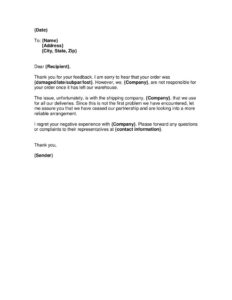
Complaint Disavowal
Download a free Complaint Disavowal letter template to professionally redirect a customer complaint to the responsible third party — free PDF and DOCX download.
PDF
DOCX
4 downloads
0
likes
Download Files
- DOCX
A Complaint Disavowal letter is a business letter used to acknowledge a customer’s complaint while professionally explaining that the problem falls outside your company’s direct control — most often when a shipping carrier, not the seller, caused a damaged, late, or lost order. It lets you stay courteous and accountable for the relationship without accepting responsibility for an error you did not make. You can download this template free in both PDF and DOCX formats, with no signup required.
What Is a Complaint Disavowal?
A Complaint Disavowal is a written response a company sends to a customer who has lodged a complaint, in which the business acknowledges the customer’s frustration but clarifies that the underlying fault lies with a third party. Customer service teams, small business owners, and account managers typically issue it. The letter documents that the seller received and took the complaint seriously, identifies the actual source of the problem (such as a delivery contractor), and points the customer toward the responsible party for resolution. Done well, it preserves goodwill, protects the company’s reputation, and creates a paper trail showing the matter was handled promptly and transparently rather than ignored.
When Do You Need a Complaint Disavowal?
This letter fits situations where a customer is unhappy but the root cause sits with someone other than your business. Common scenarios include:
- A package arrives damaged after leaving your warehouse in good condition, and the carrier mishandled it in transit.
- An order is late because the shipping company missed its delivery window despite timely dispatch on your end.
- A shipment is lost entirely after a confirmed handoff to the courier.
- A customer received a subpar item due to rough handling, improper storage, or temperature damage during delivery.
- You have already decided to end your relationship with an unreliable carrier and want to reassure the customer you are taking action.
- A complaint is escalating publicly and you need a measured, documented reply that redirects it appropriately.
What a Complaint Disavowal Should Have
An effective disavowal balances empathy with clarity. It should include the date and the recipient’s full contact details, a sincere acknowledgment of the customer’s experience, and a plain statement of where your responsibility ends — for example, once goods leave your warehouse. It should clearly name the third party at fault, briefly explain the nature of the problem, and offer reassurance that you are taking steps to prevent recurrence. Crucially, it must provide the responsible party’s contact information so the customer can pursue resolution directly. The tone should stay professional and regretful, never dismissive, and the letter should close with a courteous sign-off from a named sender.
How to Fill Out a Complaint Disavowal
- Enter the {Date} you are sending the letter at the top.
- Fill in the recipient block: the customer’s {Name}, {Address}, and {City, State, Zip} so the letter is correctly addressed.
- Open with the greeting, replacing {Recipient} with the customer’s name to keep it personal.
- In the opening line, choose the accurate descriptor for the order issue: {damaged/late/subpar/lost}. Select only the one that matches the complaint.
- Insert your business name in the first {Company} field to identify who is writing.
- Name the shipping carrier in the second {Company} field as the party responsible for the delivery problem.
- Reference the carrier again in the third {Company} field where you express regret about the negative experience.
- Add the carrier’s {contact information} — phone, email, or claims web address — so the customer can follow up directly.
- Sign off by adding your name in the {Sender} field, and include your title if appropriate.
Striking the Right Tone
The hardest part of a disavowal is sounding sincere while declining responsibility. Lead with empathy — thank the customer for their feedback and express genuine regret before you explain the cause. Avoid language that sounds defensive or blames the customer. Stating that you have already ceased a problematic partnership signals accountability and shows the customer their complaint produced real action, which softens the message that you are not directly liable. Keep the explanation factual and brief; over-explaining can read as making excuses.
Disavowal vs. Apology vs. Refund Letter
A Complaint Disavowal is distinct from a full apology letter, which accepts fault and often promises corrective action on your part. It also differs from a refund or replacement letter, where you compensate the customer regardless of cause. The disavowal sits between these: it validates the customer’s frustration but redirects responsibility. In some cases you may still choose to offer a goodwill gesture even while disavowing legal liability — many businesses do this to protect long-term loyalty. Decide in advance whether your reply is purely informational or whether you will pair it with a separate concession.
Common Mistakes to Avoid
- Sounding cold or robotic — failing to acknowledge the customer’s frustration before explaining the cause.
- Leaving placeholder fields unfilled, such as forgetting to remove the unused options in {damaged/late/subpar/lost}.
- Confusing the two companies — mixing up your business name and the carrier’s name in the repeated {Company} fields.
- Omitting the carrier’s contact information, which leaves the customer with no path to resolution and makes the letter feel like a brush-off.
- Making promises you cannot keep, like guaranteeing a faster replacement when the carrier controls timing.
- Disavowing responsibility when your own terms or local consumer law actually make you liable to the buyer.
Frequently Asked Questions
What is a Complaint Disavowal letter? It is a business letter that responds to a customer complaint by acknowledging their experience while explaining that a third party — typically a shipping carrier — is responsible for the problem. It directs the customer to the responsible party for resolution while keeping your tone professional and empathetic.
How do I fill out the Complaint Disavowal template? Add the date and the customer’s name and address, personalize the greeting, select the correct issue from the {damaged/late/subpar/lost} options, and insert your company name, the carrier’s name, and the carrier’s contact information in the appropriate fields. Finish by signing with your name and title.
Is a Complaint Disavowal legally binding? No. This letter is a communication tool, not a contract, and sending it does not by itself eliminate any legal obligations you may have to the customer. Your actual liability depends on your sales terms and applicable consumer protection laws, so review those before disclaiming responsibility.
Does this letter need to be notarized or witnessed? No. A complaint response is ordinary business correspondence and requires no notarization or witnesses. It simply needs to be accurate, professional, and signed by an authorized representative of your company.
Can I still offer a refund after sending a disavowal? Yes. Disavowing direct responsibility and offering a goodwill gesture are not mutually exclusive. Many businesses redirect the complaint to the carrier while still providing a replacement or partial credit to protect the customer relationship.
How much does this template cost? Nothing — the Complaint Disavowal template is completely free to download in PDF and DOCX formats, with no account or signup required. You can edit the DOCX version to match your branding and tone before sending.
This template is provided as a general example for informational purposes only and does not constitute legal, financial, or business advice. Consumer protection rules and liability for delivered goods vary by jurisdiction and by your own contractual terms — consult a qualified professional before disclaiming responsibility to a customer.
Related Forms
- New Employee Introduction
- Reservation Confirmation Letter
- Offer To Settle Disputed Account
- Unpaid Invoice
- Landlord Unauthorized Subletting Warning
- Follow Up
Browse more in Business Letters.