
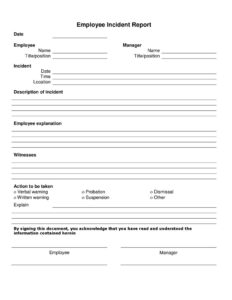
Employee Incident Report Form
Document workplace incidents accurately with our free Employee Incident Report Form template, available as a free PDF and DOCX download.
PDF
DOC
0
likes
Download Files
- DOC
An Employee Incident Report Form is a written record used by managers and HR to document a workplace incident involving an employee—what happened, when, where, and what action will follow. Most people reach for it to create a clear, dated paper trail after a policy violation, conflict, accident, or performance concern. You can download it free here in PDF and DOCX, with no signup required.
What Is an Employee Incident Report Form?
An Employee Incident Report Form is a structured document an employer uses to record the details of a specific workplace event involving a staff member. It is typically completed by a supervisor or manager, sometimes with input from HR, and captures the facts of an incident along with the employee’s own explanation. The form documents the date, location, and a factual description, then notes the disciplinary or corrective action being taken—ranging from a verbal warning to dismissal. Because it is signed by the parties involved, it serves as an objective record that protects both the organization and the employee, supports consistent treatment across staff, and provides reference material if the matter escalates or recurs in the future.
When Do You Need an Employee Incident Report Form?
Use this form any time an event warrants a documented response. Common situations include:
- Policy violations—an employee breaks a written company rule, such as attendance, dress code, or safety protocol.
- Workplace conflicts—a verbal dispute or altercation between coworkers that requires a formal record.
- Safety incidents—an accident, near-miss, or unsafe behavior that needs to be logged for follow-up.
- Performance or conduct concerns—repeated mistakes or behavior that justify a verbal or written warning.
- Insubordination or misconduct—refusal to follow reasonable instructions or actions that disrupt operations.
- Progressive discipline—documenting each step (verbal warning, written warning, probation, suspension) before any termination decision.
Having a completed form for each event helps managers apply discipline fairly and gives HR a consistent history to reference.
What an Employee Incident Report Form Should Have
A complete report leaves no ambiguity about what happened and what comes next. Strong forms include the report date and the names of the employee and reporting manager, the employee’s title or position, and the exact date, time, and location of the incident. The heart of the document is a factual description of the incident written in neutral language, followed by space for the employee’s explanation in their own words. It should also list any witnesses, specify the action to be taken—with clearly marked options such as verbal warning, written warning, probation, suspension, dismissal, or other—and provide a signature line acknowledging that the employee has read and understood the contents.
How to Fill Out an Employee Incident Report Form
- Date: Enter the date you are completing the report, which may differ from the incident date.
- Employee and manager: Record the name of the employee involved and the name of the manager or supervisor preparing the report.
- Name and title/position: Confirm the employee’s full name and their job title or position within the organization.
- Incident, time, and location: Identify the type of incident, the exact time it occurred, and the specific location, such as a department, room, or job site.
- Description of incident: Write a clear, factual account of what happened in chronological order, avoiding opinions or assumptions.
- Employee explanation: Allow the employee to provide their version of events in their own words.
- Witnesses: List the names of anyone who observed the incident.
- Action to be taken: Select the appropriate response—verbal warning, written warning, probation, suspension, dismissal, or other—and use the explain field to add detail.
- Signatures: Have the employee and manager sign to acknowledge they have read and understood the information.
Understanding the Disciplinary Action Options
The form lists a graduated set of responses so the action fits the seriousness of the incident. A verbal warning is often the first, mildest step for minor or first-time issues and is documented here even though it was delivered orally. A written warning formalizes a repeated or more serious concern. Probation places the employee under a defined period of closer monitoring with clear expectations. Suspension temporarily removes the employee from work, with or without pay, depending on company policy. Dismissal ends employment and is generally reserved for severe or repeated violations. The other option with its explanation field covers responses that do not fit a standard category, such as mandatory retraining, a performance improvement plan, or a referral to HR for further review. Selecting the right level and documenting the reasoning supports a fair, consistent process.
Tips for Writing an Objective Report
The credibility of an incident report rests on objectivity. Stick to observable facts—what was said and done, in what order, and at what time—rather than characterizing the employee’s intent or character. Quote statements directly where possible and attribute observations to specific witnesses. Complete the form as soon as possible after the event while memories are fresh, and store it securely in the employee’s confidential file. Give the employee a genuine opportunity to add their explanation, since a record showing both sides is far more defensible than a one-sided account.
Common Mistakes to Avoid
- Vague descriptions: Writing “behaved badly” instead of describing the specific words or actions that occurred.
- Skipping the employee’s explanation: Omitting their side undermines fairness and the report’s reliability.
- Delaying the report: Waiting days or weeks lets details fade and weakens the record.
- Inconsistent discipline: Choosing an action that is harsher or lighter than what similar incidents received.
- Missing signatures: Failing to obtain acknowledgment leaves the document incomplete.
- Including opinion or emotion: Editorializing instead of recording neutral, verifiable facts.
Frequently Asked Questions
What is an Employee Incident Report Form used for? It is used to formally document a specific workplace incident involving an employee, including what happened, who was involved, and what corrective action will be taken. It creates a consistent, dated record that supports fair treatment and can be referenced if the situation escalates or recurs.
Who should fill out the form? Typically a manager or supervisor completes the report, often with HR involvement, since they are responsible for documenting the facts and determining the appropriate action. The employee involved is given space to add their own explanation and is asked to sign acknowledging the contents.
Does the employee have to sign the report? Most employers ask the employee to sign to confirm they have read and understood the information. A signature does not necessarily mean the employee agrees with the report—only that they received it; if an employee refuses to sign, note that fact and have a witness confirm it.
Is an Employee Incident Report Form legally binding? The form itself is an internal record rather than a contract, but it can become important evidence in disputes, grievances, or legal proceedings. Because employment rules vary by jurisdiction, keep the report accurate, factual, and stored confidentially.
How much does this template cost? This template is completely free to download from Business Forms Pro in both PDF and DOCX formats, with no signup or account required. You can customize the DOCX version to match your company’s policies and branding.
How should I store completed incident reports? Keep them in a secure, confidential location—typically the employee’s personnel file—with access limited to authorized managers and HR staff. Retain them according to your organization’s record-keeping policy and any applicable legal requirements.
This template is a general example provided for informational purposes only and is not legal, HR, or professional advice. Employment laws and disciplinary requirements vary by jurisdiction and by organization—consult a qualified HR professional or attorney before relying on this form for any specific situation.
Official resource: for the rules that apply to your situation, see the U.S. Department of Labor.
Related Forms
- Employee Orientation Checklist
- Employee Reference Request
- Employee Work Schedule
- Employee Personnel Data Change
- Employee Exit Interview
- Monthly Time Card With Approval
Browse more in Employment.