
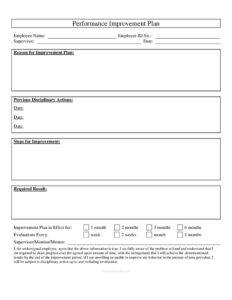
Performance Improvement Plan
Free performance improvement plan (PIP) template in PDF & DOCX. Learn what a PIP is, how to write one, how to respond, and download a printable form today.
PDF
DOC
9 downloads
0
likes
Download Files
- DOC
A performance improvement plan (PIP) is a structured document a manager uses to help an underperforming employee meet clear expectations within a set time frame. It spells out the problem, the goals, and the support on offer. Download the free PIP template below in PDF or DOCX. No signup or email required.
What Is a Performance Improvement Plan?
A performance improvement plan — often shortened to PIP — is a formal, written framework that documents where an employee is falling short, defines exactly what acceptable performance looks like, and gives them a fair, fixed period to get there. Rather than a vague conversation that’s easy to forget, a PIP turns feedback into specific goals, deadlines, and check-ins. A good plan is genuinely two-sided: it holds the employee accountable, but it also commits the manager to provide the coaching, resources, and regular feedback the employee needs to succeed. Used well, a PIP is a tool for *saving* a struggling employee, not just a box to tick before letting them go.
When Should a PIP Be Used?
A performance improvement plan is appropriate when an employee’s work has slipped in a way that’s measurable and fixable — missed targets, recurring quality problems, or behavior that’s affecting the team — and informal feedback hasn’t turned things around. It is not the right tool for a one-off mistake, a personality clash, or issues better handled through training or a simple conversation. Managers typically reach for a PIP after they’ve already raised the concern verbally, given the employee a chance to adjust, and seen the problem continue. Putting the expectations in writing at that point protects both sides: the employee gets a clear, documented path forward, and the company has a fair record of the support that was offered.
What a Good PIP Includes
An effective plan is specific and balanced. It should name the exact performance gaps with concrete examples, define the standard the employee needs to reach, list the steps and resources that will help them get there, set a realistic timeline with scheduled check-ins, and describe what happens if the goals are or aren’t met. Vague plans fail because no one can tell whether the employee has actually improved. The template above is built around these elements so nothing important is left to interpretation.
How to Fill Out a Performance Improvement Plan
- Enter the employee name, employee ID, supervisor, and the date the plan begins.
- State the reason for the improvement plan clearly, with specific, factual examples rather than general complaints.
- Note any previous disciplinary actions and their dates, so the plan reflects the full history.
- List the steps for improvement and the required result for each — what the employee must do, and what success looks like.
- Set how long the plan is in effect (commonly 30, 60, or 90 days) and how often evaluations will happen (weekly, biweekly, or monthly).
- Identify the supervisor, monitor, or mentor responsible for support, then have the employee and manager sign and date to confirm the expectations are understood.
Setting SMART Improvement Goals
The goals are the heart of the plan, and the best ones follow the SMART formula: Specific, Measurable, Achievable, Relevant, and Time-bound. Instead of “improve communication,” a SMART goal reads “respond to client emails within one business day and provide a weekly status update every Friday for the next 60 days.” Measurable goals remove arguments about whether progress was made, and time-bound goals create the urgency a PIP is meant to provide. Where you can, attach numbers — call volume, error rate, deadlines met — so both sides can see improvement objectively at each check-in.
How an Employee Should Respond to a PIP
If you’re on the receiving end of a performance improvement plan, treat it as a serious but solvable challenge rather than a foregone conclusion. Read it carefully, ask questions about anything that’s unclear, and make sure the goals are realistic and the success criteria are written down. If you believe any point is inaccurate, respond calmly and in writing with your perspective. Then focus on the plan: meet every check-in, document your progress, and ask for the resources you were promised. Many employees complete a PIP successfully and keep their jobs — the people who struggle are usually the ones who ignore it or treat it as unfair rather than engaging with it.
Common Mistakes to Avoid
- Writing vague goals that can’t be measured, so “improvement” is a matter of opinion
- Setting an unrealistic timeline that no one could meet
- Skipping the scheduled check-ins, which defeats the purpose of the plan
- Using the PIP as a paper trail to justify a firing that’s already decided
- Failing to provide the support, training, or resources the plan promises
- Leaving out specific examples, so the employee can’t see what actually went wrong
Is a PIP a Step Toward Being Fired?
Not necessarily — though it’s understandable to worry. A performance improvement plan can genuinely be an attempt to help an employee recover, and many do. That said, it is also a formal step, and if performance doesn’t improve by the deadline, the plan usually outlines further consequences, up to termination. The honest answer is that a PIP is a fork in the road: the outcome depends heavily on what happens during the plan period. The best response, for both manager and employee, is to take it seriously and work the plan in good faith.
Frequently Asked Questions
What is a performance improvement plan? It’s a formal written plan that documents an employee’s performance gaps, sets specific goals and a deadline to fix them, and outlines the support and check-ins along the way.
How do you write a performance improvement plan? State the specific problem with examples, define measurable goals and the standard required, list the support and steps, set a timeline with regular check-ins, and have both parties sign. The template above includes each section.
How long should a performance improvement plan last? Most PIPs run 30, 60, or 90 days — long enough to show real change but short enough to keep momentum. The right length depends on the role and the goals.
How should I respond to a performance improvement plan? Engage with it seriously: clarify the goals, correct any inaccuracies in writing, meet every check-in, document your progress, and use the resources offered. Treating it as solvable gives you the best chance of success.
Does a PIP mean I’m getting fired? No, not automatically. A PIP is a chance to improve, and many employees complete one successfully. It is, however, a formal step, so the outcome depends on whether the goals are met.
Who should be involved in a PIP? Typically the employee, their direct manager, and often an HR representative or an assigned mentor who supports and monitors progress.
How much does this template cost? It’s free to download in PDF and DOCX.
Related Forms
Employee Evaluation Form · Disciplinary Action Form · Employee Warning Letter · Employee Self Evaluation · Employee Performance Evaluation
This template is provided for general informational purposes only and is not legal or HR advice. Employment laws and fair-process requirements vary by location — consult a qualified professional or your HR department before acting.
Official resource: for the rules that apply to your situation, see the U.S. Department of Labor.
Related Forms
- Arrival And Departure Record
- Employment Verification Letter
- Employee Pay Rate and Title History Change
- Termination Checklist
- Interview Schedule
- Job Application Comparison Chart
Browse more in Employment.