
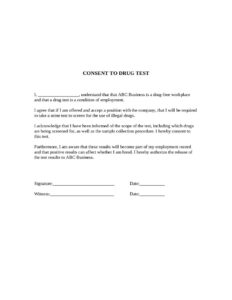
Consent To Drug Test
Download a free Consent to Drug Test form template in PDF and DOCX to document an applicant's agreement to pre-employment screening — free download, no signup.
DOCX
2 downloads
0
likes
Download Files
- DOCX
A Consent to Drug Test form is a short employment document in which a job applicant or employee acknowledges and agrees to undergo drug screening as a condition of employment. Employers most commonly use it during pre-employment hiring to obtain written, informed permission before sending a candidate for a urine test. You can download this template free in both PDF and DOCX formats — no signup required.
What Is a Consent to Drug Test Form?
A Consent to Drug Test form is a written authorization signed by an applicant or employee that confirms they understand a drug test is being requested and voluntarily agree to take it. It is typically issued by an employer’s human resources department or hiring manager and documents that the individual was informed of the test’s scope, the drugs being screened, and the sample collection procedure. The form also authorizes the release of the results to the company and acknowledges that those results become part of the employment record. In short, it protects both parties by recording informed consent before any testing takes place and by clarifying that a positive result can affect a hiring decision.
When Do You Need a Consent to Drug Test Form?
Employers and staffing professionals reach for this form whenever drug screening is part of the employment process. Common situations include:
- Pre-employment screening — after extending a conditional job offer that depends on passing a drug test.
- Maintaining a drug-free workplace — when company policy requires all new hires to be screened before their start date.
- Safety-sensitive roles — positions involving driving, heavy machinery, or public safety where employers commonly require testing.
- Onboarding documentation — to add a signed consent record to an employee’s personnel file alongside other hiring paperwork.
- Staffing and temp agencies — placing candidates with client companies that mandate clean screening results.
- Policy acknowledgment — confirming the applicant understands the company is a drug-free workplace and accepts that as a condition of employment.
What a Consent to Drug Test Form Should Have
A complete consent form makes the agreement clear and verifiable. The essential elements include the name of the individual giving consent, a statement that the employer maintains a drug-free workplace, and an acknowledgment that the test is a condition of employment. It should confirm the applicant was informed of the test’s scope — which drugs are screened and how the sample is collected — and that the results will become part of the employment record. The form should also include an explicit authorization to release results to the employer, a statement that positive results may affect hiring, and signature and date lines for both the applicant and a witness.
How to Fill Out a Consent to Drug Test Form
Follow these steps to complete the template accurately:
- Insert the individual’s name. In the opening line beginning “I, __________,” the applicant writes their full legal name to identify who is giving consent.
- Confirm the employer reference. Replace “ABC Business” with the actual company name throughout so the document reflects the correct drug-free workplace and recipient of results.
- Review the scope statement. The applicant reads the acknowledgment that they have been informed of which drugs are screened and the urine sample collection procedure.
- Confirm consent and release. Verify the language consenting to the test and authorizing release of the results to the company is accurate before signing.
- Sign and date. The applicant signs on the “Signature” line and enters the date on the adjacent “Date” line.
- Have a witness sign. A witness completes the “Witness” line and records the corresponding date to confirm the signature was made voluntarily.
Once completed, keep the signed form in the applicant’s file and provide a copy on request.
Informed Consent and Result Handling
The value of this form rests on the word informed. Before an applicant signs, the employer should genuinely explain the scope of the screening — the panel of substances being tested and the collection method (here, a urine sample). The form also states that results become part of the employment record and authorizes their release to the company. Because drug-test results are sensitive, employers should store them securely, limit access to those involved in the hiring decision, and handle any positive result consistently with company policy. Treating every applicant the same way under a uniform policy reduces the risk of disputes.
How This Differs From a Drug-Free Workplace Policy
A Consent to Drug Test form is a single, individual acknowledgment tied to one person and one screening event. A drug-free workplace policy, by contrast, is a broader company document that explains rules, expectations, testing circumstances, and consequences for all employees. The consent form often references the policy and serves as proof that a specific individual agreed to be tested. Many employers use both together: the policy sets the standard, and the signed consent records each applicant’s agreement to comply.
Common Mistakes to Avoid
- Leaving the company name as “ABC Business.” Replace the placeholder with your actual organization’s name everywhere it appears.
- Failing to explain the scope first. Obtain consent only after the applicant has been told which drugs are screened and how the sample is collected.
- Skipping the witness signature. An unwitnessed form is weaker evidence that consent was given freely.
- Missing dates. Both signature and witness dates should be filled in to establish a clear timeline.
- Applying testing inconsistently. Screening some applicants for a role but not others invites fairness and discrimination concerns.
- Mishandling results. Storing outcomes carelessly or sharing them beyond authorized staff can create privacy problems.
Frequently Asked Questions
What is a Consent to Drug Test form? It is a document in which an applicant or employee agrees in writing to undergo a drug test as a condition of employment. It records that the person was informed of the test’s scope and authorizes the employer to receive the results.
How do I fill out the form? Enter the applicant’s full name in the opening line, replace the placeholder company name with your own, confirm the scope and release language are accurate, then have the applicant and a witness sign and date the bottom. Keep the completed form in the personnel file.
Does the form need a witness? This template includes a witness line, and having a witness sign helps confirm the consent was given voluntarily. While a witness is not always legally required, it strengthens the document as a record.
Is a signed consent form legally binding? A signed, properly completed consent generally documents the individual’s agreement to be tested. However, drug-testing laws vary by state and industry, so employers should ensure their overall practices comply with applicable rules.
Can an applicant refuse to sign? Yes — signing is voluntary, but employers may treat testing as a condition of employment, meaning a refusal can affect whether a conditional offer is finalized. The form itself explains that positive results can also affect hiring.
How much does this form cost? Nothing. You can download this Consent to Drug Test template free in PDF and DOCX formats from Business Forms Pro, with no signup or payment required.
This template is a general example provided for informational purposes only and is not legal, medical, or HR advice. Drug-testing requirements and employee privacy rules vary by jurisdiction and industry. Consult a qualified attorney or HR professional before implementing a testing program.
Official resource: for the rules that apply to your situation, see the U.S. Department of Labor.
Related Forms
- Check Driving Record
- Job Application Comparison Chart
- Manual Timecard Bi-Weekly Mini
- Termination Checklist
- Letter Of Demotion
- Payroll Statement
Browse more in Employment.