
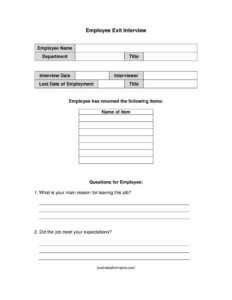
Employee Exit Interview
Download a free Employee Exit Interview form template in PDF and DOCX to gather honest departing-employee feedback and improve retention — free download.
PDF
DOCX
1 downloads
0
likes
Download Files
- DOCX
An Employee Exit Interview form is a structured questionnaire HR uses to capture honest feedback from a departing employee before their last day. People most often use it to understand why staff leave and to spot patterns worth fixing. This template is free to download in both PDF and DOCX formats, with no signup required.
What Is an Employee Exit Interview Form?
An Employee Exit Interview form is a document an employer completes during a final conversation with a resigning or departing worker. It records identifying details such as the employee’s name, department, and last date of employment, confirms that company property has been returned, and walks through a set of standardized questions about their experience. The form gives HR a consistent way to document feedback across many departures so it can be compared over time. Rather than relying on an informal goodbye chat, it turns the exit moment into usable data on management, pay, workload, and culture. The completed form typically lives in the employee’s personnel file and informs retention strategy.
When Do You Need an Employee Exit Interview Form?
This form is useful any time an employee leaves and you want to learn from their departure. Common scenarios include:
- An employee resigns to take a position at another company and you want to understand what drew them away.
- A valued team member is leaving and leadership wants candid feedback on management, support, and the review process.
- HR is investigating high turnover in a specific department and needs consistent data across exits.
- You are offboarding an employee and must confirm that laptops, keys, badges, or equipment have been returned.
- A worker is being laid off or their role is eliminated, and you want to close the relationship professionally.
- You are building a retention program and need real, firsthand input on what the company does well and poorly.
What an Employee Exit Interview Form Should Have
A complete exit interview form combines administrative facts with open feedback questions. The administrative top section identifies the employee and the circumstances of departure: name, department, job title, the interview date, the interviewer’s name, and the last date of employment. A property-return section confirms what items the employee has handed back. The core of the form is a set of consistent questions covering reason for leaving, whether the job met expectations, adequacy of support, satisfaction with the review process, pay fairness, what they liked most and least, and whether they would return. A final open comments area lets the employee add anything the structured questions missed. Keeping the same questions for every exit is what makes the data comparable.
How to Fill Out an Employee Exit Interview Form
- Enter the employee name, department, and title at the top so the record is clearly attributed.
- Record the interview date and the interviewer conducting the session.
- Add the last date of employment to anchor the timing of the departure.
- Under returned items, list the property the employee has handed back — laptop, keys, ID badge, phone, or documents.
- Ask question 1, the main reason for leaving, and capture the answer verbatim where possible.
- Work through whether the job met expectations, whether they received adequate support, and their view of the review process.
- Note their suggestions to improve the work environment and whether they would work here again.
- Cover compensation by recording whether they felt paid commensurately with their duties.
- Document what they liked most and least, whether the work felt rewarding, and what a new job offers that this one didn’t.
- Finish with the additional comments field and confirm details with the employee.
Getting Honest, Useful Answers
The value of an exit interview depends entirely on candor, and a worker who feels rushed or judged will give safe, generic answers. Schedule the interview a few days before the last working day rather than during the final hour of chaos. Open by explaining that feedback is used to improve the workplace and will be summarized without blame. Where possible, have someone other than the employee’s direct manager conduct the session so the person feels free to comment on management itself. Ask open follow-up questions when an answer is short — for example, if someone says the job didn’t meet expectations, ask which expectations specifically. The structured questions on this form give you a reliable baseline, but the most valuable insights often surface in the additional comments section once the formal questions are out of the way.
Turning Feedback Into Action
A stack of completed exit interviews is only useful if someone reviews them. Periodically aggregate the responses to look for recurring themes: are several people in one department citing lack of support? Are departing employees consistently saying pay didn’t match their duties? Tracking the “main reason for leaving” across many forms reveals whether turnover stems from compensation, management, growth, or culture. Share anonymized trends with leadership so the patterns drive real change rather than sitting in a file. The questions on whether the employee would return and what a new job offers are especially telling about competitive gaps.
Common Mistakes to Avoid
- Skipping the property-return section, then chasing missing laptops and badges weeks after the employee is gone.
- Having the direct supervisor conduct the interview, which discourages honest feedback about management.
- Asking the questions but never aggregating or acting on the answers.
- Treating the conversation as a formality and rushing through it on the final day.
- Leading the employee toward positive answers instead of letting them speak freely.
- Failing to record the interview date or interviewer, making the record hard to verify later.
Frequently Asked Questions
What is the purpose of an employee exit interview? The purpose is to capture honest feedback from a departing employee about their experience, why they are leaving, and how the workplace could improve. The information helps employers reduce turnover, fix management or pay issues, and confirm that company property has been returned. It also gives the relationship a professional, respectful close.
Is an exit interview mandatory for the employee? Generally no — participation is usually voluntary, and an employee can decline to answer some or all questions. Many people choose to take part because it offers a chance to give constructive feedback. Employers should make clear that honest answers will not affect references or final pay.
Who should conduct the exit interview? An HR representative or a neutral party is usually best, rather than the employee’s direct manager. This helps the departing person speak candidly about leadership, support, and the review process without feeling judged. The interviewer’s name is recorded on the form for the record.
When should the exit interview take place? Ideally a few days before the employee’s last date of employment, when there is enough time for a calm conversation. Doing it at the very last minute often produces rushed, surface-level answers. Some organizations also send a follow-up survey shortly after departure.
Is this exit interview form legally binding? The form is a feedback and offboarding record, not a contract, so it does not create binding obligations on either party. It is best treated as an internal HR document kept in the personnel file. Confidentiality of the responses should be handled according to your company’s data policies.
How much does this template cost? This Employee Exit Interview form is completely free to download from Business Forms Pro in both PDF and DOCX formats, with no signup required. You can edit the questions and fields to match your organization. Use it as a ready-made starting point for a consistent offboarding process.
This template is a general example provided for informational purposes only and is not legal, financial, or HR-compliance advice. Employment and data-handling requirements vary by jurisdiction, so consult a qualified professional before relying on this form.
Official resource: for the rules that apply to your situation, see the U.S. Department of Labor.
Related Forms
- Employee Warning Letter
- Shift Change Request
- Tarjeta De Tiempo Manual Miniatura
- Manual Timecard Bi-Weekly Mini
- Grievance Report
- Employee Official Warning Letter
Browse more in Employment.