
Job Acceptance Letter
Use our free Job Acceptance Letter template to formally accept a job offer with confidence and professionalism — free download in PDF and DOCX.
PDF
DOCX
2 downloads
0
likes
Download Files
- DOCX
A Job Acceptance Letter is a short, formal letter you send to an employer to officially confirm that you accept their job offer. Most people use it to lock in their start date and signal professionalism the moment an offer is extended, and you can download it free here in both PDF and DOCX formats — no signup required.
What Is a Job Acceptance Letter?
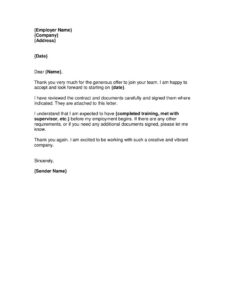
A Job Acceptance Letter is a written response from a candidate to a hiring company that confirms acceptance of an offered position. It is typically issued by the new employee and addressed to the employer or hiring manager, and it documents the candidate’s intent to join, the agreed start date, and acknowledgment that any contracts or onboarding documents have been reviewed and signed. While the offer letter does the heavy lifting on terms like salary and title, the acceptance letter creates a clear, dated paper trail confirming you said yes. It is courteous, brief, and professional — a final handshake in writing that sets a positive tone before your first day.
When Do You Need a Job Acceptance Letter?
This letter is useful any time you want to confirm an offer in writing rather than relying solely on a phone call or quick email. Common situations include:
- You received a formal written offer and want to accept it clearly and on the record.
- The employer asked you to return signed contracts and onboarding paperwork together with a confirmation.
- You want to put your agreed start date in writing to avoid any confusion later.
- You are transitioning from another job and need a documented commitment before giving notice.
- You want to acknowledge pre-employment requirements, such as completing training or meeting a supervisor.
- You simply want to make a strong, gracious first impression with your future team.
What a Job Acceptance Letter Should Have
A complete acceptance letter is short but covers a few essentials. It should clearly identify the employer and company, include the date, and address the appropriate contact by name. The body must state plainly that you accept the offer, confirm your start date, and reference any contracts or documents you reviewed and signed. It is good practice to acknowledge any pre-employment expectations — like onboarding training or an introductory meeting — and to invite the employer to flag anything else you need to complete. Finally, close with a warm, professional sign-off and your name. Keeping it concise and free of conditions or counter-negotiations is what makes it effective.
How to Fill Out a Job Acceptance Letter
- Enter the Employer Name at the top so the letter is addressed to the correct individual handling your hire.
- Add the Company name and the company Address beneath it, just as you would on a standard business letter.
- Fill in the Date you are writing and sending the letter — this is the date your acceptance is on record.
- In the greeting, replace {Name} with the hiring manager or contact who extended the offer (for example, “Dear Ms. Carter”).
- Confirm your start {date} in the body so both parties agree on when employment begins.
- Keep the sentence noting that you reviewed and signed the contract and documents, and attach those signed items to the letter.
- Replace the placeholder {completed training, met with supervisor, etc.} with the actual pre-employment steps your employer expects.
- Sign off and add your Sender Name at the bottom, then sign by hand if you are submitting a printed copy.
Tips for a Strong, Professional Acceptance
Send your acceptance promptly once you have decided — a quick, gracious response reflects well on you. Match the tone of the company; the sample’s warm reference to a “creative and vibrant company” works for a relaxed culture, but you can dial it more formal for traditional industries. Double-check that the start date, title, and any conditions you reference match exactly what appears in the offer or contract. If you negotiated anything verbally, make sure those points are reflected in the signed paperwork before you send the acceptance, because this letter confirms the terms rather than reopening them. Keep a copy for your own records alongside the signed contract.
Acceptance Letter vs. Offer Letter
It is easy to confuse the two, but they serve opposite directions. The offer letter comes from the employer and lays out the position, compensation, and conditions of employment. The acceptance letter comes from you, the candidate, and confirms that you agree to those terms and intend to start. The acceptance letter is generally shorter and references the offer rather than restating every detail. Together they create a tidy record: the employer’s proposal and your documented yes, often accompanied by signed contracts that formalize the working relationship.
Common Mistakes to Avoid
- Leaving placeholder brackets like {Name} or {date} in the final version — always replace every field.
- Stating a start date that does not match the one in your signed contract or offer.
- Using the acceptance letter to renegotiate terms; handle negotiation before you accept.
- Forgetting to attach the signed contract and onboarding documents you reference.
- Sending it to the wrong contact or misspelling the hiring manager’s name.
- Being so brief that you omit the start date, or so long that the gracious tone gets lost.
Frequently Asked Questions
What is a Job Acceptance Letter? It is a short formal letter from a candidate to an employer confirming that they accept a job offer. It typically states the agreed start date, acknowledges that contracts and onboarding documents have been reviewed and signed, and closes on a positive note. It creates a clear, dated record of your acceptance.
How do I fill out a Job Acceptance Letter? Add the employer name, company, and address at the top, then the date and a greeting to your hiring contact. In the body, confirm your start date, note that you have signed the attached documents, and acknowledge any pre-employment steps. Finish with a warm closing and your name, then sign it.
Does a Job Acceptance Letter need to be notarized or witnessed? No. An acceptance letter is a professional courtesy and confirmation, not a notarized legal instrument, so it generally does not require a notary or witnesses. The legally binding terms live in the signed offer letter or employment contract you attach. Always follow any specific instructions your employer provides.
Is a Job Acceptance Letter legally binding? The letter itself mainly confirms your intent to accept and your start date, while the binding terms are set out in the employment contract you sign. Depending on your jurisdiction and the documents involved, an accepted offer can create a contractual relationship. If you have questions about your obligations, review the contract carefully or consult a professional.
Should I send the acceptance letter by email or on paper? Either works, and many employers accept a signed PDF by email for speed. If your employer requested physical signatures on contracts, you may submit a printed, hand-signed letter with the paperwork. The DOCX version lets you edit easily, while the PDF preserves formatting for sending.
How much does this Job Acceptance Letter template cost? It is completely free to download here in both PDF and DOCX formats, with no signup required. You can customize every field to match your offer and company. Reuse and adapt it for future roles whenever you need it.
This Job Acceptance Letter template is a general example provided for informational purposes only and is not legal, financial, or employment advice. Requirements and the effect of accepting an offer vary by jurisdiction and employer. For guidance on your specific situation, consult a qualified professional.
Official resource: for the rules that apply to your situation, see the U.S. Department of Labor.
Related Forms
- Direct Deposit Authorization
- Employee Official Warning Letter
- Employee Patents And Inventions Agreement
- Sexual Harassment Complaint
- Paycheck Authorization Form
- Employee Orientation Checklist
Browse more in Employment.