
Hazard Assessment
Download a free Hazard Assessment form template in PDF and DOCX to identify workplace hazards, document controls, and protect employees — no signup needed.
PDF
DOC
1 downloads
0
likes
Download Files
- DOC
A Hazard Assessment is a workplace safety document used to identify potential dangers in a department or task, evaluate their severity, and record the controls put in place to reduce risk. The most common reason people use it is to systematically inspect a work area before employees begin a job and to create a written record that hazards were recognized and addressed. You can download this Hazard Assessment template free in PDF and DOCX, with no signup required.
What Is a Hazard Assessment?
A Hazard Assessment is a structured evaluation completed by a trained assessor — often a supervisor, safety officer, or team lead — that documents the hazards associated with specific tasks in a defined location. It records what could go wrong, how serious each risk is, and what control measures or safety equipment will be used to protect workers. Employers use it to meet occupational health and safety obligations, demonstrate due diligence, and guide safer work practices. The completed form becomes part of a department’s safety file, showing that hazards were not only identified but also rated and corrected. It is both a planning tool and a record of accountability.
When Do You Need a Hazard Assessment?
Hazard assessments are valuable any time work conditions, equipment, or tasks introduce risk to employees. Common situations include:
- Before introducing a new task, process, or piece of machinery into a department.
- When setting up a temporary or changing work location, such as a construction site or maintenance area.
- As part of a recurring scheduled inspection of a workshop, warehouse, kitchen, or production floor.
- After a near-miss, incident, or injury reveals a previously unrecognized hazard.
- When onboarding new employees who need to understand the risks of their assigned tasks.
- To satisfy regulatory, insurance, or client safety audit requirements.
Types of Hazards to Consider
A thorough assessment looks beyond the obvious. When listing hazards on the form, consider physical hazards (moving parts, falls, noise), chemical hazards (fumes, solvents, dust), ergonomic hazards (repetitive motion, heavy lifting), electrical hazards, biological hazards, and environmental factors like heat or poor lighting. Naming the category alongside the specific hazard helps the assessor choose the right control plan and the right safety equipment for the task.
What a Hazard Assessment Should Have
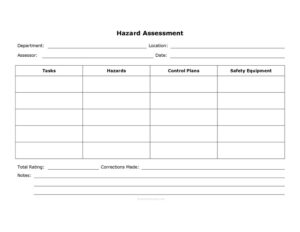
A complete and useful Hazard Assessment ties each task to its hazards, its controls, and a clear rating. It should clearly identify the department and location being assessed, name the assessor, and carry a date so the record is traceable. For each task it should list the associated hazards, the control plans designed to reduce them, and the required safety equipment. A total rating summarizes overall risk, while a corrections section confirms that issues were resolved. Notes capture context, and a signature with date verifies that a responsible person reviewed and approved the assessment.
How to Fill Out a Hazard Assessment
- Department: Enter the department or work unit being evaluated, such as Maintenance, Shipping, or Food Prep.
- Location: Specify the exact area — building, floor, room, or job site — so the assessment is tied to a physical place.
- Assessor: Write the full name of the person conducting the assessment.
- Date: Record the date the assessment is performed.
- Tasks: List each task or activity being assessed individually rather than lumping them together.
- Hazards: For each task, describe the specific hazards present, including the type of risk.
- Control Plans: Document the measures that eliminate or reduce each hazard, such as guarding, procedures, or training.
- Safety Equipment: Note the personal protective equipment required, like gloves, respirators, or eye protection.
- Total Rating: Assign an overall risk score or level reflecting the combined severity and likelihood.
- Corrections Made: Record any fixes completed during or after the assessment.
- Notes: Add follow-up actions, deadlines, or observations.
- Assessor Signature and Date: Sign and date to certify the assessment is accurate and complete.
Rating Hazards and Prioritizing Controls
The Total Rating field exists to help teams prioritize. A common approach multiplies the likelihood of an incident by the severity of its potential outcome, producing a score that flags which hazards need immediate attention versus routine monitoring. When choosing control plans, follow the hierarchy of controls: try to eliminate the hazard first, then substitute, then apply engineering controls, then administrative controls, and use personal protective equipment as the last line of defense. Recording controls in this order encourages stronger, more permanent solutions rather than relying solely on safety equipment.
Keeping the Record Useful After Completion
A Hazard Assessment is most valuable when it leads to action and stays current. Once corrections are made, note who completed them and when, and schedule a re-assessment if conditions change or new equipment arrives. Store completed forms where supervisors and auditors can find them, and review them with affected employees so the people doing the work understand the hazards and controls. Treating the document as a living record — rather than a one-time formality — turns it into a genuine safety improvement tool.
Common Mistakes to Avoid
- Listing tasks too broadly so that real hazards get overlooked — break work into specific steps.
- Naming hazards without assigning matching control plans or safety equipment.
- Leaving the Total Rating blank, which makes it impossible to prioritize fixes.
- Skipping the Corrections Made field and never confirming whether issues were actually resolved.
- Forgetting the assessor signature and date, which undermines the record’s credibility.
- Filing the assessment away without sharing it with the employees who face the hazards daily.
Frequently Asked Questions
What is a Hazard Assessment used for? It is used to identify dangers tied to specific tasks in a work area, evaluate how serious those risks are, and document the controls and protective equipment that reduce them. Employers rely on it to plan safe work, meet safety obligations, and keep a written record of due diligence.
Who should complete a Hazard Assessment? A trained and competent person — typically a supervisor, safety officer, or experienced team member familiar with the tasks — should conduct the assessment. Involving the workers who perform the job often produces a more accurate and practical result.
How do I fill out the Total Rating field? Assign a risk level or numeric score based on how likely an incident is and how severe its consequences could be. A common method multiplies likelihood by severity, with higher numbers signaling hazards that demand immediate correction.
Does a Hazard Assessment need to be signed? Yes — the assessor signature and date confirm that a responsible person reviewed the area, identified the hazards, and verified the controls. Signing strengthens the document’s value as a record during safety audits or inspections.
How often should hazard assessments be done? Conduct them before new tasks or equipment are introduced, on a regular scheduled basis, and any time an incident, near-miss, or change in conditions occurs. Many workplaces also re-assess after corrections are made to confirm the controls are working.
Is this Hazard Assessment template free to download? Yes. You can download this template free in both PDF and DOCX formats with no signup required, and you can customize the fields to fit your department, tasks, and rating system.
This Hazard Assessment template is a general example provided for informational purposes only and is not legal, safety, or compliance advice. Occupational health and safety requirements vary by jurisdiction, industry, and workplace — consult a qualified safety professional or your local regulatory authority to ensure your assessments meet applicable standards.
Official resource: for the rules that apply to your situation, see the U.S. Department of Labor.
Related Forms
- Education Verification
- Accrued Benefits Statement
- Lactation Accommodation Request
- Adverse Action Notice
- Employee Warning Letter
- Employee Name Change Notification
Browse more in Employment.