
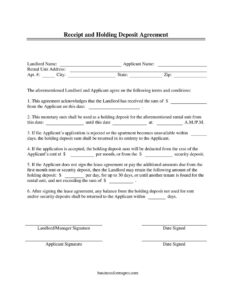
Receipt And Holding Deposit Agreement
Download a free Receipt and Holding Deposit Agreement template to document a rental holding deposit, terms, and refund rules. Free PDF and DOCX download.
PDF
DOCX
0
likes
Download Files
- DOCX
A Receipt and Holding Deposit Agreement is a short written contract between a landlord and a rental applicant that confirms the landlord received a deposit to temporarily hold a rental unit while the application is processed. People most often use it to take a unit off the market in good faith without committing either party to a full lease yet. You can download this Receipt and Holding Deposit Agreement free in PDF and DOCX formats, with no signup required.
What Is a Receipt and Holding Deposit Agreement?
A Receipt and Holding Deposit Agreement is a document a landlord or property manager issues to an applicant who pays money to reserve a vacant rental unit. It serves two purposes at once: it acts as a receipt acknowledging the funds were received, and it sets out the conditions under which that money is held, applied, or refunded. The agreement records who paid, how much, when, and what happens next — whether the deposit converts toward rent or the security deposit, gets refunded if the application is rejected, or is partly retained if the applicant backs out. It is a preliminary step before a lease, not the lease itself.
When Do You Need a Receipt and Holding Deposit Agreement?
This agreement is useful any time money changes hands before a lease is signed. Common situations include:
- An applicant wants you to stop showing the unit to others while their credit and background checks are completed.
- You want documented proof that you received a specific sum on a specific date, protecting both sides from disputes.
- A prospective tenant needs a few days to provide pay stubs, references, or a co-signer before committing.
- You manage multiple units and need a clear paper trail for each applicant’s payment and reservation period.
- You want to define, in writing, how much you may keep if the applicant changes their mind and the unit sits empty.
- An applicant asks for written assurance that their money will be returned in full if you reject their application.
What a Receipt and Holding Deposit Agreement Should Have
A complete agreement clearly identifies the landlord and applicant, the exact rental unit being held, and the dollar amount received. It should state the date the money was paid and the window of time the unit is held. Crucially, it must spell out the three possible outcomes: a full refund if the application is rejected or the unit becomes unavailable, application of the deposit toward rent or the security deposit if accepted, and a defined retention amount if the applicant fails to sign or pay. Finally, it needs dated signatures from both the landlord or manager and the applicant to be enforceable.
How to Fill Out a Receipt and Holding Deposit Agreement
- Enter the Landlord Name and the Applicant Name at the top so both parties are clearly identified.
- Fill in the Rental Unit Address, including Apt. #, City, State, and Zip to specify exactly which unit is being held.
- In paragraph 1, write the dollar amount received and the date the landlord received it.
- In paragraph 2, record the start date and end date the holding period runs, plus the time (A.M./P.M.) the hold expires.
- In paragraph 3, enter the number of days within which a full refund is issued if the application is rejected or the unit becomes unavailable.
- In paragraph 4, note the monthly rent amount and the security deposit amount the holding deposit may be applied against if accepted.
- In paragraph 5, fill in the per-day retention amount the landlord may keep if the applicant does not sign or pay, and the maximum total that may be retained.
- In paragraph 6, enter the number of days within which any unused balance is returned after the lease is signed.
- Have both the Landlord/Manager and Applicant sign and date the agreement.
How It Differs From a Security Deposit and First Month’s Rent
It is easy to confuse a holding deposit with other rental payments, but they serve different roles. A holding deposit reserves the unit during the application stage and is paid before any lease exists. A security deposit, by contrast, protects the landlord against damage or unpaid rent and is collected at lease signing. First month’s rent covers the initial occupancy period. This agreement bridges the gap: if the application is approved, paragraph 4 allows the holding deposit to be credited toward the rent or security deposit rather than treated as an extra charge. Keeping these categories distinct in your records helps avoid double-counting and makes any later accounting transparent for both parties.
Tips for Handling Holding Deposits Fairly
Be specific about timeframes. A vague hold period invites disputes, so always fill in the start date, end date, and expiration time. Document the payment method and keep a copy of the signed agreement for your files. If you reject an application, return the deposit promptly within the stated number of days and keep proof of the refund. Many jurisdictions limit how much a landlord may retain and require prompt refunds, so the retention terms in paragraph 5 should reflect actual costs of holding the unit rather than a penalty.
Common Mistakes to Avoid
- Leaving the dollar amount or the date received blank, which undermines the document’s value as a receipt.
- Failing to define the holding period end date and time, leaving the reservation open-ended.
- Forgetting to specify how the deposit applies toward rent or the security deposit if the applicant is approved.
- Setting a per-day retention or maximum amount that exceeds what local law allows.
- Not giving the applicant a signed copy, so neither side has matching records.
- Treating the holding deposit as automatically non-refundable when the agreement provides for refunds in certain situations.
Frequently Asked Questions
What is a Receipt and Holding Deposit Agreement? It is a written contract confirming that a landlord received money from a rental applicant to reserve a specific unit during the application process. It records the amount, the dates, and the conditions for refunding or applying the deposit. It is a preliminary step that comes before signing a full lease.
Is a holding deposit refundable? Under this template, the deposit is fully refundable if the application is rejected or the unit becomes unavailable within the stated number of days. If the applicant is approved, it is typically applied toward rent or the security deposit. If the applicant backs out, the landlord may retain part of it according to the terms in paragraph 5.
How is the holding deposit different from a security deposit? A holding deposit reserves the unit before a lease exists, while a security deposit is collected at lease signing to cover potential damage or unpaid rent. This agreement allows the holding deposit to be credited toward the security deposit or rent if the application is accepted.
Does this agreement need to be notarized or witnessed? Notarization is generally not required for a holding deposit agreement, and signatures from the landlord and applicant are usually sufficient. Requirements can vary by location, so check your local rules if you want added formality. Both parties should keep a signed, dated copy.
Is a Receipt and Holding Deposit Agreement legally binding? Once both parties sign and date it, the agreement generally creates an enforceable understanding about the deposit and the hold. Its enforceability depends on local landlord-tenant laws, including limits on retention amounts and refund timelines. Keeping the terms reasonable and clearly written helps it hold up.
How much does this template cost? This Receipt and Holding Deposit Agreement template is completely free to download from Business Forms Pro in both PDF and DOCX formats. There is no signup or account required. You can edit the DOCX version to match your unit, amounts, and timeframes.
This template is provided as a general example for informational purposes only and is not legal, financial, or tax advice. Landlord-tenant laws, including holding deposit limits and refund requirements, vary by state and locality. Consult a qualified attorney or professional before using this document in your situation.
Official resource: for the rules that apply to your situation, see HUD.
Related Forms
- Noise Complaint Letter
- Rent Demand Letter
- Covid Rent Extension Landlord
- Security Deposit Return Letter
- Tenant Late Rent Log
- Property Safety Upgrades Tenant Notification
Browse more in Landlord Documents.