
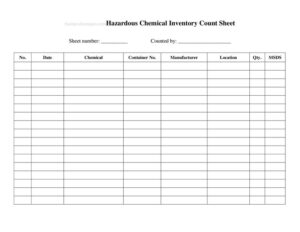
Hazardous Chemical Inventory
Free hazardous chemical inventory template in PDF & DOCX to log chemicals, containers, manufacturers, locations, and SDS. Stay organized and compliant.
PDF
DOCX
7 downloads
0
likes
Download Files
- DOCX
A hazardous chemical inventory is a count sheet that records every hazardous chemical on site — its container, manufacturer, location, quantity, and the location of its safety data sheet. Keeping an accurate inventory is a cornerstone of workplace safety and chemical-hazard compliance. Download this free template in PDF or DOCX and start your log. No signup required.
What Is a Hazardous Chemical Inventory?
A hazardous chemical inventory is a written list of the hazardous substances a workplace stores or uses, along with the key details needed to manage them safely. It tells you what chemicals are present, how much of each, where they’re kept, who manufactured them, and where to find the corresponding safety data sheet (SDS). Maintaining this list is fundamental to hazard communication: in an emergency, responders and employees need to know quickly what’s on hand and how dangerous it is. For many workplaces, keeping and updating a chemical inventory is also part of meeting occupational safety obligations.
When Do You Need One?
- Any workplace that stores or uses hazardous chemicals — labs, manufacturing, cleaning, agriculture, salons, and more.
- Conducting a periodic chemical count or safety audit.
- Preparing hazard communication records and matching chemicals to their safety data sheets.
- Supporting emergency planning so responders know what’s on site.
- Onboarding a new location or reviewing what’s accumulated in storage over time.
- Identifying expired, unlabeled, or no-longer-needed chemicals for safe disposal.
What the Inventory Should Record
A useful inventory captures enough detail to identify and locate every chemical. For each entry, record the chemical name, the container number, the manufacturer, the location where it’s stored, the quantity on hand, and whether an SDS (safety data sheet) is on file. A sheet number, the date, and the name of the person who counted it round out the record so you know how current it is and who to ask about it.
How to Fill Out the Inventory Sheet
- Enter the sheet number, the date, and who it was counted by.
- For each chemical, assign a line number and write the chemical name as it appears on the label.
- Record the container number and the manufacturer.
- Note the storage location so the chemical can be found quickly.
- Enter the quantity on hand at the time of the count.
- Confirm whether the SDS is on file for that chemical, and flag any that are missing.
Keeping the Inventory Safe and Current
An inventory is only useful if it’s current, so review and update it on a regular schedule and whenever chemicals are added or removed. Match every chemical to its safety data sheet and keep those sheets accessible to employees — an inventory that points to missing SDS documents flags a gap you can close. Use the count as a chance to spot expired, leaking, unlabeled, or unneeded chemicals and arrange proper disposal. Store the completed inventory where it can be reached in an emergency, and make sure the people who work with these chemicals know it exists and how to read it.
Common Mistakes to Avoid
- Letting the inventory go stale so it no longer reflects what’s actually on site.
- Listing a chemical but not noting whether its safety data sheet is on file.
- Vague locations that make a chemical hard to find in a hurry.
- Skipping container numbers or quantities, weakening the record’s usefulness.
- Not flagging expired, unlabeled, or leaking containers for disposal.
- Storing the only copy somewhere it can’t be reached in an emergency.
Labeling, Storage, and Safe Disposal
An inventory is the starting point for handling chemicals safely, but it works hand in hand with good labeling and storage. Every container on your inventory should carry a legible label identifying its contents and hazards; an entry on the sheet that points to an unlabeled drum is a red flag to fix immediately. Store chemicals according to their compatibility — keeping incompatible substances apart, flammables in appropriate cabinets, and everything secured against spills and tampering — and make sure the storage locations recorded on your inventory match reality so a chemical can always be found quickly. The inventory count is also the natural moment to weed out what shouldn’t be there: expired products, containers with degraded or missing labels, leaking vessels, and chemicals the business no longer uses. These should be flagged and arranged for proper disposal through an appropriate hazardous-waste channel rather than poured down a drain or thrown in the trash, both of which can be dangerous and unlawful. Pair every chemical with its safety data sheet and keep those sheets where employees can reach them, because in an emergency the SDS is what tells responders how to act. Finally, train the people who work with these substances to read both the inventory and the labels, and to report new chemicals so the list stays current. An accurate, well-maintained inventory backed by proper labeling and storage is one of the simplest, highest-impact safety controls a workplace can put in place.
Frequently Asked Questions
What is a hazardous chemical inventory? It’s a count sheet listing the hazardous chemicals on site with their containers, manufacturers, locations, quantities, and whether a safety data sheet is on file — a core part of workplace hazard communication.
What is an SDS? A safety data sheet is the document that describes a chemical’s hazards, safe handling, storage, and emergency measures. The inventory should note whether the SDS for each chemical is on file and accessible to employees.
How often should I update the inventory? Review it on a regular schedule and update it any time chemicals are added or removed. A current inventory is what makes it useful for safety audits and emergencies.
Who needs a chemical inventory? Any workplace that stores or uses hazardous chemicals — from labs and factories to cleaning services and salons. The size of the list varies, but the need for one does not.
How do I fill it out? For each chemical, record the name, container number, manufacturer, location, quantity, and SDS status, along with the sheet number, date, and who counted it. The template above provides a column for each.
How much does this template cost? Nothing — it’s free to download in PDF and DOCX, with no signup required.
Related Forms
- Weekly Music Practice Log
- Weekly Status Report
- Photo Log
- Edit Log
- Retirement Income Sources
- Office Supplies Inventory
Browse more in Log and Inventory.