
Vendor Price Analysis
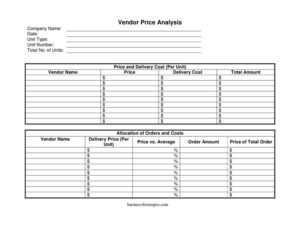
Compare supplier pricing side by side with our free Vendor Price Analysis template, available as a free download in PDF and DOCX formats.
PDF
DOCX
6 downloads
0
likes
Download Files
- DOCX
A Vendor Price Analysis is a structured worksheet used to compare the prices, delivery costs, and total order amounts offered by competing suppliers so you can choose the most cost-effective vendor. Purchasing teams reach for it whenever they need to justify a sourcing decision with hard numbers rather than gut feel. It is free to download here in both PDF and DOCX formats, with no signup required.
What Is a Vendor Price Analysis?
A Vendor Price Analysis is a procurement document that lays out each vendor’s quoted unit price, delivery cost, and total order value in a single comparable view. It is typically prepared by a buyer, purchasing manager, or small-business owner when collecting quotes for goods or materials. The form documents not only the raw price per unit but also how each vendor’s pricing measures against the group average, plus how orders and costs are allocated across suppliers. By capturing the company name, date, vendor names, unit types, and total amounts in one place, it creates a transparent paper trail that supports the final award and can be revisited during audits or budget reviews.
When Do You Need a Vendor Price Analysis?
This worksheet earns its keep any time pricing decisions involve more than one supplier or a meaningful spend. Common situations include:
- Comparing three or more bids for a recurring inventory purchase, such as raw materials or packaging.
- Documenting why you selected a particular vendor when management or a client requires justification.
- Renegotiating an existing contract and needing to show how a current supplier’s price stacks up against the market average.
- Splitting a large order across multiple vendors to balance cost, capacity, and delivery reliability.
- Preparing a budget forecast where unit and delivery costs feed directly into projected spend.
- Reviewing past purchases during a procurement audit or cost-reduction initiative.
What a Vendor Price Analysis Should Have
A complete analysis is built around comparability — every vendor should be evaluated on the same line items. The essential elements are the identifying header (company name and date), a clear list of vendor names, and the unit details that describe exactly what is being priced (unit number, unit type, and total number of units). It should capture each vendor’s price per unit, delivery cost, and the combined price-and-delivery cost per unit, then roll those up into the price of the total order and the total amount. The Price vs. Average column is what turns raw data into insight, showing whether a vendor is above or below the group benchmark. Finally, an allocation section records how orders and costs are distributed when business is split.
How to Fill Out a Vendor Price Analysis
- Enter your Company Name and the Date of the analysis at the top so the document is properly attributed and timestamped.
- Record each Vendor Name being compared, giving every supplier its own row or column.
- Define the item using the Unit Number and Unit Type (for example, boxes, pallets, or pieces) so all vendors quote the same thing.
- Enter the Total No. of Units you intend to purchase across the order.
- Fill in each vendor’s Price (the base cost per unit) and their Delivery Price (Per Unit).
- Add the per-unit Delivery Cost and calculate the combined Price and Delivery Cost (Per Unit).
- Multiply the per-unit figure by quantity to get the Price of Total Order and the overall Total Amount.
- Complete the Price vs. Average field to flag whether each vendor sits above or below the benchmark.
- Use the Allocation of Orders and Costs section and the Order Amount field to record how you intend to split the purchase.
How to Read the Price vs. Average Column
The Price vs. Average comparison is the analytical heart of this form. To calculate it, total every vendor’s combined price-and-delivery cost per unit, divide by the number of vendors to find the average, then express each vendor’s figure as a difference from that average. A negative variance means the vendor is cheaper than the field; a positive one means they are more expensive. Reading this column alongside the total amount prevents a common trap: a vendor with the lowest unit price can still produce a higher total order cost once delivery is included. By isolating the variance, you can quickly spot the genuine value leader rather than the one with the most eye-catching headline rate.
Allocating Orders Across Multiple Vendors
You will not always award the entire order to a single supplier. The Allocation of Orders and Costs section lets you split volume strategically — perhaps giving the bulk to the lowest-cost vendor while reserving a portion for a backup to protect against supply disruptions. Use the Order Amount field to note how many units go to each vendor and what that portion costs. Documenting allocation here keeps your reasoning visible and makes it easy to reconcile against invoices when goods arrive. It also helps you track whether splitting actually saved money once delivery economies of scale are factored in.
Common Mistakes to Avoid
- Comparing vendors on unit price alone while ignoring delivery cost, which can flip the cheapest-looking quote into the most expensive total.
- Failing to standardize the unit type, so one vendor quotes per box and another per piece, making the numbers meaningless.
- Leaving the date blank, which makes it impossible to know whether quotes are still valid or have expired.
- Forgetting to update the Price vs. Average column after adding or removing a vendor, leaving a stale benchmark.
- Recording the allocation decision without noting the order amount per vendor, so the split cannot be verified later.
- Mixing currencies or tax treatments across vendors without flagging the difference.
Frequently Asked Questions
What is a Vendor Price Analysis used for? It is used to compare competing supplier quotes on an apples-to-apples basis, factoring in both unit price and delivery cost. The goal is to identify the most cost-effective vendor and document the reasoning behind a purchasing decision. It also serves as a record for audits, budgeting, and future negotiations.
How do I calculate the Price vs. Average figure? Add up the combined price-and-delivery cost per unit for every vendor, divide by the number of vendors to find the average, and then compare each vendor’s figure to that average. A result below the average means the vendor is cheaper than the field, while a result above means they are more expensive. This single number makes ranking vendors fast and objective.
Should I always choose the vendor with the lowest unit price? Not necessarily. A low unit price can still produce a high total order cost once delivery, minimum order quantities, and reliability are considered. This form encourages you to look at the total amount and allocation rather than the headline rate alone.
Can I split an order between multiple vendors with this form? Yes. The Allocation of Orders and Costs section and the Order Amount field are designed for exactly that, letting you record how many units go to each supplier and at what cost. Splitting can reduce risk and sometimes lower overall spend, and documenting it keeps your decision transparent.
Is this Vendor Price Analysis template free? Yes, it is completely free to download in both PDF and DOCX formats, with no signup or payment required. The DOCX version is editable, so you can add vendors, adjust columns, and insert your company branding before use.
How often should I run a vendor price analysis? For recurring purchases, many buyers refresh the analysis each time they reorder or at least quarterly, since pricing and delivery costs shift over time. For one-off or large purchases, complete a fresh analysis for each sourcing event. Keeping the date field current ensures you always know how recent your comparison is.
This Vendor Price Analysis template is provided as a general example for informational purposes only and does not constitute financial, procurement, or legal advice. Pricing rules, tax treatment, and contracting requirements vary by jurisdiction and industry — consult a qualified professional before making purchasing or contractual decisions.
Related Forms
- General Journal
- Book Inventory
- Petsitter Daily Log
- Maintenance Log
- Firearm Inventory
- Cleaning Log By Room
Browse more in Log and Inventory.