
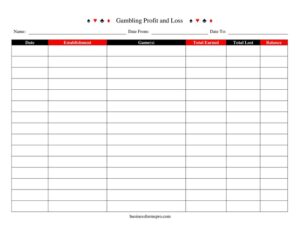
Casino Earnings Log
Track gambling wins and losses with the free Casino Earnings Log template — record sessions, totals, and balances; free download in PDF and DOCX.
PDF
DOC
3 downloads
0
likes
Download Files
- DOC
A Casino Earnings Log is a simple record-keeping sheet used to track your gambling wins, losses, and running balance across sessions and establishments. People most often use it to keep an accurate, dated history of their casino activity for personal budgeting or tax preparation. It’s free to download here in both PDF and DOCX formats, with no signup required.
What Is a Casino Earnings Log?
A Casino Earnings Log is a session-by-session document that captures how much you won and lost during gambling activity over a defined period. It’s typically maintained by the individual gambler — whether a casual player, frequent visitor, or someone reporting gambling income — rather than issued by a casino. The log documents the date and location of play, the games involved, amounts earned and lost, and a calculated balance. Its purpose is to give you a clear, organized financial picture of your gambling outcomes so you can monitor spending, evaluate results honestly, and have supporting documentation ready if you ever need to substantiate winnings or losses. Because it relies on consistent, contemporaneous entries, the log works best when you fill it in promptly after each visit.
When Do You Need a Casino Earnings Log?
This log fits a wide range of situations where keeping a written gambling record matters. Common reasons people use it include:
- Tax recordkeeping: Maintaining a contemporaneous record of winnings and losses to support what you report, since many jurisdictions require documentation to substantiate gambling figures.
- Budget control: Tracking how much you actually spend versus win over a month, quarter, or year to set responsible limits.
- Multiple establishments: Comparing results across different casinos, card rooms, or venues you visit.
- Game-specific analysis: Seeing whether you fare better at slots, blackjack, poker, or table games over time.
- Responsible gambling: Reviewing patterns honestly, which can help you recognize whether play is staying within healthy boundaries.
- Reimbursement or shared bankrolls: Documenting outcomes when you play with pooled funds or on behalf of a group.
What a Casino Earnings Log Should Have
A complete and useful log balances enough detail to be credible with enough simplicity to maintain consistently. The essential elements are the player’s name, a defined reporting period (a start and end date), and an individual line for each gambling session. Each session line should identify the date, the establishment, the games played, the total amount earned, the total amount lost, and a resulting balance. The running balance is what turns a list of numbers into a meaningful summary — it shows whether you are ahead or behind over the chosen period. For records intended to support tax filings, accuracy and dating matter most: every entry should be recorded as close to the event as possible rather than reconstructed from memory months later.
How to Fill Out a Casino Earnings Log
- Name: Enter your full legal name as the person whose gambling activity the log covers.
- Date From: Record the first date of the reporting period this sheet covers, such as the start of a month or tax year.
- Date To: Enter the closing date of the period, so the log clearly defines its span.
- Date: For each session row, write the specific calendar date you played.
- Establishment: Note the casino, card room, or venue name where the session took place.
- Game(s): List the games you played that day — for example, slots, blackjack, roulette, or poker.
- Total Earned: Enter the gross amount you won during that session before subtracting any losses.
- Total Lost: Enter the total amount you lost or wagered and did not recover that session.
- Balance: Calculate the net result for the row (Total Earned minus Total Lost) and, if you prefer, keep a cumulative running balance down the column.
Tips for Keeping an Accurate Gambling Record
The value of a Casino Earnings Log depends almost entirely on how consistently and honestly you keep it. Record entries the same day you play, while the figures are fresh, rather than reconstructing them later. Keep supporting items where possible — win/loss statements from the casino’s player’s club, ATM and bank records, ticket stubs, or photos of payout slips — because these corroborate your log. Treat each session as a separate line rather than lumping a whole trip together; session-level detail is more defensible and more informative. Be consistent about whether your “Total Earned” reflects gross winnings or net of the buy-in, and apply the same convention every time so your balance is meaningful.
How This Differs From a Casino Win/Loss Statement
People sometimes assume a casino-issued win/loss statement replaces a personal log. It generally does not. Casino statements are estimates based on tracked card play and may omit cash games, untracked machines, or visits where you didn’t insert a player’s card. Your own Casino Earnings Log captures everything you choose to record, in your own words, and can be far more complete. The two work best together: your contemporaneous log as the primary record, and the casino statement as corroborating support. Keeping both gives you a stronger, more credible picture of your overall gambling activity.
Common Mistakes to Avoid
- Filling it in from memory: Reconstructing months of play at once invites errors and undermines the log’s credibility.
- Mixing earned and lost amounts: Netting wins and losses into a single number loses the detail that makes the record useful and verifiable.
- Skipping the establishment or date: Vague entries are hard to substantiate and weaken the record’s value.
- Inconsistent conventions: Switching between gross and net figures from row to row makes the running balance unreliable.
- Forgetting to keep backups: Failing to retain receipts, statements, or other supporting documents leaves the log unsupported.
- Leaving the reporting period blank: Without clear Date From and Date To values, the totals lack context.
Frequently Asked Questions
What is a Casino Earnings Log used for? It is a personal record of your gambling sessions, capturing wins, losses, and a running balance over a defined period. People use it for budgeting, analyzing results across games and venues, and supporting figures reported for tax purposes. The log helps turn scattered gambling activity into an organized, reviewable history.
How do I fill out the log correctly? Enter your name and the reporting period at the top, then add one row per session with the date, establishment, games played, total earned, total lost, and the resulting balance. Record entries promptly after each session for accuracy. Keep the same conventions throughout so your totals stay consistent.
Does a Casino Earnings Log need to be notarized or witnessed? No. It is a personal recordkeeping tool, not a legal instrument, so it does not require notarization or witnesses. Its credibility comes from being accurate, contemporaneous, and backed by supporting documents like receipts or casino statements.
Can I use this log for taxes? Many people keep a log like this to support gambling figures, but tax rules for reporting winnings and deducting losses vary by jurisdiction and situation. The log is useful documentation, but it does not replace professional guidance. Consult a qualified tax advisor about how to report your specific activity.
Is the casino’s win/loss statement enough on its own? Usually not, because those statements are estimates and may miss untracked play. Your own log captures activity the casino may not record. Keeping both your personal log and the casino statement gives you the strongest, most complete record.
How much does this template cost? Nothing — it is completely free to download here in PDF and DOCX formats with no signup required. You can print it for handwritten entries or edit the DOCX version on your computer. Use whichever format fits how you prefer to keep records.
This template is provided as a general example for informational purposes only and is not legal, financial, or tax advice. Gambling reporting and recordkeeping requirements vary by jurisdiction and individual circumstances. Consult a qualified tax or legal professional regarding your specific situation.
Related Forms
- Inventory Tag
- Incoming Mail Log
- Pre-Trip Vehicle Inspection Checklist
- Employee Covid Attestation Log
- Beauty Salon Supplies Inventory Card
- Bird Strike Form
Browse more in Log and Inventory.