
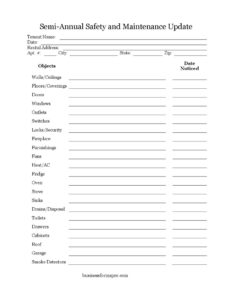
Semi Annual Safety And Maintenance Update
Download a free Semi-Annual Safety and Maintenance Update form to inspect rental units, log repairs, and protect tenants — free template, no signup.
PDF
DOCX
4 downloads
0
likes
Download Files
- DOCX
A Semi-Annual Safety and Maintenance Update is a rental property inspection log used twice a year to record the condition of a unit’s safety devices, fixtures, and systems. Landlords and property managers most often use it to document smoke detectors, appliances, and structural items so problems are caught early and repairs are tracked. You can download it free here in PDF and DOCX with no signup required.
What Is a Semi-Annual Safety and Maintenance Update?
A Semi-Annual Safety and Maintenance Update is a structured checklist that documents the working condition of a rental unit at a regular six-month interval. It is typically completed by a landlord, property manager, or maintenance technician — sometimes alongside the tenant — and it records each major component of the home, from smoke detectors and outlets to floors, windows, and appliances. The form serves as a written record showing that the property was inspected, what issues were noticed, and when. Over time, these logs build a maintenance history that supports preventive upkeep, demonstrates due diligence on safety devices, and helps resolve disputes about who is responsible for damage.
When Do You Need a Semi-Annual Safety and Maintenance Update?
- Routine twice-a-year inspections — to confirm that smoke detectors, heat/AC, and locks are functioning before each season.
- Lease renewals — to assess whether a unit needs repairs or upgrades before a tenant re-signs.
- Tenant turnover — to compare a unit’s current condition against earlier records when one resident moves out and another moves in.
- Preventive maintenance planning — to spot small issues like a slow drain or a sticking window before they become costly repairs.
- Insurance and liability documentation — to show that safety devices were checked and that hazards were addressed promptly.
- Responding to a tenant complaint — to formally log a reported problem with the date it was noticed and the affected fixture.
What a Safety and Maintenance Update Should Have
A complete update identifies the property and tenant, the inspection date, and the condition of each system in the unit. The form should include clear address details so the record is tied to a specific unit, the date of inspection and the date any defect was first noticed, and a line for every major component — safety devices, plumbing, electrical, appliances, and structure. Leaving room to note the specific condition of each item is what turns a checklist into a useful record. Each row should make it easy to mark whether an item is in good order or needs attention.
How to Fill Out a Semi-Annual Safety and Maintenance Update
- Enter the Rental Address, Apt. #, City, State, and Zip to identify the exact unit being inspected.
- Record the Tenant Name currently occupying the unit and the inspection Date.
- Use Date Noticed to log when any problem was first observed or reported.
- Check safety items first: Smoke Detectors, Locks/Security, Outlets, and Switches.
- Inspect heating and air with Heat/AC, then the Fireplace and Fans.
- Test the kitchen: Stove, Oven, Fridge, Sinks, Drains/Disposal, Cabinets, and Drawers.
- Check plumbing fixtures including Toilets and any remaining Drains.
- Review structure and surfaces: Walls/Ceilings, Floors/Coverings, Doors, Windows, and Roof.
- Note the Garage, Furnishings, and any loose Objects requiring attention, then sign and date the completed log.
How to Document Each Condition Effectively
The value of this log depends on the detail you record beside each item. Rather than simply marking a box, add a short note describing what you found — for example, “smoke detector battery replaced,” “bathroom drain slow,” or “window latch loose in bedroom.” When you flag a defect, always fill in the Date Noticed field so there is a clear timeline between discovery and repair. If a tenant reported the issue, note that as well. Consider taking dated photos to attach to your records; while the form itself captures the written summary, images strengthen the documentation and reduce later disputes about the unit’s condition.
Following Up After the Inspection
An inspection log is only useful if it drives action. After completing the form, separate items into those that pass, those needing minor attention, and those requiring urgent repair — safety devices like smoke detectors and security locks always take priority. Schedule and track repairs against the same record so your next semi-annual update can confirm the issue was resolved. Keep completed forms in a consistent file, organized by unit and date, so you can quickly review a property’s full maintenance history. Many landlords give the tenant a copy of each update to keep communication transparent and to confirm shared awareness of the unit’s condition.
Common Mistakes to Avoid
- Skipping the Date Noticed field — without it, you lose the timeline that proves prompt action on hazards.
- Marking items “OK” without testing — actually press the test button on smoke detectors and run faucets rather than guessing.
- Vague entries — “needs work” tells you little; describe the specific fixture and the specific problem.
- Inconsistent timing — a “semi-annual” log loses value if inspections happen randomly instead of roughly every six months.
- Not retaining old forms — discarding past updates erases the maintenance history that protects you in disputes.
- Failing to follow up — logging a defect without scheduling the repair defeats the purpose of the inspection.
Frequently Asked Questions
What is a Semi-Annual Safety and Maintenance Update form? It is a twice-yearly rental inspection checklist that records the working condition of a unit’s safety devices, appliances, plumbing, electrical, and structure. Landlords and property managers use it to track repairs and document that safety items like smoke detectors were checked.
How do I fill out the form? Start with the property address, apartment number, city, state, zip, tenant name, and inspection date. Then go through each listed item — from smoke detectors and outlets to the stove, sinks, windows, and roof — noting its condition and using the Date Noticed field whenever you find a defect.
How often should I complete it? As the name suggests, the form is designed to be used roughly every six months, or twice per year. Many landlords also complete one at move-in and move-out so they have a clear before-and-after record for each tenant.
Does the tenant need to be present or sign it? The tenant does not have to be present, but inspecting together can be helpful and builds trust. While a signature is not strictly required, having the tenant acknowledge the recorded condition can reduce later disputes; check your local rules on advance notice before entering a unit.
Is this form legally binding? The update itself is a documentation and record-keeping tool rather than a binding contract. However, the records it creates can serve as important evidence of maintenance and safety diligence in disputes or insurance matters, so accuracy and consistency matter.
How much does the template cost? Nothing — this Semi-Annual Safety and Maintenance Update template is completely free to download in both PDF and DOCX formats, with no signup required. You can edit the DOCX version to add your own fields or company details.
This template is provided as a general example for informational purposes only and is not legal, financial, or property-management advice. Inspection, notice, and habitability requirements vary by jurisdiction — consult a qualified professional or your local housing authority for guidance specific to your situation.
Related Forms
- Geocache Log
- Visitor Log
- Employee Password Tracker
- Fire Emergency Checklist
- Log Sheet
- Vehicle Maintenance Log
Browse more in Log and Inventory.