
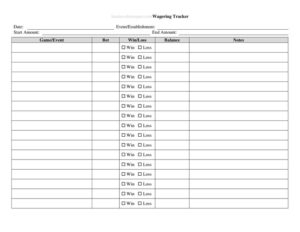
Wagering Tracker
Use this free Wagering Tracker template to log bets, stakes, odds, and outcomes and review your results over time — free download in PDF and DOCX.
PDF
DOCX
5 downloads
0
likes
Download Files
- DOCX
A Wagering Tracker is a simple log used to record every bet you place — the date, event, stake, odds, and result — so you can see exactly how your wagering performs over time. People most often use it to replace messy notes and memory with a clear, honest record of wins, losses, and net position. It is free to download here in both PDF and DOCX, with no signup required.
What Is a Wagering Tracker?
A Wagering Tracker is a personal record-keeping sheet for anyone who places bets and wants an organized account of their activity. Rather than guessing whether you are up or down, you write each wager into a row and tally the results. It documents what you staked, what you stood to win, and what actually happened. Hobbyists, sports bettors, fantasy players, and people setting personal limits all use it to bring discipline to an activity that otherwise lives in scattered receipts and screenshots. The tracker itself is neutral: it is a budgeting and accountability tool. Its core job is to turn individual bets into data you can review, so patterns — good and bad — become visible.
When Do You Need a Wagering Tracker?
A Wagering Tracker is useful any time you want a complete, dated record instead of relying on memory. Common situations include:
- Tracking sports bets across several games or platforms so you know your real net result for the week or season.
- Setting and monitoring a budget, where you cap how much you stake per week and use the log to stay inside it.
- Comparing strategies, such as testing whether one type of bet or one event category performs better than another over many entries.
- Reviewing performance honestly after a streak, when emotion can distort how well you think you are doing.
- Keeping records for tax or accounting reasons in jurisdictions where winnings and losses may be reportable.
- Practicing responsible play, where simply writing down each wager creates a pause and a record that discourages impulsive bets.
What a Wagering Tracker Should Have
A complete tracker captures enough detail to reconstruct any single bet and to total your overall position. The essentials are a unique entry or date for each wager, a clear description of the event or market, the amount staked, the odds or price, the potential payout, the actual outcome, and the resulting profit or loss. A running balance column lets you see your net position grow or shrink at a glance. Optional fields — the platform or bookmaker, the bet type, and a notes column for your reasoning — add context that makes later review far more useful. The most important quality is consistency: every row filled out the same way, every time, with no gaps.
How to Fill Out a Wagering Tracker
Work one row per bet and complete the columns in order:
- Date — enter the day you placed the wager so entries stay in chronological order.
- Event or selection — describe what you bet on, such as the teams, match, race, or market.
- Bet type — note the kind of wager (single, parlay, over/under, etc.) for later comparison.
- Platform or bookmaker — record where the bet was placed, useful if you use more than one.
- Stake — write the exact amount you risked on this entry.
- Odds or price — log the odds as offered, in your preferred format (decimal, fractional, or American).
- Potential payout — calculate what a win would return, including your stake.
- Result — once the event settles, mark it won, lost, pushed, or void.
- Profit or loss — enter the net gain or the negative stake for a loss.
- Running balance — add or subtract from the previous row to keep a live total.
- Notes — capture your reasoning or anything unusual for future review.
Getting the Most From Your Tracker
The value of a Wagering Tracker comes from reviewing it, not just filling it in. Set a regular check-in — weekly or monthly — and add up your total staked, total returned, and net result. Look at which bet types and which events delivered your best and worst returns; you will often find your overall record is shaped by a handful of categories. Track your strike rate (wins divided by total settled bets) alongside profit, because a high win rate with poor odds can still lose money. If you keep the file in spreadsheet form, formulas can total the profit and balance columns automatically. Be ruthlessly honest: record losing bets the moment they settle, not just the wins.
Responsible Use and Limits
A tracker works best as part of a clear plan. Decide before you start how much you are willing to risk over a set period, and treat that figure as a hard ceiling rather than a target. The running balance column makes it easy to spot when you are chasing losses — a string of increasing stakes after a bad run. If reviewing your tracker reveals stakes climbing beyond what you set aside, or betting that no longer feels like a choice, that is a signal to step back. Many regions offer free, confidential support services for anyone concerned about their gambling. Use the tracker as an early-warning system, not just a scoreboard.
Common Mistakes to Avoid
- Logging only winning bets, which paints a falsely positive picture of your results.
- Leaving the result column blank on bets that have already settled, so your net total is never accurate.
- Mixing odds formats from row to row, which makes payout figures inconsistent and hard to compare.
- Forgetting to update the running balance, the single column that tells you whether you are up or down.
- Recording bets from memory days later, when stake amounts and odds get fuzzy and errors creep in.
- Skipping the notes column, losing the context that would explain why a strategy worked or failed.
Frequently Asked Questions
What is a Wagering Tracker used for? It is a log for recording every bet you place along with its stake, odds, outcome, and net result. People use it to see their true profit or loss over time, compare strategies, and stay within a budget. It turns scattered bets into reviewable data.
How do I fill out a Wagering Tracker? Add one row per bet, entering the date, event, bet type, stake, odds, and potential payout when you place it. Once the event settles, fill in the result and the profit or loss, then update your running balance. Adding notes about your reasoning makes later review far more useful.
Is this Wagering Tracker free to download? Yes. You can download it free here in both PDF and DOCX formats with no signup required. The DOCX version is editable, so you can add columns, rename fields, or set up formulas to total your results automatically.
Should I record losing bets too? Absolutely. Logging losses is the whole point — a tracker that shows only wins gives a misleading and overly optimistic picture. Recording every settled bet, win or lose, is the only way to know your real net position.
Can I use a Wagering Tracker for tax records? It can serve as a helpful personal record of your activity, since it dates and details each wager. However, reporting rules for gambling winnings and losses vary widely by jurisdiction, so confirm what your local tax authority requires and keep supporting documents like receipts or statements.
Does the tracker help with responsible gambling? Yes, in a practical way. By forcing you to write down each stake and watch your running balance, it makes overspending and loss-chasing visible early. If your records show betting beyond your limits, treat that as a prompt to pause and seek the free support services available in your area.
This Wagering Tracker template is a general example provided for informational and organizational purposes only. It is not legal, financial, or tax advice, and gambling laws and reporting requirements vary by jurisdiction. Consult a qualified professional regarding your specific situation, and seek confidential support if gambling is affecting your wellbeing.
Related Forms
- Yearly Cleaning Log
- Beer Cider Tasting Log
- Visitor Log
- Cash Register Log
- Social Security Options Planner
- Contracts List
Browse more in Log and Inventory.