
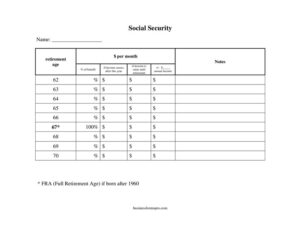
Social Security Options Planner
Compare claiming ages, benefit estimates, and break-even points with our free Social Security Options Planner template — free download in PDF and DOCX.
PDF
DOCX
2 downloads
0
likes
Download Files
- DOCX
A Social Security Options Planner is a worksheet that helps you compare the financial outcomes of claiming Social Security retirement benefits at different ages so you can choose the strategy that fits your situation. People most often use it to weigh whether to file early, at full retirement age, or to delay benefits for a larger monthly check. You can download it free in PDF and DOCX with no signup required.
What Is a Social Security Options Planner?
A Social Security Options Planner is a personal planning document used by individuals approaching retirement, financial coaches, and household budgeters to organize and compare Social Security claiming decisions side by side. It documents your projected monthly benefit at various ages, your full retirement age, life-expectancy assumptions, spousal considerations, and the break-even point where delaying pays off. Rather than relying on a vague sense of “sooner is better” or “later is better,” the planner turns the decision into concrete numbers you can read at a glance. It is a worksheet, not an official government filing — you still claim benefits through the Social Security Administration. Its value is in helping you arrive at a clear, defensible decision before you ever file.
When Do You Need a Social Security Options Planner?
This worksheet is useful any time the timing of your benefits is in question. Common scenarios include:
- Approaching age 62. You are newly eligible to claim and want to see what an early-filing reduction actually costs you each month and over your lifetime.
- Deciding whether to delay past full retirement age. You want to quantify the delayed-retirement credits earned by waiting until 67, 68, 69, or 70.
- Coordinating as a married couple. You and a spouse are mapping out who claims first to maximize household and survivor benefits.
- Still working in your 60s. You want to understand how earned income, the earnings test, and taxes interact with claiming early.
- Reviewing options with an advisor. You need a clean summary to bring to a financial planner or family meeting.
- Comparing against pensions and savings. You are sequencing withdrawals from a 401(k), IRA, or pension and need to slot Social Security into the bigger picture.
What a Social Security Options Planner Should Have
A complete planner captures everything needed to compare scenarios fairly. The strongest worksheets include your date of birth and full retirement age (FRA), your estimated benefit at FRA from your Social Security statement, projected monthly amounts at several candidate claiming ages, a life-expectancy assumption, a break-even age calculation, spousal and survivor notes where applicable, and a column for tax or earnings-test impacts. It should also leave space for your final decision and the reasoning behind it. Keeping all of these elements in one place ensures you are comparing apples to apples rather than juggling figures across multiple screens or scraps of paper.
How to Fill Out a Social Security Options Planner
Work through the planner one row at a time so each scenario is grounded in your real numbers:
- Enter your identifying details. Write your name, date of birth, and your full retirement age, which depends on your birth year.
- Record your FRA benefit estimate. Pull the monthly amount from your official Social Security statement at ssa.gov and enter it as your baseline.
- List candidate claiming ages. Create a row for age 62, your FRA, and age 70, adding any in-between ages you are considering.
- Fill in the projected monthly benefit for each age, applying the early reduction or delayed credit figures from your statement.
- Add a life-expectancy assumption. Enter a target age so you can calculate lifetime totals.
- Calculate cumulative benefits and the break-even age. Multiply monthly amounts by the months received to find where delaying overtakes filing early.
- Note spousal, survivor, earnings-test, and tax factors in the comments column.
- Record your chosen option and a short note explaining why.
Understanding the Break-Even Point
The break-even age is the heart of this planner. Because claiming early gives you smaller checks sooner and delaying gives you larger checks later, there is an age at which the total dollars collected under each strategy become equal. Live past that age and waiting wins; pass away before it and claiming early wins. The planner lets you test how moving your life-expectancy assumption up or down shifts the math. Remember that break-even analysis ignores some real factors — investment returns on early benefits, ongoing income needs, and the peace of mind of guaranteed larger payments later — so treat it as one input among several rather than the only answer.
Coordinating Spousal and Survivor Benefits
For married couples, the decision is rarely about one person in isolation. A higher-earning spouse who delays not only boosts their own check but also raises the survivor benefit the other spouse may receive for life. Use the spousal notes section to record each person’s FRA benefit, planned claiming age, and the resulting survivor amount. Many couples find that having the higher earner delay while the lower earner claims earlier balances near-term cash flow with long-term security. Capturing both partners’ numbers on the same worksheet makes these trade-offs visible.
Common Mistakes to Avoid
- Using a guessed benefit figure instead of the actual estimate from your Social Security statement.
- Ignoring the earnings test if you plan to keep working while claiming before full retirement age.
- Overlooking taxes — a portion of benefits may be taxable depending on your other income.
- Forgetting survivor benefits when comparing options as a couple, which can undervalue delaying.
- Picking an unrealistic life expectancy that skews the break-even result in one direction.
- Treating the worksheet as a filing — you still apply directly through the Social Security Administration.
Frequently Asked Questions
What is a Social Security Options Planner used for? It is a worksheet for comparing how much you would receive if you claim Social Security at different ages. It organizes your benefit estimates, break-even age, and spousal factors in one place so you can make an informed claiming decision. It is a planning tool, not an application.
How do I fill out the planner? Start by entering your date of birth and full retirement age, then add your benefit estimate from your Social Security statement. Create rows for ages 62, your FRA, and 70, fill in the projected monthly amount for each, and calculate the cumulative totals and break-even age. Finish by noting your chosen option and the reasons behind it.
Where do I get my benefit estimates? The most accurate figures come from your personal my Social Security account at ssa.gov, which shows your projected monthly benefit at various claiming ages based on your earnings record. Use those numbers rather than online averages so your comparison reflects your actual situation.
Does this worksheet file my claim with Social Security? No. The planner is a private decision-making tool only. To actually start benefits, you must apply through the Social Security Administration online, by phone, or at a local office.
Is delaying benefits always the better choice? Not necessarily. Delaying produces larger monthly checks, but the best choice depends on your health, life expectancy, other income, marital status, and whether you need the money sooner. The planner helps you weigh these factors rather than prescribing a single answer.
How much does this template cost? Nothing — it is completely free to download in both PDF and DOCX formats with no signup required. You can print it, fill it out by hand, or edit the DOCX version on your computer and reuse it as your estimates change.
This template is a general example provided for informational purposes only and does not constitute financial, tax, or legal advice. Social Security rules, benefit amounts, and tax treatment vary by individual circumstances and change over time. Consult the Social Security Administration and a qualified financial professional before making any claiming decision.
Related Forms
- Inventory Tag
- Social Media Tracker
- Sterilization Log
- Computer Update Tracker
- Edit Log
- Salad Bar Items Inventory Spreadsheet
Browse more in Log and Inventory.