
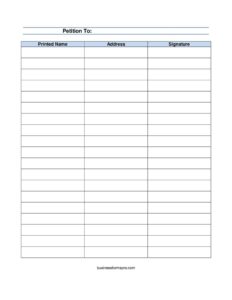
Petition Form Long
Gather organized signatures for any cause with our free Petition Form Long template, with name, address, and signature fields — free download in PDF and DOCX.
PDF
DOCX
4 downloads
0
likes
Download Files
- DOCX
A Petition Form Long is a multi-signature document used to collect the printed names, addresses, and signatures of people who support a specific request, change, or cause. People most often use it to demonstrate broad backing for an issue to a decision-maker such as a city council, school board, employer, or community organization. You can download this Petition Form Long for free in both PDF and DOCX formats, with no signup required.
What Is a Petition Form Long?
A Petition Form Long is a standardized sheet that records a clear statement of what is being requested along with the supporting details of each signer. It is typically issued or circulated by an individual, advocacy group, neighborhood association, or community organizer who wants to show that many people share a single position. The form documents who supports the petition, where they live or are based, and that they personally endorsed the statement by signing their name. Unlike a casual letter, the long version is built to hold numerous signatures in an organized, repeatable structure, making it easy to tally, verify, and present. It serves as written evidence that a request carries collective weight behind it.
When Do You Need a Petition Form Long?
This template fits any situation where you want to gather and present multiple voices behind one request. Common scenarios include:
- Local government requests — asking a city council or county board to add a stop sign, build a sidewalk, or reconsider a zoning decision.
- School and education matters — urging a school board to keep a program, change a policy, or address a safety concern.
- Workplace concerns — collecting employee signatures to request improved conditions, scheduling changes, or new resources.
- Community and neighborhood causes — opposing or supporting a development, requesting park improvements, or addressing traffic issues.
- Homeowners and tenant associations — petitioning a board or landlord on shared maintenance, rules, or amenities.
- Nonprofit and advocacy campaigns — demonstrating public support for an initiative, fundraiser, or policy position.
Types of Petitions
Petitions generally fall into a few broad categories, and this long form works for most of them. Public-policy petitions ask elected officials or government bodies to act on a law or local rule. Organizational petitions are directed at a company, school, board, or association. Community petitions raise grassroots concerns among neighbors or members. While official ballot or recall petitions often have strict legal formatting set by a government office, this template is well suited to informal and organizational petitions where the goal is to show genuine, documented support rather than satisfy a statutory filing requirement.
What a Petition Form Long Should Have
A complete petition combines a clear ask with verifiable signer information. The most important elements are:
- A recipient line identifying who the petition is addressed to.
- A concise statement of purpose describing exactly what signers are supporting or requesting.
- A repeating block for each signer’s printed name, address, and signature.
- Enough rows to collect a meaningful number of signatures on each page.
- Optional space for a date and contact information for the organizer.
Keeping the statement short and specific helps signers understand what they are endorsing and keeps the petition focused.
How to Fill Out a Petition Form Long
Follow these steps to complete the form using its actual fields:
- Petition To: At the top, write the name and title of the person or body the petition is directed to — for example, “To the City Council of Springfield” or “To the Principal of Lincoln High School.” Be specific so the right decision-maker receives it.
- Statement of purpose: Below the recipient, clearly state what you are requesting in one or two sentences so every signer reads the same ask.
- Printed Name: Each supporter writes their full name legibly. Printed names make the petition easy to read and verify later.
- Address: Each signer enters their address. This shows they live in the relevant area or belong to the relevant group, which strengthens the petition’s credibility.
- Signature: Each person signs on the same line as their printed name and address to confirm they personally endorse the statement.
- Repeat: Continue down the page, one signer per row, and add more printed pages as needed. Number the pages if you collect many sheets.
Circulating and Submitting Your Petition
Once your sheets are filled, keep them organized and intact. Do not separate a signer’s printed name from their signature, and avoid altering the statement after people have signed it, since the wording they agreed to must stay the same. When you are ready to submit, count the total number of valid signatures, make a copy for your records, and deliver the petition to the named recipient in person, by mail, or through the proper channel. A short cover note summarizing the request and the signature count can help the recipient understand the petition at a glance.
Common Mistakes to Avoid
- Vague wording — an unclear statement of purpose leaves signers unsure of what they endorsed and weakens the petition.
- Missing recipient — leaving the “Petition To” line blank makes it unclear who should act on the request.
- Illegible names — signatures alone are hard to verify, so always collect a printed name beside each one.
- Incomplete addresses — without addresses, it is difficult to show signers belong to the affected community.
- Changing the text after signing — editing the statement once people have signed undermines its integrity.
- Duplicate signatures — allowing the same person to sign multiple times can discredit the entire petition.
Frequently Asked Questions
What is a Petition Form Long used for? It is used to collect many signatures supporting a single request, statement, or cause and to present that support to a decision-maker. The “long” format provides repeating rows so you can gather names, addresses, and signatures from numerous supporters in an organized way.
How do I fill out a Petition Form Long? Address it to the right recipient on the “Petition To” line, state your request clearly, and then have each supporter add their printed name, address, and signature on a separate row. Add more pages as you collect additional signatures and keep all sheets together.
Is a petition legally binding? A petition is generally a formal request rather than a binding legal contract, and it does not by itself compel action. Its power comes from the number and credibility of signers; official petitions tied to elections or specific laws may carry legal weight only when they meet strict government requirements that vary by jurisdiction.
Does a petition need to be notarized or witnessed? Most informal and organizational petitions do not require notarization or witnesses. However, certain official petitions — such as those filed with a government office — may have specific verification rules, so check the relevant agency’s requirements before circulating.
How many signatures do I need? There is no universal number; it depends on your goal and your audience. For official petitions, the required count is set by the governing body, while for community or organizational petitions, a larger number simply makes a stronger impression.
How much does this Petition Form Long template cost? It is completely free to download from Business Forms Pro in both PDF and DOCX formats, with no signup or payment required. You can print it for in-person signatures or edit the DOCX to add your own statement of purpose.
This Petition Form Long template is a general example provided for informational purposes only and is not legal advice. Requirements for official petitions vary by jurisdiction and by the body receiving them — consult a qualified professional or the relevant agency to confirm what applies to your situation.
Related Forms
- Housesitting Instructions
- Goal Planner
- Hotel Comparison Chart
- Pocket Temperature Converter
- Large-Print Guest List
- Decision Tree
Browse more in Miscellaneous.