
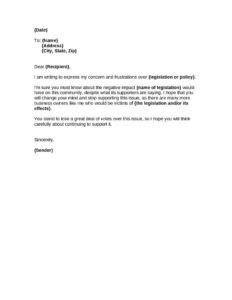
Letter to Legislator Showing Concern
Use our free Letter to Legislator Showing Concern template to voice opposition to a bill or policy and urge your representative to reconsider. Free download.
DOCX
0
likes
Download Files
- DOCX
A Letter to Legislator Showing Concern is a formal written message sent to an elected representative to express opposition or worry about a specific piece of legislation, policy, or pending decision. People most often use it to make their voice heard when a proposed law could negatively affect their business, family, or community. This template is free to download in editable PDF and DOCX formats, with no signup required.
What Is a Letter to Legislator Showing Concern?
A Letter to Legislator Showing Concern is a piece of constituent correspondence that documents your personal objection to a bill, regulation, or political stance and asks your representative to reconsider their position. It is typically written by an individual citizen, small business owner, or community member and addressed to a senator, assembly member, council representative, or other elected official. The letter records who you are, what issue concerns you, why it matters, and what action you want the legislator to take. Unlike a petition or a mass-form email, a personalized letter carries more weight because it shows a real constituent took the time to write. It serves as both a persuasive appeal and a paper record of public sentiment on the issue.
When Do You Need a Letter to Legislator Showing Concern?
This letter is useful any time you want to influence a public official before they vote, sign, or publicly back a measure. Common situations include:
- A proposed bill or regulation that would raise costs or burdens on your small business or industry.
- A local ordinance or zoning change that would harm your neighborhood or property values.
- A tax, fee, or budget proposal you believe will hurt working families or local employers.
- An environmental, health, or safety policy you feel was rushed without community input.
- A vote scheduled soon where you want your representative to know how their decision affects their constituents.
- Follow-up after a town hall or public meeting where you want to put your concerns in writing for the record.
What a Letter to Legislator Showing Concern Should Have
To be effective and credible, your letter should clearly identify the legislator by name and correct title, state the exact bill number or policy you are addressing, and explain your personal stake in the outcome. It should describe the specific harm you anticipate, remain respectful even while firm, and end with a clear request — usually asking the official to vote against or stop supporting the measure. Including your full name and contact details establishes that you are a real constituent. A dated letter also creates a timestamp that proves you raised the concern before any vote took place.
How to Fill Out a Letter to Legislator Showing Concern
- Enter the Date at the top so there is a clear record of when you raised the issue.
- In the To: Name field, write the legislator’s full name and proper title (for example, “The Honorable Jane Doe”).
- Complete the Address and City, State, Zip lines with the official’s district or capitol office address.
- Use the Dear {Recipient} salutation, addressing them formally — “Dear Senator Doe” or “Dear Assemblymember Doe.”
- Replace {legislation or policy} with the specific bill name or number you are concerned about.
- In the {name of legislation} placeholder, restate the measure and briefly describe the negative impact you foresee on your community.
- Fill in {the legislation and/or its effects} to explain how you and others like you would be directly harmed.
- Sign off after “Sincerely,” and enter your full name in the {Sender} field, adding your address or phone number so the office can verify you are a constituent.
Tips for Making Your Letter More Persuasive
Legislators and their staff read a high volume of mail, so clarity and brevity help your message land. Keep the letter to one page and lead with the bill number and your position. Replace vague statements with concrete examples — instead of saying a policy is “bad for business,” explain that it would force you to cut staff or raise prices. A respectful, factual tone is far more effective than anger or threats; the template’s reminder about lost votes is a legitimate point to make, but frame it as a genuine reflection of constituent feeling rather than a personal warning. If you can, reference how many other people share your view, since officials weigh how widely an issue resonates in their district.
How This Letter Differs From a Petition or Form Email
A petition gathers many signatures behind a single statement, and a mass form email sends identical text from thousands of senders. Both show breadth of support, but individual letters like this one show depth and authenticity. Legislative offices often tally personalized letters separately because they signal a motivated, engaged constituent who is likely to vote and to talk to neighbors. Sending your own letter — especially one that names the specific bill and your personal stake — typically carries more influence than adding your name to a pre-written campaign. You can use this template as your personal letter while still joining broader advocacy efforts.
Common Mistakes to Avoid
- Leaving placeholder text like {legislation or policy} in the final letter instead of naming the actual bill.
- Writing to the wrong official — confirm which representative actually covers your district and the issue.
- Being vague about the harm; specific, real-world consequences are far more convincing.
- Using a hostile or insulting tone that gives staff a reason to dismiss your message.
- Forgetting to include your full name and address, which makes the office unable to confirm you are a constituent.
- Sending the letter after the vote has already happened — check the legislative calendar and send early.
Frequently Asked Questions
What is a Letter to Legislator Showing Concern used for? It is used to formally tell an elected official that you oppose or are worried about a specific bill, policy, or decision. The letter explains your concerns, describes the impact on you and your community, and asks the legislator to change or reconsider their position before they vote.
How do I fill out the template? Add the date, the legislator’s name, title, and office address, then a formal salutation. Replace each bracketed placeholder with the specific legislation and the real effects you are worried about, then sign with your full name and contact information so the office knows you are a constituent.
Does this letter need to be notarized or witnessed? No. A constituent letter to a legislator is informal correspondence and does not require notarization, witnesses, or any official certification. You simply need to sign it and send it; the goal is to communicate your views, not to create a legal contract.
Is this letter legally binding? No. The letter expresses an opinion and a request — it does not create any legal obligation for the legislator to act in a particular way. Its value is persuasive and political, helping shape how an official understands constituent sentiment.
How much does this template cost? Nothing. You can download the Letter to Legislator Showing Concern free from Business Forms Pro in both PDF and editable DOCX formats, with no signup or payment required.
Should I mail, email, or hand-deliver the letter? Any method can work, but check your representative’s preferred contact channel. Mailed letters create a tangible record, while email is faster and often reaches staff more quickly. Whatever you choose, send it well before any scheduled vote so it can influence the decision.
This template is a general example provided for informational purposes only and is not legal, political, or professional advice. Rules and contact procedures for elected officials vary by jurisdiction and office. For guidance on a specific issue or advocacy strategy, consult a qualified professional or your representative’s office directly.
Related Forms
- Corporate Minutes
- Credit Information Release Authorization
- Entry Form
- Production Goal Sign
- Flow Chart
- Petsitting Instructions
Browse more in Miscellaneous.