
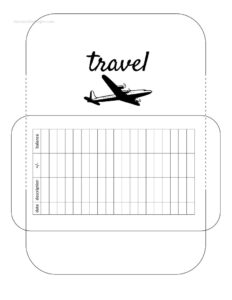
Travel Cash Envelope
Use a free Travel Cash Envelope template to budget and track your trip spending by category, with no signup. Free download in PDF and DOCX.
PDF
DOCX
0
likes
Download Files
- DOCX
A Travel Cash Envelope is a simple budgeting tool that lets you set aside a fixed amount of cash for a specific trip expense and track what you spend as you go. People most often use it to control vacation or business-travel spending without overshooting their budget, and you can download it here for free in PDF and DOCX, with no signup required.
What Is a Travel Cash Envelope?
A Travel Cash Envelope is a labeled paper or printable envelope used to hold and account for cash earmarked for travel costs such as food, transport, lodging extras, or souvenirs. It follows the classic cash-envelope budgeting method: you decide how much each category gets, place that cash inside, and only spend what is in the envelope. The front of the envelope acts as a mini ledger where you record the starting amount, each withdrawal, and the running balance. Travelers, families, students on study trips, and small-business employees on a per-diem all use it to stay disciplined, avoid card surprises, and know exactly how much money remains at any moment during a journey.
When Do You Need a Travel Cash Envelope?
This template fits almost any situation where cash needs a clear home and a paper trail. Common scenarios include:
- Vacation budgeting — splitting a holiday fund into envelopes for meals, activities, and shopping so one category cannot eat the others.
- Daily spending limits — assigning a fixed cash amount per day of a trip to keep an overall budget on track.
- Business travel per-diems — employees tracking meal and incidental allowances to reconcile against an expense report later.
- Family or group trips — giving each traveler or each child their own envelope to manage independently.
- Cash-only destinations — places where cards are rarely accepted and carrying organized cash is essential.
- Emergency funds — keeping a separate sealed envelope for unexpected costs like a missed connection or medical pharmacy run.
Types of Travel Cash Envelopes
Although the template is one design, you can use it several ways. A category envelope holds money for a single type of expense, such as “Food” or “Transport.” A daily envelope holds one day’s total spending allowance. A traveler envelope belongs to one person in a group. Many people print several copies and combine these approaches — for example, one envelope per day with category notes written on the back. The flexible layout means you decide the labels that match how you actually travel.
What a Travel Cash Envelope Should Have
A complete and useful Travel Cash Envelope includes a few core elements: a clear label or category name so you know what the cash is for; a trip name and date range to tie it to a specific journey; a starting amount placed inside; a transaction log with space for the date, description, and amount of each withdrawal; and a running balance so you always see what is left. Adding a total budgeted line and a notes area for reconciliation makes the envelope doubly useful when you return home and review your spending.
How to Fill Out a Travel Cash Envelope
Follow these steps to set up and use your envelope effectively:
- Name the category. Write a clear label such as Food, Transport, Lodging, or Souvenirs on the front so the envelope’s purpose is obvious at a glance.
- Add the trip details. Note the trip name or destination and the travel dates so the envelope is tied to one specific journey.
- Record the starting amount. Count the cash you place inside and write that figure as your opening balance.
- Log each expense. Every time you spend, write the date, a short description, and the amount removed from the envelope.
- Update the running balance. Subtract each expense from the previous balance and write the new total so you always know what remains.
- Add notes if needed. Use any blank space to flag receipts kept, refunds added back, or money moved between envelopes.
- Reconcile at the end. When the trip ends, compare the cash left to your written balance and review the log against your overall budget.
Tips for Getting the Most From the Envelope System
To make cash envelopes work on the road, decide your category amounts before you leave so you are not improvising at the airport. Carry only the envelopes you need each day and leave the rest secured at your accommodation. Keep small bills inside for easier transactions and tipping. When an envelope runs low, resist topping it up from another category without first writing the transfer down — that single habit keeps the whole system honest. Tucking receipts into the envelope makes later expense claims and budget reviews far simpler.
Common Mistakes to Avoid
- Forgetting to log small purchases — coffees, snacks, and tips add up fast and quietly drain the balance.
- Mixing categories — pulling food money for shopping defeats the purpose unless you record the transfer.
- Not setting a realistic starting amount — too little leads to constant card use; too much undermines the discipline.
- Skipping the date range — without trip dates, old envelopes get confused with current spending.
- Carrying every envelope at once — losing one wallet should not cost you the entire trip budget.
- Ignoring reconciliation — never comparing cash left to the written balance means errors and theft go unnoticed.
Frequently Asked Questions
What is a Travel Cash Envelope used for? It is used to hold and track a set amount of cash for a specific travel expense, such as food or transport. By spending only what is inside, you keep your trip budget under control and always know how much money remains.
How do I fill out a Travel Cash Envelope? Label the envelope with a category, add your trip name and dates, and write the starting cash amount. Each time you spend, log the date, description, and amount, then update the running balance so it stays accurate.
Is the cash envelope method good for travel? Many travelers find it effective because physical cash makes spending feel real and visible in a way that cards do not. It also helps in cash-preferred destinations and prevents overspending across categories, though you should still keep cash secure.
Can I use this template for business travel per-diems? Yes. You can label an envelope for meals or incidentals, record your allowance as the starting amount, and log every expense, which makes reconciling against a company expense report much easier when you return.
Is this Travel Cash Envelope template legally binding? No. It is a personal budgeting and tracking tool, not a contract or financial instrument. Its value comes from helping you organize and account for your own cash, not from any legal effect.
How much does this template cost? Nothing — it is completely free to download here in both PDF and DOCX formats with no signup required. You can print as many copies as you need for each category, day, or traveler.
This template is provided as a general example for informational purposes only and does not constitute financial, tax, or accounting advice. Budgeting needs and any employer or per-diem reimbursement rules vary, so consult a qualified professional or your organization’s policy where appropriate.
Official resource: for the rules that apply to your situation, see the Consumer Financial Protection Bureau.
Related Forms
- Debit Register Wallet
- Date Night Cash Envelope
- Balance Sheet
- Monthly Receipts List
- Automatic Payment Dates Tracker
- Accounts Receivable Aging
Browse more in Money.