
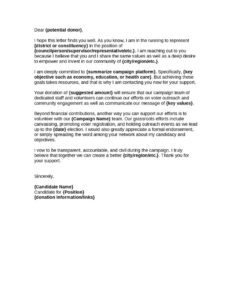
Campaign Donation Request Letter
Use our free Campaign Donation Request Letter template to ask supporters for contributions with a clear, persuasive appeal — free download in PDF and DOCX.
DOCX
3 downloads
0
likes
Download Files
- DOCX
A Campaign Donation Request Letter is a written appeal sent by a political campaign, committee, or candidate asking supporters to contribute money to fund campaign activities. The most common reason people use it is to launch or sustain a fundraising drive with a clear, personal ask that motivates recipients to give. You can download this template free in both PDF and DOCX formats — no signup required.
What Is a Campaign Donation Request Letter?
A Campaign Donation Request Letter is a fundraising communication issued by a candidate, campaign manager, finance director, or volunteer coordinator on behalf of a political effort. It documents a specific request for financial support, explaining who is asking, why the funds are needed, how much is being requested, and how the recipient can give. The letter combines a personal narrative with a concrete call to action, and it typically references the campaign’s goals, deadlines, and any legal disclosures required for political fundraising. Whether mailed on letterhead, emailed, or handed out at events, the letter serves as the formal touchpoint that turns a supporter’s goodwill into a measurable contribution.
When Do You Need a Campaign Donation Request Letter?
This letter is useful at nearly every stage of a campaign’s fundraising cycle. Common scenarios include:
- Launching a campaign — when a candidate announces and needs seed money for staff, signage, and outreach.
- Hitting a fundraising deadline — end-of-quarter or pre-election pushes when reported totals matter publicly.
- Funding a specific need — a targeted ask for a mailer, a digital ad buy, or a get-out-the-vote operation.
- Re-engaging past donors — reaching out to people who gave in a prior cycle to renew their support.
- Hosting a fundraising event — inviting supporters to a dinner or reception and requesting a contribution or ticket purchase.
- Matching-gift challenges — when a donor pledges to match contributions and you want to maximize the window.
What a Campaign Donation Request Letter Should Have
An effective letter balances persuasion with the practical details a supporter needs to act. Key elements include a clear sender identification (candidate or committee name), a dated greeting addressed to the recipient, a compelling opening that states the purpose, a short story or message explaining what’s at stake, a specific dollar ask or suggested giving levels, and an explicit deadline. It should also provide easy ways to donate — a website link, a return envelope, a phone number, or a QR code — along with a sincere thank-you and a signature. Because political contributions are regulated, the letter should also include any required disclaimers, such as who paid for the communication and applicable contribution limits or eligibility statements where relevant.
How to Fill Out a Campaign Donation Request Letter
Work through the template section by section so nothing important is left out:
- Date and sender details: Add the date and your campaign or committee name, address, and contact information at the top.
- Recipient name and salutation: Personalize the greeting with the supporter’s name rather than a generic “Dear Friend” whenever possible.
- Opening hook: State immediately why you’re writing — the race, the cause, and the urgency.
- The message: Tell a short, authentic story about the candidate’s mission and what the funds will accomplish.
- The specific ask: Name a dollar amount or list suggested giving levels (for example $25, $50, $100, $250).
- Deadline and impact: Tie the request to a date and explain what each gift level makes possible.
- How to give: Provide the donation URL, mailing instructions, and any enclosed reply card.
- Disclosures: Insert the required “Paid for by” line and any contribution-eligibility language.
- Closing and signature: Thank the reader, sign with the candidate’s or director’s name, and consider a handwritten postscript for warmth.
Tips for Writing an Appeal That Converts
The strongest donation letters feel personal, not mass-produced. Lead with emotion and a clear stake, then make the ask early — many readers skim, so don’t bury the request in the final paragraph. Use specific giving levels because they nudge recipients toward a concrete decision and often raise average gift size. A short, well-placed postscript is one of the most-read parts of any direct-mail letter, so use it to restate the deadline or the matching-gift opportunity. Finally, make donating effortless: include multiple giving channels and double-check that every link, QR code, and reply envelope works before the letter goes out.
Legal and Compliance Notes
Political fundraising is governed by federal, state, and local rules, and requirements vary widely depending on the office sought and where the campaign operates. Many jurisdictions require disclaimer language identifying who paid for the communication, and some impose contribution limits, donor-eligibility rules (such as restrictions on contributions from corporations or foreign nationals), and reporting obligations. Keep accurate records of every gift, including donor name, address, occupation, and employer where required. This template provides general fundraising language only and does not include jurisdiction-specific disclaimers, so confirm the exact requirements with your campaign’s compliance officer or election authority before distributing.
Common Mistakes to Avoid
- Burying the ask — failing to request a specific dollar amount early and clearly.
- Omitting required disclaimers — leaving out the “Paid for by” line or eligibility language your jurisdiction mandates.
- No deadline — without urgency, supporters set the letter aside and forget.
- Broken or missing donation links — making it hard to give kills conversions.
- Generic salutations — impersonal greetings reduce response rates dramatically.
- Forgetting to thank donors — skipping gratitude damages long-term donor relationships.
Frequently Asked Questions
What is a Campaign Donation Request Letter? It is a written appeal from a political campaign or committee asking supporters to contribute money. The letter explains who is asking, why the funds are needed, how much is requested, and how to give, combining a persuasive message with a clear call to action.
How do I fill out the template? Start by adding the date, your committee details, and the recipient’s name, then write a personal message explaining your cause. Add a specific dollar ask, a deadline, instructions for how to donate, any required disclaimers, and a signature with an optional postscript.
Do I need to include a legal disclaimer? Many jurisdictions require political communications to state who paid for them and may impose other disclosures. Because rules vary by location and office, confirm the exact disclaimer language with your campaign’s compliance officer or local election authority before sending.
How much should I ask donors to give? There is no single right amount — most campaigns list suggested giving levels such as $25, $50, $100, and $250 to guide the reader toward a decision. Tailor the levels to your audience and tie each amount to a concrete impact when possible.
Is this letter legally binding? No. A donation request letter is an appeal, not a contract, and it does not obligate anyone to contribute. The legal obligations in political fundraising relate to disclosure, contribution limits, and reporting rather than to the letter itself.
Is this template really free? Yes. You can download the Campaign Donation Request Letter free in both PDF and DOCX formats with no signup required, then customize the wording, giving levels, and disclaimers to match your campaign.
This template is a general example provided for informational purposes only and is not legal, financial, or campaign-finance advice. Political fundraising requirements vary by jurisdiction and office. Consult a qualified election-law attorney or your campaign’s compliance professional before distributing any donation request.
Related Forms
- Campaign Endorsement Request Letter
- Speaking Events Tracker
- Fundraising Budget
- Election Contributions Form
- Support Outreach Hours
- Opinion Poll
Browse more in Political.