
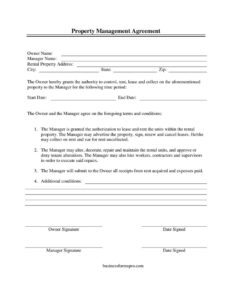
Property Management Agreement
Download a free Property Management Agreement template in PDF or DOCX to grant a manager authority to lease, maintain, and collect rent on your property.
PDF
DOCX
0
likes
Download Files
- DOCX
A Property Management Agreement is a contract in which a property owner authorizes a manager to control, rent, lease, and collect rent on a specified rental property. People most often use it to formally hand off the day-to-day operation of a rental to a professional manager or trusted individual while keeping clear records of money collected and spent. You can download this template free in PDF or DOCX — no signup required.
What Is a Property Management Agreement?
A Property Management Agreement is a written contract between a property owner and a manager that defines exactly what authority the manager holds over a rental property. It is typically issued by the owner and signed by both parties to confirm the manager may advertise units, sign and cancel leases, collect rent, and arrange repairs on the owner’s behalf. The agreement documents the scope of the manager’s powers, the time period during which those powers apply, and the manager’s obligation to report income and expenses back to the owner. By putting these terms in writing, both sides reduce misunderstandings and create a reference point if a dispute about money, maintenance, or authority ever arises.
When Do You Need a Property Management Agreement?
This agreement is useful any time an owner wants someone else handling a rental property. Common situations include:
- An owner hires a professional property management company to run a multi-unit building.
- An out-of-state or absentee landlord needs a local manager to handle tenants and repairs.
- A family member or trusted associate is asked to oversee a rental while the owner travels or relocates.
- An owner of several units wants one person authorized to advertise, lease, and renew leases consistently.
- A property requires ongoing maintenance and the owner wants the manager empowered to hire contractors.
- An owner wants a clear paper trail of collected rent and paid expenses for accounting or tax records.
What a Property Management Agreement Should Have
A complete agreement clearly names both parties and the exact property, then spells out the manager’s powers and limits. Key elements include the full legal names of the owner and manager, the rental property address (with city, state, and ZIP), and a defined term with start and end dates. It should describe the leasing authority granted — advertising, signing, renewing, and canceling leases — along with rent collection rights, including the ability to pursue uncollected rent. It should also cover maintenance authority, the power to hire workers and contractors, and the manager’s duty to submit receipts for all rent received and expenses paid. Finally, it needs a space for additional conditions and signature lines with dates for both parties.
How to Fill Out a Property Management Agreement
- Enter the Owner Name — the full legal name of the person or entity that owns the property.
- Enter the Manager Name — the individual or company being granted authority.
- Fill in the Rental Property Address, followed by City, State, and Zip so the property is unambiguous.
- Set the term by entering the Start Date and End Date during which the manager holds authority.
- Review the listed powers: leasing and renting units, advertising, signing, renewing and canceling leases, collecting rent and suing for unpaid rent, and altering, repairing, and maintaining the units.
- Confirm the manager understands the authority to hire workers, contractors, and supervisors for repairs, and to approve or deny tenant alterations.
- Note the reporting requirement: the manager must submit all rent receipts and expense records to the owner.
- Use the Additional conditions section to add management fees, payment schedules, reporting frequency, or any limits.
- Both parties sign and date the Owner Signature and Manager Signature lines.
Setting Fees and Reporting Expectations
The base template grants broad authority but leaves the financial relationship to the Additional conditions section, so this is where careful detail pays off. Spell out how the manager is compensated — a flat monthly fee, a percentage of collected rent, or a combination — and when payment is due. Define how often the manager must deliver receipts and statements, whether monthly, quarterly, or after each transaction, and how rent funds are held and transferred to the owner. You may also want to set a spending threshold above which the manager must get the owner’s approval before authorizing a repair. Clear money terms prevent the most common friction between owners and managers and make end-of-year accounting far simpler.
How This Differs From a Power of Attorney
A Property Management Agreement is a service contract tied to a specific property and a defined time period, granting authority limited to leasing, collecting rent, and maintaining the units. A general power of attorney, by contrast, can grant much broader legal authority over an owner’s affairs. If your situation requires the manager to sign documents that bind you legally beyond ordinary property operations — such as selling the property — a separate, properly executed instrument is usually needed. Keep this agreement focused on management duties and consult a professional when broader powers are involved.
Common Mistakes to Avoid
- Leaving the property address incomplete — always include city, state, and ZIP to identify the exact property.
- Forgetting to set an End Date, which can leave the manager’s authority open-ended.
- Omitting the management fee and payment terms from the Additional conditions section.
- Failing to specify how often the manager reports rent and expenses to the owner.
- Not defining a spending limit for repairs that require the owner’s prior approval.
- Signing without both dates filled in, which can create confusion about when the term actually began.
Frequently Asked Questions
What is a Property Management Agreement used for? It is used to authorize a manager to operate a rental property on the owner’s behalf — including advertising, leasing, collecting rent, and arranging repairs. It documents the scope of that authority and the manager’s duty to report income and expenses. This keeps both parties aligned on responsibilities and money.
How do I fill out a Property Management Agreement? Enter the owner and manager names, the full property address, and the start and end dates of the management term. Review the granted powers, add any fees or limits in the Additional conditions section, and have both parties sign and date the form. Filling in every blank avoids ambiguity later.
Does a Property Management Agreement need to be notarized? Notarization is not always required for a management contract, but requirements vary by state and by the policies of the parties involved. Some owners and managers choose to notarize signatures for added assurance. Check your local rules and consider notarizing if you want extra protection.
Is this agreement legally binding? When both the owner and manager sign and date the agreement and the terms are lawful, it generally creates a binding contract. Including clear, complete terms strengthens its enforceability. As with any contract, having a professional review it before signing is wise.
Can the manager really collect rent and sue for unpaid rent? This template grants the manager authority to collect rent and pursue uncollected rent, but the actual ability to file suit may depend on state landlord-tenant and licensing laws. You can narrow or expand these powers in the Additional conditions section. Verify what your jurisdiction allows before relying on this authority.
How much does this template cost? This Property Management Agreement template is completely free to download from Business Forms Pro in both PDF and DOCX formats. There is no signup required. You can edit the DOCX version to add your own fees, reporting schedule, and conditions.
This template is a general example provided for informational purposes only and is not legal, financial, or tax advice. Property management laws and licensing requirements vary by jurisdiction. Consult a qualified attorney or professional before finalizing any agreement.
Official resource: for the rules that apply to your situation, see HUD.
Related Forms
- Intent To Vacate Apartment
- Complaint Letter Against Tenant
- Closed Sales Tracker
- Inspection Checklist
- Real Estate Needs Wants Checklist
- Real Estate Listing Tracker
Browse more in Rental and Real Estate.