
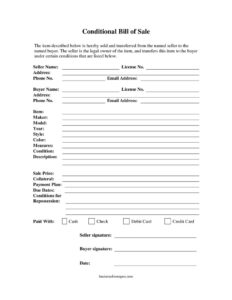
Conditional Bill Of Sale
Download a free Conditional Bill of Sale template in PDF and DOCX to document a sale with payment terms, conditions, and repossession rights.
PDF
DOCX
8 downloads
0
likes
Download Files
- DOCX
A Conditional Bill of Sale is a document that transfers ownership of an item from a seller to a buyer subject to specific conditions, most often the completion of payments under an agreed plan. People use it most commonly when selling an item on installments and the seller wants the right to repossess it if the buyer defaults. You can download this template free in both PDF and DOCX formats, with no signup required.
What Is a Conditional Bill of Sale?
A Conditional Bill of Sale is a written record of a sale in which the transfer of full ownership depends on the buyer meeting one or more stated conditions — typically paying the full purchase price over time. It is issued and signed by the seller (the legal owner of the item) and accepted by the buyer. Unlike an outright bill of sale, which transfers ownership immediately and unconditionally, this version documents both the transfer and the strings attached to it. The form records the item’s full description, the agreed sale price, the payment method and schedule, any collateral, and the precise conditions under which the seller may reclaim the item if the buyer fails to perform.
When Do You Need a Conditional Bill of Sale?
This form fits any private sale where the buyer is not paying the entire amount up front and the seller wants protection until they do. Common scenarios include:
- Selling a used vehicle, trailer, or motorcycle on a monthly payment plan rather than a single lump sum.
- Transferring equipment, machinery, or tools to a buyer who will pay in scheduled installments.
- Selling furniture, electronics, or appliances to a buyer paying part now and the balance later.
- Private financing arrangements where the seller acts as the lender and retains the right to repossess on default.
- Selling livestock, instruments, or other valuable property where collateral or repossession terms protect the seller.
- Any deal where both parties want a clear, signed record of the price, the payment due dates, and what happens if a payment is missed.
What a Conditional Bill of Sale Should Have
A complete Conditional Bill of Sale leaves no room for confusion about who owns what and when. The essential elements are the full legal names and contact details of both the seller and the buyer, a detailed description of the item being sold, the total sale price, the payment method and plan, and the specific conditions tied to the transfer. Crucially, it should spell out the due dates for installment payments and the exact circumstances under which the seller may repossess the item. Any collateral securing the deal should be named. Dated signatures from both parties turn the document into a binding record of the agreement.
How to Fill Out a Conditional Bill of Sale
- Date: Enter the date the sale agreement is being signed.
- Seller Name and Buyer Name: Write the full legal names of both parties exactly as they appear on official identification.
- Contact details: Record the seller’s or buyer’s Address, Phone No., and Email Address so the parties can reach each other.
- Item and Description: Name the Item and give a detailed Description, including identifiers such as Maker, Model, Year, Style, Color, Measures, and License No. where applicable.
- Condition: Note the current physical Condition of the item (new, used, fair, etc.).
- Sale Price: Enter the total agreed price.
- Paid With: Indicate the payment method — Cash, Check, Credit Card, or Debit Card.
- Payment Plan and Due Dates: Lay out the installment amounts and the Due Dates for each payment.
- Collateral and Conditions for Repossession: List any Collateral and state the exact Conditions for Repossession.
- Signatures: Both parties add the Seller Signature and Buyer Signature to finalize the document.
How It Differs From a Standard Bill of Sale
A standard bill of sale records an immediate, unconditional transfer: the buyer pays, the seller hands over the item, and ownership passes completely. A Conditional Bill of Sale, by contrast, keeps conditions attached to the transaction. The buyer takes possession but the seller retains rights — usually the ability to repossess — until the buyer satisfies the agreed conditions, most often paying off the full balance. This makes the conditional version the right choice for installment or seller-financed deals. Once the buyer meets every condition, many parties follow up with a simple written acknowledgment that all terms have been fulfilled and ownership is now unconditional, giving the buyer a clean record of clear title.
Tips for a Smooth Transaction
Be specific in the Conditions for Repossession section: state how many missed payments trigger repossession, how much notice the seller must give, and how the item will be returned. Match the Payment Plan and Due Dates precisely so there is no dispute about amounts or timing. Keep receipts or notes for each payment as the buyer pays it down. Both parties should keep a signed copy. For higher-value items such as vehicles, check whether your local titling office requires additional paperwork to register the lien or to complete the title transfer once payments finish.
Common Mistakes to Avoid
- Leaving the Conditions for Repossession blank or vague, which defeats the purpose of a conditional sale.
- Failing to specify exact Due Dates or installment amounts in the Payment Plan.
- Omitting key identifiers like Model, Year, License No., or serial details that distinguish the item.
- Not recording the Paid With method, leaving ambiguity about how payments are made.
- Forgetting one of the signatures — both the Seller Signature and Buyer Signature are needed.
- Not keeping copies for both parties or failing to track each payment against the balance.
Frequently Asked Questions
What is a Conditional Bill of Sale used for? It documents the sale of an item under specific conditions, most commonly when the buyer pays in installments rather than all at once. The seller retains certain rights, such as repossession, until the buyer meets the agreed conditions. It protects both sides by putting the price, payment plan, and terms in writing.
How is it different from a regular bill of sale? A regular bill of sale transfers ownership immediately and unconditionally once payment is made. A Conditional Bill of Sale attaches conditions — usually full payment — that the buyer must satisfy before the transfer becomes final. Until then, the seller keeps defined rights over the item.
Is a Conditional Bill of Sale legally binding? When both parties sign it voluntarily and the terms are clear, it generally serves as a binding record of their agreement. Its enforceability depends on local laws and how completely the conditions are stated. For high-value or financed deals, some jurisdictions have additional requirements worth checking.
Does it need to be notarized or witnessed? Notarization is not always required, but it can add credibility and make the document easier to enforce if a dispute arises. Some buyers and sellers choose to sign before a notary or witnesses for added protection. Check your local rules, especially for vehicles or other titled property.
What happens if the buyer stops paying? The Conditions for Repossession section should describe exactly what occurs on default, such as how many missed payments allow the seller to reclaim the item and what notice is required. Spelling this out clearly in advance prevents misunderstandings. Following the stated process helps both parties handle a default fairly.
How much does this template cost? This Conditional Bill of Sale template is completely free to download from Business Forms Pro in both PDF and DOCX formats. There is no signup or payment required. You can fill it out on your computer or print and complete it by hand.
This template is a general example provided for informational purposes only and does not constitute legal, financial, or tax advice. Requirements for conditional sales, liens, and repossession vary by jurisdiction. Consult a qualified professional to ensure your document meets the rules that apply to your situation.
Official resource: for the rules that apply to your situation, see your state DMV.
Related Forms
- Large-Print Bill of Sale
- Salvage Bill Of Sale
- Dry Cleaning Ticket
- Jewelry Bill of Sale
- Business Bill of Sale
- Artwork Bill Of Sale
Browse more in Bills of Sale.