
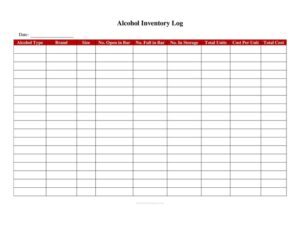
Alcohol Inventory Log
Track liquor, wine, and beer stock accurately with our free Alcohol Inventory Log template, available as a free download in PDF and DOCX formats.
PDF
DOC
4 downloads
0
likes
Download Files
- DOC
An Alcohol Inventory Log is a tracking sheet bars, restaurants, and hotels use to count and record their stock of liquor, wine, and beer over a given period. The most common reason people use one is to know exactly how much alcohol they have on hand, catch shrinkage, and control beverage costs. It’s free to download here in both PDF and DOCX formats — no signup required.
What Is an Alcohol Inventory Log?
An Alcohol Inventory Log is a structured document that records the quantity of each alcoholic product a venue holds at a specific point in time. It is typically completed by a bar manager, beverage director, or trained staff member during regular stock counts. The log documents opening counts, products received, products used or sold, and closing counts for each item. Restaurants, nightclubs, hotels, and catering operations rely on it to reconcile what was purchased against what was sold, to value inventory for accounting, and to flag theft, over-pouring, or spoilage. In short, it turns a chaotic back-bar into a measurable, manageable asset that supports better purchasing and pricing decisions.
When Do You Need an Alcohol Inventory Log?
Most establishments count on a fixed schedule, but several situations make an Alcohol Inventory Log especially important:
- End-of-month or weekly stock counts — to value inventory and calculate beverage cost percentage for the period.
- Before placing supplier orders — so you reorder based on real par levels instead of guesswork.
- Shift changes or manager handovers — to confirm what is on hand when responsibility passes from one person to another.
- Investigating shrinkage — when pour costs spike, a detailed log helps pinpoint where bottles are disappearing.
- Annual accounting and tax preparation — when your bookkeeper needs an accurate dollar value for closing stock.
- Liquor license audits or compliance checks — when a regulator or owner wants documented control over alcohol movement.
Types of Items to Track
A complete log usually separates products into logical groups so counting stays fast and consistent. Common categories include spirits (vodka, whiskey, gin, rum, tequila, brandy), wine (red, white, sparkling, dessert), beer (bottles, cans, kegs), and mixers and specialty items (liqueurs, bitters, vermouth). Grouping items the same way every count reduces errors and makes period-over-period comparisons meaningful.
What an Alcohol Inventory Log Should Have
A useful log captures enough detail to reconcile usage without becoming tedious to complete. Key elements include the counting date and the staff member responsible, a clear product name and category, the unit or bottle size, the opening quantity, amounts received during the period, amounts used or sold, the closing count, and the unit cost so you can calculate total value. A notes column for damaged, expired, or comped items keeps the numbers honest. A signature or initials line adds accountability for each count.
How to Fill Out an Alcohol Inventory Log
- Header details: Enter the venue name, the inventory date, and the name of the person performing the count.
- Category: Record the product group — spirits, wine, beer, or mixers — so similar items stay together.
- Product name: Write the brand and type, for example “Tito’s Vodka” or “Cabernet Sauvignon,” being specific enough to avoid confusion.
- Unit size: Note the bottle, can, or keg size (e.g., 750ml, 1L, 12oz, half-barrel).
- Opening count: Enter the quantity on hand at the start of the period, usually the prior closing count.
- Received: Add deliveries logged during the period from supplier invoices.
- Used/sold: Record amounts depleted through service, or leave for system calculation.
- Closing count: Enter the physical count taken today, counting full and partial bottles.
- Unit cost and total value: List cost per unit and multiply by closing count for the dollar value.
- Notes and sign-off: Flag any breakage or expiry, then initial to confirm the count is complete.
Tips for Accurate Counting
Consistency is everything. Count partial bottles the same way each time — many bars estimate to the nearest tenth using a sight count or a scale for precision. Always count in the same order and location, working shelf by shelf so nothing is missed or double-counted. Schedule counts at the same time, ideally after close and before any deliveries, so the snapshot is clean. If two people share the task, have one count and one record to reduce errors. Keep completed logs on file; comparing several periods reveals trends in usage, seasonal swings, and slow-moving stock that ties up cash.
Why It Matters for Cost Control
Alcohol is one of the highest-margin and highest-risk categories in any food-and-beverage operation. A reliable inventory log lets you calculate your pour cost — the ratio of cost of goods to alcohol sales — and compare it to your target. When the actual usage from the log diverges from what your point-of-sale reports as sold, the gap signals over-pouring, unrecorded sales, spillage, or theft. Catching that gap early protects margins far more effectively than raising menu prices.
Common Mistakes to Avoid
- Inconsistent partial-bottle estimates — guessing differently each count makes your numbers meaningless over time.
- Counting during service or after deliveries — moving stock skews the snapshot and corrupts reconciliation.
- Vague product names — “whiskey” instead of the specific brand makes matching to invoices impossible.
- Forgetting to log received deliveries — missing received quantities will overstate your apparent usage.
- Skipping the notes column — unrecorded breakage and comps look like shrinkage and trigger false alarms.
- Not having a sign-off — without accountability, errors are hard to trace back to a count.
Frequently Asked Questions
What is an Alcohol Inventory Log used for? It is used to record how much liquor, wine, and beer a venue has on hand at a given time. Bars and restaurants use it to value stock, reconcile purchases against sales, control pour costs, and detect shrinkage. It also supports ordering decisions and accounting at period close.
How often should I count alcohol inventory? Most operations count at least monthly to close their books, while busy bars count weekly or even daily for high-theft items. The right frequency depends on your volume, staff turnover, and how tightly you need to manage costs. Counting consistently on the same schedule is more valuable than counting often but irregularly.
How do I count partial bottles accurately? Many venues use a tenths method, estimating each open bottle as a fraction of full by sight, while others weigh bottles on a scale for precision. Whatever method you choose, apply it the same way every count so your figures stay comparable. Consistency matters more than perfect accuracy on any single bottle.
Is this Alcohol Inventory Log template free? Yes. You can download it free here in both PDF and DOCX formats with no signup or account required. The DOCX version is fully editable, so you can add your own product categories, columns, or branding to match your operation.
Can I use this log to calculate pour cost? Yes. By recording opening counts, deliveries, and closing counts along with unit costs, you can determine the value of alcohol used in a period. Dividing that cost by your alcohol sales gives your pour cost percentage, which you can compare against your target to spot problems.
Does an Alcohol Inventory Log need to be signed? A signature or initials is not legally required, but it is a strong best practice. Having the counter sign off creates accountability and makes it easier to follow up on discrepancies later. Many managers also keep a second reviewer line for added oversight.
This Alcohol Inventory Log template is provided as a general example for informational purposes only and does not constitute legal, financial, tax, or regulatory advice. Inventory, accounting, and alcohol licensing requirements vary by jurisdiction — consult a qualified professional or your local regulatory authority to ensure compliance.
Related Forms
- Daily Sales Report
- Food Charity Donation Log
- Ingredient Usage Report
- Pick Up Here Sign
- Food Cooling Log
- Cafe Menu
Browse more in Restaurant.