
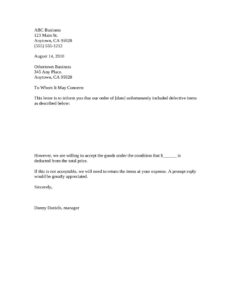
Acceptance Of Defective Goods letter
Download a free Acceptance of Defective Goods letter template in PDF and DOCX to formally accept faulty shipments while reserving your rights and remedies.
DOCX
53 downloads
0
likes
Download Files
- DOCX
An Acceptance of Defective Goods letter is a written notice a buyer sends to a seller confirming that a shipment contained defective or nonconforming items, and stating whether the buyer will keep, return, or accept the goods on specific conditions. People most often use it to document that they noticed the defect, to preserve their right to a remedy, and to put the seller on notice in writing. You can download this letter free in PDF and DOCX, with no signup required.
What Is an Acceptance of Defective Goods Letter?
An Acceptance of Defective Goods letter is a formal business document, usually issued by a buyer or purchasing department, that records receipt of goods that fail to meet the agreed specifications. It identifies the order, describes the defect, and explains how the buyer intends to proceed — for example, accepting the goods at a reduced price, accepting them while reserving the right to claim damages, or accepting some units and rejecting others. The letter creates a paper trail showing that the buyer inspected the delivery promptly and communicated the problem. This protects the buyer’s contractual rights and gives the seller a clear, dated record of the complaint so the issue can be resolved without dispute.
When Do You Need an Acceptance of Defective Goods Letter?
This letter is useful any time you receive a delivery that does not fully match what you ordered but you choose not to reject it outright. Common situations include:
- A shipment arrives with cosmetic damage, but the items are still usable and you want to keep them at a negotiated discount.
- Some units in a bulk order are defective and you accept the conforming portion while documenting the rest.
- You receive equipment or materials that fall short of specification but you need them immediately to avoid project delays.
- You want to accept goods now but explicitly reserve the right to seek repair, replacement, or compensation later.
- A supplier ships an early or partial order with quality issues and you need a written record before payment is processed.
- Your accounts payable or quality control team requires formal documentation before approving an invoice on flawed goods.
Types of Acceptance You Can Document
Not every acceptance is the same, and the letter should make your intent clear. A conditional acceptance keeps the goods but ties acceptance to a price reduction, credit, or future correction. A partial acceptance keeps only the conforming units and rejects the defective ones. A full acceptance with reservation of rights takes all the goods while preserving your claim to damages or remedies under the contract. Stating which type applies prevents the seller from later arguing that you waived your rights simply by keeping the shipment.
What an Acceptance of Defective Goods Letter Should Have
A complete and effective letter generally includes:
- The date of the letter and the date the goods were received.
- Buyer and seller names, addresses, and contact details.
- The purchase order, invoice, or contract reference number.
- A clear description of the goods and the quantity involved.
- A specific description of the defect or nonconformity.
- A statement of how you are accepting the goods (conditional, partial, or with reservation of rights).
- Any remedy you expect — discount, credit, replacement, or repair.
- A deadline for the seller to respond and a signature.
How to Fill Out an Acceptance of Defective Goods Letter
- Enter the date you are writing the letter at the top.
- Add the seller’s name and address, including the contact person or department handling the order.
- Insert your own buyer name, company, and address as the sender.
- Reference the relevant purchase order, invoice, or contract number so the seller can locate the transaction quickly.
- State the date the goods were delivered and identify the items by name, model, or SKU and quantity.
- Describe the defect or nonconformity in concrete, factual terms — what was wrong, how many units were affected, and how it differs from the agreed specification.
- Specify your acceptance terms: whether you accept all or part of the goods and on what conditions.
- Clearly reserve your rights to any remedy such as a price adjustment, credit, replacement, or claim for damages.
- Set a reasonable response deadline and explain the next step if the seller does not reply.
- Close with your name, title, and signature, and keep a copy for your records.
Reserving Your Rights and Keeping a Record
The single most important function of this letter is to show that you accepted the goods without waiving your right to a remedy. Sales law in many jurisdictions distinguishes between accepting goods and accepting them as fully conforming; if a buyer keeps defective goods without objection, a seller may later argue the buyer waived the defect. Stating your reservation of rights in writing, with the defect described and dated, helps avoid that outcome. Send the letter through a method that produces proof of delivery, such as tracked mail or email with a read receipt, and file a copy alongside the purchase order, the delivery note, and any photographs of the defect.
How It Differs From a Rejection Letter
An Acceptance of Defective Goods letter keeps the goods, while a rejection letter refuses them and asks the seller to take them back. Use acceptance when the goods still have value to you or you cannot afford the delay of returning them; use rejection when the defect makes the goods unusable or when your contract gives you a clean right to refuse nonconforming delivery. The two documents can also work together — for instance, accepting part of a shipment while rejecting the defective remainder.
Common Mistakes to Avoid
- Waiting too long to send the letter — prompt notice after inspection is usually expected.
- Describing the defect vaguely instead of stating exactly what is wrong and how many units are affected.
- Forgetting to reserve your rights, which can be read as full, unconditional acceptance.
- Leaving out the purchase order or invoice number, making it hard to tie the complaint to the order.
- Failing to state the remedy you want, so the seller has nothing concrete to respond to.
- Not keeping a dated copy or proof that the letter was sent and received.
Frequently Asked Questions
What is an Acceptance of Defective Goods letter? It is a written notice from a buyer to a seller confirming that delivered goods were defective or nonconforming, and stating how the buyer will proceed. It documents the problem while typically reserving the buyer’s right to a remedy such as a discount, replacement, or credit.
How do I fill out the letter? Enter the date, the seller and buyer details, and the order or invoice number, then describe the goods and the specific defect. State whether you accept all or part of the shipment and on what terms, reserve your rights, set a response deadline, and sign it.
Does this letter need to be notarized or witnessed? No. An Acceptance of Defective Goods letter is ordinary business correspondence and does not generally require notarization or witnesses. What matters is that it is clear, dated, signed, and sent in a way that creates proof of delivery.
Is the letter legally binding? It is a formal communication that can carry legal weight as evidence of notice and of the terms on which you accepted the goods. Whether it creates binding obligations depends on your contract and local sales law, so word it carefully and reserve your rights.
Should I send it before or after paying the invoice? Ideally send it as soon as you discover the defect and before final payment is approved, so the issue is on record and any agreed credit or discount can be applied. If you have already paid, send it promptly anyway to preserve your claim.
How much does this template cost? Nothing. You can download the Acceptance of Defective Goods letter free from Business Forms Pro in both PDF and DOCX formats, with no signup required, and edit it to fit your order and the specific defect.
This template is a general example provided for informational purposes only and is not legal, financial, or tax advice. Sales and contract requirements vary by jurisdiction and by the terms of your agreement. Consult a qualified professional before relying on this letter for an important transaction.
Need to work out sales tax? Use our free Sales Tax Calculator to add or remove sales tax from any amount in seconds.
Official resource: for the rules that apply to your situation, see the U.S. Small Business Administration.
Related Forms
- Gift Certificate Log
- Authorization To Return Merchandise
- Vendor Performance Warning Letter
- Proposal Form
- Sales Projection
- Price Quote Request Form
Browse more in Sales.