
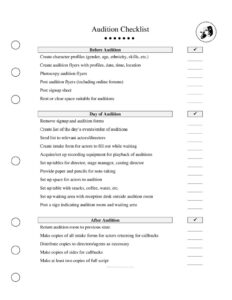
Audition Checklist
Stay organized for casting with this free Audition Checklist template, covering before, during, and after the audition — free download in PDF and DOCX.
PDF
DOC
7 downloads
0
likes
Download Files
- DOC
An Audition Checklist is a planning tool that walks a director, stage manager, or casting team through every task needed to run a smooth audition — from posting flyers to scheduling callbacks. People most often use it to make sure nothing is forgotten on a hectic casting day, so actors are seen on time and decisions are captured cleanly. You can download this checklist free in PDF and DOCX, with no signup required.
What Is an Audition Checklist?
An Audition Checklist is a structured to-do list used by theater companies, film projects, schools, and community productions to organize the casting process. It is typically created and managed by a stage manager, casting director, or production assistant, and it documents the logistical and creative steps required before, during, and after auditions. Rather than relying on memory, the checklist breaks the process into phases — preparation, the audition day itself, and post-audition follow-up — and assigns concrete tasks to each. It ensures that flyers go out, space is booked, intake forms are ready, recording equipment works, and callback materials are prepared. In short, it turns a chaotic, deadline-driven activity into a repeatable system the whole team can follow.
When Do You Need an Audition Checklist?
This checklist is useful any time you are responsible for organizing casting, whether for a single show or an ongoing season. Common scenarios include:
- Staging a new theatrical production and needing to cast multiple roles across several days of open and invited auditions.
- Running a school or university drama program where students try out for parts and you must manage flyers, signups, and waiting areas.
- Casting a short film or web series that requires recorded auditions for later playback by directors and producers.
- Hosting open-call auditions for a community theater group where dozens of actors may arrive in a single day.
- Coordinating callbacks after initial rounds, when you need sides, full scripts, and updated schedules ready for returning actors.
- Training a new stage manager or production assistant who needs a reliable framework to learn the casting workflow.
What an Audition Checklist Should Have
A complete Audition Checklist is organized into three clear phases so nothing slips through the cracks. The Before Audition section handles planning: character profiles, flyers, signup sheets, and securing the space. The Day of Audition section covers on-site logistics: the running order, intake forms, recording equipment, table setup for the creative team, and a welcoming waiting area. The After Audition section manages follow-through: restoring the space, copying intake forms and sides, and contacting actors for callbacks. A strong checklist also leaves room for notes, names of responsible team members, and target dates so each task has clear ownership and timing.
How to Fill Out an Audition Checklist
- Build character profiles. List each role with gender, age range, ethnicity, special skills, and any other casting requirements so actors know what you are seeking.
- Create and distribute flyers. Add the profiles, date, time, and location to a flyer, photocopy it, and post copies physically and on online forums.
- Post a signup sheet and rent or clear a space suitable for auditions well before the date.
- On the day, remove signup and audition forms from posting spots and create the order of the day’s auditions.
- Send the running list to relevant actors and directors so everyone knows the schedule.
- Prepare an intake form for actors to complete while waiting, and set up recording equipment for playback.
- Arrange the room: tables for the director, stage manager, and casting director; paper and pencils for notes; a clear audition space; a refreshment table; and a reception desk outside.
- Post signs marking the audition room and waiting area.
- After auditions, restore the room, copy intake forms and sides, distribute them to directors and agents, prepare at least two full scripts, and contact actors with callback details.
Tips for a Smooth Audition Day
The audition room sets the tone for how performers feel, so small touches matter. Keep the waiting area separate from the audition space so actors waiting their turn cannot hear or see those auditioning — this keeps comparisons fair and nerves manageable. Assign one team member to greet arrivals at the reception desk, hand out intake forms, and keep the running order moving on time. Test your recording equipment before the first actor arrives; a failed playback can cost you a strong contender. Finally, keep snacks, water, and coffee stocked, because long casting days are draining for both the panel and the talent.
Preparing for Callbacks
Callbacks are where the checklist’s post-audition section earns its place. Make clean copies of every intake form so directors and agents can review actors’ details and availability. Photocopy the relevant sides — the short scenes actors will read — and prepare at least two full scripts for reference. When you contact actors for callbacks, give them complete information: date, time, location, and which sides to prepare. Confirming these details in writing reduces no-shows and ensures performers arrive ready to deliver their best work.
Common Mistakes to Avoid
- Vague character profiles that fail to specify skills or age ranges, leading to mismatched auditioners.
- Posting flyers too late, leaving little time for actors to prepare or sign up.
- Forgetting to test recording equipment, so playback fails when directors want to review performances.
- Combining the waiting and audition areas, which lets waiting actors overhear and creates an uneven playing field.
- Not copying intake forms and sides in advance, causing scrambles before callbacks begin.
- Skipping confirmation of callback details, resulting in confused actors or missed appointments.
Frequently Asked Questions
What is an Audition Checklist used for? It is a task list that guides the casting team through preparing, running, and following up on auditions. It ensures flyers, signups, space, equipment, and callback materials are all handled so the process runs smoothly and fairly.
Who typically uses this checklist? Stage managers, casting directors, directors, and production assistants use it most. It is equally helpful for school drama programs, community theaters, and independent film projects that need an organized casting workflow.
Can I customize the checklist for my production? Yes. The DOCX version is fully editable, so you can add roles, adjust the running order, include extra setup tasks, or remove items that do not apply to your space or budget.
Do I need recording equipment for every audition? Not always, but it is invaluable when directors or producers cannot attend in person or want to compare performances later. The checklist includes a setup step so you can plan for playback when needed.
How far in advance should I post audition flyers? There is no fixed rule, but posting flyers well ahead of the date gives actors time to prepare and sign up. Earlier posting generally improves turnout and the quality of your candidate pool.
How much does this Audition Checklist cost? Nothing. You can download it free from Business Forms Pro in both PDF and DOCX formats, with no signup or payment required, and reuse it for every production you cast.
This Audition Checklist template is a general example provided for informational purposes only and is not legal, financial, or professional advice. Casting practices, labor rules, and union requirements vary by location and project — consult a qualified professional or relevant guild for guidance specific to your production.
Related Forms
- Costume Information Sheet
- Rehearsal Report
- Costume Change Tracker
- Intermission Checklist
- Understudy Tracker
- Prop Pre-Set Checklist
Browse more in Theater.