
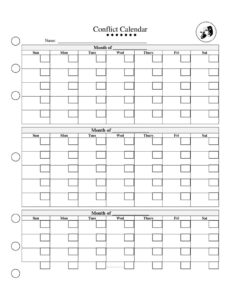
Conflict Calendar
Download a free Conflict Calendar template to track cast and crew scheduling conflicts before rehearsals begin — free download in PDF and DOCX.
PDF
DOC
12 downloads
0
likes
Download Files
- DOC
A Conflict Calendar is the form theater directors and stage managers use to collect every date a cast or crew member is unavailable during a production’s rehearsal and performance period. It’s the single most common tool for building a realistic rehearsal schedule before blocking even begins, and you can download it free in PDF and DOCX with no signup required.
What Is a Conflict Calendar?
A Conflict Calendar is a scheduling document, usually distributed at auditions or the first rehearsal, on which each participant lists the days and times they cannot attend. In community, school, and professional theater, it is typically issued by the stage manager or production manager and collected from every actor, designer, and crew member. Rather than recording when someone can rehearse, it captures the opposite: work shifts, classes, family obligations, other commitments, and known absences. The completed forms become the master reference the director and stage manager use to plan which scenes are called on which nights, ensuring the people needed are actually in the room.
When Do You Need a Conflict Calendar?
This form is essential any time multiple people must coordinate around a fixed production timeline. Common scenarios include:
- Casting a show. Directors collect conflicts at or right after auditions so casting decisions account for who can actually attend key rehearsals.
- Building a rehearsal schedule. A stage manager uses the calendars to decide which scenes to block on which nights based on actor availability.
- School and community theater. Student and volunteer casts juggle classes, jobs, and family events, making written conflicts especially important.
- Managing tech week. Identifying who has conflicts during the critical final week before opening helps avoid last-minute crises.
- Crew and design coordination. Lighting, sound, and stage crew members submit conflicts so load-in and tech calls can be planned.
- Touring or multi-venue runs. Performers list dates they cannot travel or perform across an extended schedule.
What a Conflict Calendar Should Have
A complete Conflict Calendar gives the stage management team everything they need to plan with confidence. At minimum it should capture the participant’s name and role, a way to reach them, the production and its rehearsal period, and a clearly organized space to record every date and time conflict. The strongest versions also distinguish between hard conflicts (absolutely cannot attend) and soft conflicts (would prefer not to, but could if essential), include a date the form was submitted, and provide a signature or acknowledgment line confirming the information is accurate and that the participant understands unexcused absences may affect their role.
How to Fill Out a Conflict Calendar
Because a blank template can be adapted to any show, fill it out completely and legibly so the stage manager can trust your entries:
- Production information. Write the show title, the producing organization, and the full rehearsal-to-closing date range at the top.
- Your name and role. Enter your full name and the character or crew position you are auditioning for or assigned to.
- Contact details. Provide a phone number and email so the team can reach you about schedule questions.
- List each conflict. For every date you are unavailable, record the day, the specific times (for example, 6:00–9:00 p.m.), and a brief reason such as work, class, or a prior commitment.
- Mark severity. Note whether each conflict is hard or soft so the stage manager knows what is flexible.
- Flag tech week. Double-check the final week before opening and list any conflicts there clearly, as these are the hardest to work around.
- Sign and date. Add your signature and the submission date to confirm the calendar is accurate and complete.
Hard Conflicts vs. Soft Conflicts
One of the most useful distinctions on a Conflict Calendar is between hard and soft conflicts. A hard conflict is an absolute — a work shift you cannot move, a wedding, an exam — and the stage manager will treat it as immovable when scheduling. A soft conflict is a preference or low-priority commitment that you could rearrange if a critical rehearsal requires it. Labeling conflicts honestly gives the production team room to plan around true obligations while still calling you for essential scenes. Avoid marking everything as hard; doing so makes the schedule impossible to build and can affect how you’re cast.
How Stage Managers Use the Completed Calendars
Once collected, the stage manager compiles every individual calendar into a master conflict grid that shows, at a glance, who is missing on each rehearsal date. The director uses this grid to decide which scenes to rehearse on which nights, grouping scenes around available actors. Keeping the originals on file also protects everyone: if attendance becomes an issue, the team can reference what was submitted and agreed to. Update the master grid promptly whenever a new conflict arises so it stays a reliable planning tool throughout the run.
Common Mistakes to Avoid
- Listing only some conflicts. Forgetting a recurring class or shift creates surprises mid-process; review your whole schedule before submitting.
- Being vague about times. “Busy Tuesdays” is far less useful than “Tuesdays 5–8 p.m.”; specify exact windows.
- Marking everything as a hard conflict. Overstating unavailability makes the schedule unbuildable and signals you may not be reliable.
- Ignoring tech and performance weeks. These dates are non-negotiable for most productions, so flag any conflict there immediately.
- Adding conflicts after casting without telling anyone. Always communicate new conflicts to the stage manager as soon as they arise.
- Submitting late or unsigned. A missing signature or a calendar turned in after schedules are set undermines the whole process.
Frequently Asked Questions
What is a Conflict Calendar in theater? It is a form on which cast and crew members list every date and time they are unavailable during a show’s rehearsal and performance period. The stage manager uses these calendars to build a rehearsal schedule that works around everyone’s commitments.
When should I submit my Conflict Calendar? Most productions collect conflicts at auditions or the first rehearsal so the schedule can be planned before blocking starts. Submitting it on time is critical, because schedules are often locked in within the first week.
What’s the difference between a hard and soft conflict? A hard conflict is something you absolutely cannot move, like a work shift or exam, while a soft conflict is a preference you could rearrange if needed. Labeling each one honestly helps the stage manager plan around your true obligations.
Can I add conflicts after I’ve submitted the form? You should avoid new conflicts once casting and scheduling are done, but life happens — notify the stage manager immediately if something comes up. They will update the master grid, though late conflicts may not always be accommodatable.
Is a Conflict Calendar legally binding? No, it is a scheduling and communication tool, not a contract. However, many productions treat the information as a commitment, and unexcused absences beyond what you listed can affect your role.
How much does this Conflict Calendar template cost? Nothing — it is completely free to download in both PDF and DOCX formats with no signup required. You can print it for in-person distribution or edit the DOCX to add your production’s name, dates, and logo.
This Conflict Calendar template is a general example provided for informational purposes only and is not legal, employment, or contractual advice. Scheduling policies and attendance expectations vary by production and organization — confirm requirements with your director or stage manager and consult a qualified professional where appropriate.
Related Forms
- Blocking Key
- Audition Sheet
- Script Assignment Tracker
- Rehearsal Schedule
- Performance Report
- Box Office Count
Browse more in Theater.