
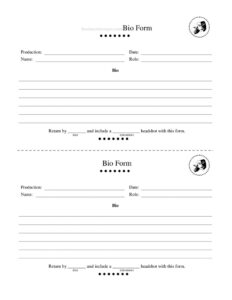
Bio Form
Collect cast and crew biographies for your playbill with this free Theater Bio Form template, plus headshot guidelines — free download in PDF and DOCX.
PDF
DOCX
5 downloads
0
likes
Download Files
- DOCX
A Theater Bio Form is the simple worksheet a stage manager, director, or program coordinator hands to every cast and crew member so they can submit a short biography and headshot for the production’s playbill. It is most commonly used to gather consistent, deadline-ready bios for the printed program before opening night, and you can download it free here in both PDF and DOCX formats — no signup required.
What Is a Theater Bio Form?
A Theater Bio Form is a standardized document that collects the information needed to write each participant’s program biography. Rather than chasing actors and crew through scattered emails and text messages, the production team distributes one uniform form that captures the person’s name, their role in the show, and a short written bio in their own words. It is typically issued by the stage manager, producer, or program designer for a specific production and returned by a set deadline, often alongside a headshot. The completed forms become the raw material for the printed playbill, the lobby display, and sometimes the company website. Because every contributor uses the same template, the bios arrive in a predictable format that is far easier to edit and lay out.
When Do You Need a Theater Bio Form?
This form is useful any time a production publishes information about the people involved. Common situations include:
- Assembling a printed playbill for a community, school, or professional theater production where each cast and crew member gets a short bio.
- Gathering headshots and bios for a lobby display or cast board outside the auditorium.
- Building a production page on the company website that lists who performed which role.
- Coordinating a large ensemble where the stage manager needs a single, organized way to collect dozens of bios by one deadline.
- Onboarding guest artists, understudies, or designers who join after the main cast and still need their information in the program.
- Archiving production records so the company has a consistent file of who participated in each show across seasons.
What a Theater Bio Form Should Have
A complete Theater Bio Form keeps the request clear and the responses uniform. The essentials are the production title so contributors know which show the bio is for, the date the form is issued or due, and the contributor’s full name exactly as they want it printed. It should capture the person’s role — whether a character name, an ensemble credit, or a crew title — and provide space for the bio text itself. Finally, a good form states the return deadline and the required headshot dimensions so the photo fits the program layout. Together these fields give the program designer everything needed without follow-up.
How to Fill Out a Theater Bio Form
Work through the fields in order so nothing is missed:
- Production: Write the exact name of the show, for example “A Midsummer Night’s Dream — Spring 2025.” This ties your bio to the correct program.
- Date: Enter the date you are completing the form, or note the due date provided so you can track the deadline.
- Name: Print your full name precisely as you want it to appear in the playbill, including any stage name, middle initial, or preferred spelling.
- Role: List your character name or crew position. If you play multiple parts or hold more than one role, list each one clearly.
- Bio: Write your biography in the space provided. Aim for two to four sentences in the third person, covering recent credits, training, and a brief personal note or thank-you. Keep it within any word limit the production sets.
- Return and headshot: Note the return-by date and attach a headshot matching the requested dimensions. Submit both together so the designer has a complete package.
Writing a Strong Bio and Submitting a Usable Headshot
The bio section is where most contributors hesitate, so a few conventions help. Theater bios are almost always written in the third person — “Jordan is thrilled to return to the Riverside Players” rather than “I am thrilled.” Lead with your most relevant or recent credits, mention any training or affiliations, and close with a short note of gratitude to family, the director, or the company. Keep the length consistent with what the program designer requests, because a bio that runs long may be trimmed without your input.
For the headshot, follow the requested dimensions exactly and send a high-resolution file rather than a screenshot or social-media thumbnail. A clean, well-lit photo with a simple background reproduces best in print. If the production specifies a black-and-white program, a strong contrast photo will look sharper than a busy color image. Naming the file with your name and the production title makes the designer’s job much easier.
Common Mistakes to Avoid
- Missing the return-by date, which can leave your bio out of the printed program entirely.
- Writing in the first person when the program style calls for third person, creating inconsistency the editor must fix.
- Submitting a headshot that ignores the requested dimensions, forcing awkward cropping or a blurry enlargement.
- Listing the wrong role or character name, especially in productions with double-casting or last-minute changes.
- Exceeding the word limit, which leads to your bio being cut to fit the layout.
- Forgetting to confirm spelling of your name and others’, since misprints in a program are difficult and costly to correct.
Frequently Asked Questions
What is a Theater Bio Form used for? It is used to collect a short biography, role, and headshot from each cast and crew member so the information can be printed in a production’s playbill or posted online. Using one form keeps every submission consistent and helps the program designer assemble the document quickly.
How long should my theater bio be? Most productions ask for two to four sentences, roughly 50 to 100 words, though the exact limit depends on the program’s space. Check whether your production set a word count and stay within it so your bio is printed in full.
Should I write my bio in first or third person? The standard convention for theater programs is third person — for example, “Maria recently appeared in…” rather than “I recently appeared in.” If your production specifies a different style, follow that instead for consistency across the playbill.
What headshot should I send with the form? Send a clear, high-resolution photo that matches the dimensions requested on the form. Avoid screenshots and heavily filtered images, and name the file with your name and the production so the designer can match it to your bio.
Is there a deadline for returning the form? Yes — the form includes a return-by date set by the production team, and missing it may mean your bio is left out of the printed program. Submit your completed form and headshot together, well before the deadline if possible.
Is this Theater Bio Form free to download? Yes. You can download this template completely free in PDF and DOCX formats with no signup required, and edit the fields, deadline, and headshot dimensions to fit your production.
This template is provided as a general example for informational purposes only and does not constitute legal or professional advice. Program requirements, image rights, and consent practices vary by organization and jurisdiction — consult your production’s leadership or a qualified professional for guidance specific to your situation.
Related Forms
- Conflict Calendar
- Instrument Schedule
- Multiple Location Schedule
- Lighting Inventory Sheet
- Stage Choreography Numbers Black
- Costume Measurement Form
Browse more in Theater.