
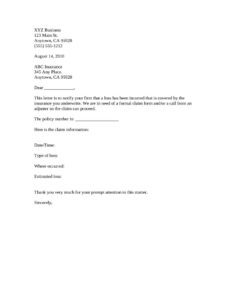
Insurance Claim
Notify your insurer of a covered loss with this free Insurance Claim letter template — request an adjuster and start your claim, free download in PDF and DOCX.
DOCX
0
likes
Download Files
- DOCX
An Insurance Claim letter is a short, formal notice you send to your insurance company to report that a covered loss has occurred and to request a claim form or a call from an adjuster. People most often use it to start the claims process quickly and create a written record of the date they reported a loss. This template is free to download in PDF and DOCX with no signup required.
What Is an Insurance Claim Letter?
An Insurance Claim letter is a written communication from a policyholder (or their business) to an insurer notifying them that a loss has occurred under an active policy. It identifies the policyholder, references the policy number, and summarizes the basic facts of the loss so the carrier can open a claim file and assign an adjuster. Unlike a full claim package with supporting documents, this letter is the opening step — a prompt, dated notice that puts the insurer on notice and asks them to send formal claim forms or contact you. It is commonly used by businesses and individuals alike whenever timely notification matters.
When Do You Need an Insurance Claim Letter?
This letter is useful any time you need to formally report a loss and protect your right to file a claim. Common situations include:
- A business suffers property damage, theft, or equipment loss covered by a commercial policy and wants to notify the carrier in writing.
- You experience a medical, liability, or general loss and your policy requires prompt written notice within a set time frame.
- Your insurer has been slow to respond to a phone report and you want a documented, dated record of your notice.
- You need to request a formal claim form before you can submit detailed documentation and estimates.
- You want an adjuster assigned and need a clear paper trail showing when and how you reported the incident.
- An accountant, office manager, or risk coordinator is filing on behalf of a company and needs a clean, professional template.
What an Insurance Claim Letter Should Have
A complete claim notice is brief but contains every detail the insurer needs to locate your policy and open a file. At minimum it should include your name and full return address, the date the letter is written, the insurer’s name and address, the policy number, and a clear statement that a covered loss has occurred. It should also summarize the key facts: the date and time of the loss, the type of loss, where it occurred, and an estimated dollar value. Finally, it should make a specific request — a formal claim form and/or a call from an adjuster — and close with a courteous signature. Keeping these elements together in one page makes it easy for the carrier to act quickly.
How to Fill Out an Insurance Claim Letter
- Enter your name and full return address at the top — in this template, the business name and address (for example, XYZ Business, 123 Main St., Anytown, CA) plus a phone number where you can be reached.
- Add the date you are writing the letter so there is a clear record of when notice was given.
- Fill in the insurer’s name and address (for example, ABC Insurance and its mailing address).
- Complete the salutation line — “Dear ____________” — with a specific contact, adjuster, or claims department if you know one; otherwise use a general claims contact.
- Enter your policy number exactly as it appears on your policy documents so the file can be located.
- Under the claim information, fill in the Date/Time the loss happened.
- State the Type of loss (such as fire, theft, water damage, or injury).
- Note Where occurred — the address or location of the incident.
- Provide an Estimated loss in dollars, even if approximate.
- Sign the letter and keep a dated copy for your records.
Tips for a Strong Claim Notice
Send the letter as soon as possible after the loss — many policies impose deadlines for reporting, and prompt notice helps avoid disputes about timeliness. Keep your description factual and neutral; this letter is meant to open the claim, not to argue liability or negotiate a settlement. Use an estimate for the loss amount if you do not yet have a final figure, and make clear it is preliminary. Whenever you can, send the letter by a method that provides proof of delivery, such as certified mail or email with a read receipt, and retain that confirmation along with your copy of the letter.
What Happens After You Send It
Once the insurer receives your notice, they typically open a claim file and may send a formal claim form for you to complete in detail. An adjuster may be assigned to investigate, inspect the damage, request documentation such as receipts, photos, police reports, or repair estimates, and determine coverage. Respond promptly to any follow-up requests and keep copies of everything you submit. The initial letter simply gets the process moving; the bulk of the documentation usually follows once the carrier responds.
Common Mistakes to Avoid
- Leaving out or mistyping the policy number, which delays the insurer’s ability to locate your file.
- Waiting too long to send notice and risking a missed reporting deadline under your policy.
- Omitting the date, time, or location of the loss, forcing the adjuster to follow up before they can act.
- Failing to keep a dated copy of the letter and proof that it was sent.
- Overstating or guessing wildly at the estimated loss instead of labeling it a preliminary estimate.
- Treating this short notice as the full claim and not following through with the formal claim form and supporting documents.
Frequently Asked Questions
What is an Insurance Claim letter used for? It is a formal written notice telling your insurance company that a covered loss has occurred and asking them to send a claim form or assign an adjuster. It opens the claims process and creates a dated record of when you reported the loss. It is the first step before submitting detailed documentation.
How do I fill out the claim letter? Add your name and address, the date, the insurer’s name and address, and your policy number. Then complete the claim information lines — date/time, type of loss, where it occurred, and estimated loss — and sign it. Keep a copy for your records before sending.
Do I need to include an exact dollar amount for the loss? No. You can provide a reasonable preliminary estimate and note that it is approximate. The final figure is usually determined later once an adjuster reviews documentation, repair estimates, or invoices.
Does this letter need to be notarized or witnessed? Generally no. A claim notice letter does not typically require notarization or witnesses; it just needs to be accurate, signed, and sent promptly. Always check your specific policy for any particular reporting requirements.
Is this letter legally binding on the insurer? The letter itself is a notice, not a contract — your policy is what governs coverage. However, sending timely written notice can be important for preserving your rights under the policy, which is why a dated, documented letter matters.
How much does this template cost? Nothing. You can download the Insurance Claim letter template for free in both PDF and DOCX formats, with no signup required, and edit it to fit your situation.
This template is a general example provided for informational purposes only and is not legal, financial, or insurance advice. Policy terms, reporting deadlines, and claim requirements vary by insurer and jurisdiction — review your own policy and consult a qualified professional or your insurance representative for guidance specific to your situation.
Related Forms
- Medical Release Letter
- Medical Records Release Letter
- Medical Release Form For Minor
- Request Medical Payment Plan
- Medical Bills Tracker
- Health Insurance Comparison Chart
Browse more in Medical.