
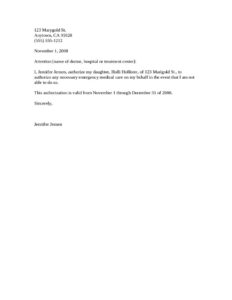
Medical Release Letter
Authorize someone to make emergency medical decisions on your behalf with this free Medical Release Letter template, available as a free download in PDF and DOCX.
DOCX
0
likes
Download Files
- DOCX
A Medical Release Letter is a short written statement that authorizes a named, trusted person to consent to emergency medical care on your behalf when you are unable to do so yourself. The most common reason people use one is to give a family member or caregiver clear permission to act quickly in a medical emergency during a specific window of time. This template is free to download in both PDF and DOCX formats, with no signup required.
What Is a Medical Release Letter?
A Medical Release Letter is a signed document, usually addressed to a doctor, hospital, or treatment center, in which one person (the author) grants another person the authority to authorize necessary emergency medical care on their behalf. It documents who is giving permission, who is receiving it, what kind of care is covered, and the time period the authorization remains valid. Unlike a comprehensive medical power of attorney, this kind of letter is often used as a simple, temporary measure — for example, while a parent travels and leaves a child or adult dependent in someone else’s care. It puts intentions in writing so providers feel confident acting on the designated person’s instructions.
When Do You Need a Medical Release Letter?
This letter is useful whenever you may not be reachable or able to give consent and want a trusted person empowered to step in. Common situations include:
- Traveling away from home while leaving a child, elderly parent, or dependent in another adult’s care.
- Authorizing an adult child or relative to make emergency decisions for you during a planned absence or recovery period.
- Summer camps, school trips, or babysitting arrangements where a guardian needs short-term authority to approve treatment.
- Hospital stays or scheduled procedures where you want a backup decision-maker on file in case you are sedated or incapacitated.
- Short-term caregiving handoffs, such as a nanny or family friend caring for someone while the primary guardian is unavailable.
- Out-of-state students or seasonal absences, where a local contact should be able to authorize urgent care.
What a Medical Release Letter Should Have
To be clear and useful to a medical provider, a complete Medical Release Letter should include a few essential elements. It should identify the author by full name and address, name the person being authorized and their relationship to the author, and describe the scope of authority being granted — in this case, the ability to authorize necessary emergency medical care. It should specify a clear start and end date so providers know exactly when the authorization applies. Finally, it should be addressed to the relevant doctor, hospital, or treatment center and closed with the author’s signature, which signals that the document reflects a genuine and considered decision.
How to Fill Out a Medical Release Letter
Follow these steps, matching each to the fields in the template:
- Add your contact details at the top — your street address, city, state, ZIP code, and phone number (for example, 123 Marygold St., Anytown, CA 95928, (555) 555-1212).
- Enter the date you are writing the letter.
- Address the recipient in the attention line — write the name of the doctor, hospital, or treatment center, or use a general line if the provider is unknown in advance.
- State your full name where the letter reads “I, [your name].”
- Name the person you are authorizing and their relationship to you (for example, “my daughter, Holli Hollister”), along with their address.
- Confirm the scope — the authority to approve any necessary emergency medical care on your behalf when you cannot.
- Set the valid dates, entering the start and end of the authorization period.
- Sign your name at the bottom under a closing such as “Sincerely.”
How This Differs From a Medical Power of Attorney
A Medical Release Letter is intentionally simple and is best suited to short-term, defined situations. A medical power of attorney (sometimes called a healthcare proxy or healthcare directive) is typically a more formal legal instrument that grants broad and ongoing authority over medical decisions, often including end-of-life choices, and may require witnesses or notarization to be enforceable. If your needs are long-term, complex, or involve significant decisions, a power of attorney may be more appropriate. For brief absences and clearly bounded situations, a release letter is often a practical, lightweight option that providers can read and act on quickly.
Tips for Making Your Letter More Effective
Keep the language clear and specific so a busy provider can understand it at a glance. Give a copy to the person you are authorizing, and consider leaving one with the relevant doctor or facility in advance. Include phone numbers where both you and your designated person can be reached. If your authorization covers a minor, list the child’s full name and date of birth so there is no confusion about who the care applies to. Set realistic dates that match the actual period you will be unavailable, and prepare a new letter if those dates change.
Common Mistakes to Avoid
- Leaving out the dates — without a clear validity period, providers may hesitate to rely on the letter.
- Failing to identify the authorized person fully, including their relationship and address.
- Being vague about scope — state plainly that it covers necessary emergency medical care.
- Forgetting to sign the letter, which undermines its credibility.
- Not giving copies to the authorized person or the relevant facility ahead of time.
- Assuming it replaces a power of attorney for broad, long-term, or major medical decisions.
Frequently Asked Questions
What is a Medical Release Letter used for? It is used to authorize a trusted person to consent to emergency medical care on your behalf when you are unavailable or unable to do so. People most often use it for short, defined periods, such as while traveling or recovering. It gives providers written confirmation of who may make urgent decisions.
How do I fill out a Medical Release Letter? Add your contact details and the date, address the doctor or facility, state your full name, name the person you are authorizing and their relationship and address, describe the scope as necessary emergency care, set the valid dates, and sign. Following the template’s order keeps the letter complete and easy for a provider to read.
Does a Medical Release Letter need to be notarized? A simple release letter often does not require notarization, but requirements vary by state and by the policies of individual hospitals or providers. Some facilities prefer or request notarization or witnesses for added assurance. Check with the relevant provider and your local rules before relying on the letter.
Is a Medical Release Letter legally binding? A clearly written, signed letter can be honored by providers, but its weight depends on jurisdiction and provider policy. For major or long-term decisions, a formal medical power of attorney may be more appropriate and enforceable. When in doubt, consult a qualified professional.
How long is the authorization valid? It is valid for the date range you specify in the letter, such as a few weeks or months while you are away. Once the end date passes, the authorization expires, and you should prepare a new letter if you need to extend it.
How much does this template cost? Nothing — this Medical Release Letter template is completely free to download in PDF and DOCX formats, with no signup required. You can edit it to fit your situation and reuse it whenever you need.
This template is provided as a general example for informational purposes only and is not legal, medical, or other professional advice. Requirements for authorizing medical care vary by jurisdiction and by provider — consult a qualified professional to ensure your document meets your needs.
Related Forms
- Injury Report Record
- Health Insurance Comparison Chart
- Insurance Claim
- Medical Records Release Letter
- Medical Release Form For Minor
- Request Medical Payment Plan
Browse more in Medical.