
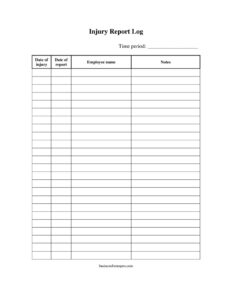
Injury Report Record
Document workplace injuries clearly with our free Injury Report Record template, available as a free download in PDF and DOCX with no signup required.
PDF
DOCX
4 downloads
0
likes
Download Files
- DOCX
An Injury Report Record is a simple log used to document workplace or facility injuries as they happen, capturing the date, the person involved, and a written account of what occurred. Most people use it to maintain a consistent, auditable trail of incidents for safety, compliance, and follow-up care. It’s free to download here in both PDF and DOCX formats, with no signup required.
What Is an Injury Report Record?
An Injury Report Record is a structured document that captures the essential facts surrounding an injury in a single, easy-to-reference entry. It is typically used by employers, supervisors, school staff, clinic personnel, sports coaches, and facility managers who need to track when and how someone got hurt. The record documents the date of injury, the date the report was filed, the name of the affected person, and detailed notes describing the event. Rather than relying on memory or scattered emails, this form creates an organized log entry that can support insurance claims, internal investigations, safety reviews, and regulatory recordkeeping. It serves as both an immediate account of an incident and a long-term reference for spotting patterns over time.
When Do You Need an Injury Report Record?
This form is useful any time an injury occurs and an accurate account needs to be preserved. Common situations include:
- Workplace accidents — an employee slips, falls, strains a muscle, or is cut while performing job duties and the incident must be documented for HR and insurance.
- Repetitive or delayed injuries — a worker reports discomfort that developed over a time period rather than from a single event, requiring a dated entry.
- School or daycare incidents — a student is hurt during class, recess, or an activity and staff must log it for parents and administration.
- Sports and recreation — a coach or trainer records an athlete’s injury during practice or competition for return-to-play decisions.
- Healthcare and care facilities — staff document a patient or resident injury such as a fall to support continuity of care.
- Safety audits and trend tracking — managers keep an ongoing log to identify recurring hazards over a defined time period.
What an Injury Report Record Should Have
A complete Injury Report Record balances brevity with enough detail to be useful later. At minimum it should clearly identify who was injured, when the injury happened, when it was reported, and what occurred. The notes section should describe the nature of the injury, the location, the apparent cause, any witnesses, and the immediate response or treatment provided. Including a defined time period helps organize entries into reporting cycles, such as weekly or monthly safety reviews. Consistency across entries is what makes the record valuable: each line should follow the same format so the log can be scanned, compared, and totaled. The clearer and more factual each entry is, the more reliable the record becomes for investigations and claims.
How to Fill Out an Injury Report Record
Walk through the form field by field, filling in each entry as soon after the incident as possible while details are fresh:
- Time period — Enter the reporting window this log covers, such as a specific week, month, or quarter. This groups related entries together for review.
- Date of injury — Record the exact date the injury occurred. If the injury developed over time, note the date it was first identified or reported, and clarify the onset in the notes.
- Date of report — Write the date this entry is being completed. A gap between the injury date and the report date should be explained in the notes.
- Employee name — Enter the full name of the injured person so the record is unambiguous. Avoid initials or nicknames.
- Notes — Describe what happened in plain, factual language: the body part affected, where it occurred, what the person was doing, the apparent cause, any witnesses, and the action taken. Stick to observable facts rather than blame or assumptions.
Keeping an Accurate and Useful Log
An Injury Report Record is most valuable when it is filled out promptly and consistently. Complete each entry the same day whenever possible, because memories fade and small details—like the exact task being performed or who witnessed it—often matter later. Use neutral, descriptive language and record facts rather than opinions about fault. If photos, witness statements, or a separate incident form exist, reference them in the notes so the record points to supporting documentation. Store the log securely, since it may contain sensitive personal and medical information that should be handled in line with privacy expectations and applicable regulations.
How It Differs From a Formal Incident Report
An Injury Report Record is typically a running log designed for quick, repeated entries across a time period, while a formal incident report is a longer, single-event document with detailed sections, signatures, and follow-up steps. Many organizations use both: the log provides an at-a-glance history of all injuries, and a dedicated incident report is completed for serious events that require investigation or regulatory filing. Think of this record as the index that captures every occurrence, complemented by deeper documentation where the situation demands it.
Common Mistakes to Avoid
- Delaying the entry — Waiting days to log an injury leads to forgotten details and weaker documentation.
- Vague notes — Writing “hurt arm” instead of describing the cause, location, and circumstances reduces the record’s usefulness.
- Confusing the dates — Mixing up the date of injury and the date of report can distort timelines for claims or audits.
- Assigning blame — Notes should state facts, not conclusions about who was at fault.
- Inconsistent formatting — Entries that don’t follow the same structure are harder to scan and compare.
- Poor confidentiality — Leaving the log accessible to unauthorized people can expose private medical details.
Frequently Asked Questions
What is an Injury Report Record used for? It is used to log injuries as they occur, capturing the date of injury, date of report, the person’s name, and a factual description of the event. Organizations rely on it for safety reviews, insurance support, and tracking patterns over time.
How do I fill out an Injury Report Record? Enter the reporting time period, the date the injury happened, the date you are filing the entry, the injured person’s full name, and detailed notes about the incident. Complete each entry as soon as possible after the injury so the details remain accurate.
Is an Injury Report Record legally required? Recordkeeping requirements vary by jurisdiction, industry, and the severity of the injury, and some events must be reported on specific official forms. This template is a helpful internal tool, but you should check the rules that apply to your organization and location.
Who should complete the form? Usually a supervisor, manager, safety officer, teacher, coach, or trained staff member completes it, often with input from the injured person and any witnesses. The key is that whoever fills it out records accurate, firsthand-supported facts.
How long should I keep injury records? Retention periods differ depending on local regulations and the nature of the injury, and some records must be kept for several years. When unsure, retain the log securely and confirm the required retention timeframe for your area and industry.
Is this Injury Report Record template really free? Yes. You can download it free in PDF or DOCX format with no signup required, and edit the fields to match your workplace or facility’s needs.
This Injury Report Record template is a general example provided for informational purposes only and is not legal, medical, or compliance advice. Recordkeeping and injury-reporting requirements vary by jurisdiction and industry — consult a qualified professional to ensure your documentation meets all applicable obligations.
Related Forms
- Medical Release Letter
- Medical Release Form For Minor
- Insurance Claim
- Request Medical Payment Plan
- Accident Claim letter
- Medical Bills Tracker
Browse more in Medical.