
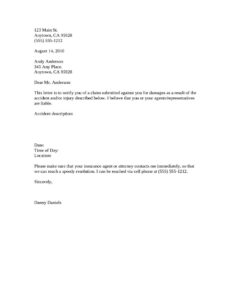
Accident Claim letter
Download a free accident claim letter template to notify a party of a damages claim after an accident or injury — free download in PDF and DOCX.
DOCX
0
likes
Download Files
- DOCX
An accident claim letter is a written notice sent to a person you believe is responsible for an accident or injury, formally informing them that a claim for damages is being made against them. People most often use it to put the other party — and their insurer or attorney — on notice and to open the door to a settlement discussion. You can download this accident claim letter free in PDF and DOCX, with no signup required.
What Is an Accident Claim Letter?
An accident claim letter is a short, formal document that a claimant sends to the party they consider liable after a collision, fall, or other incident that caused harm or property damage. It identifies the sender and recipient, briefly describes the accident, states the belief that the recipient (or their agents) is responsible, and requests that the recipient’s insurance agent or attorney make contact promptly. It is not a lawsuit and does not by itself prove fault, but it creates a clear paper trail showing that you raised the matter, when you raised it, and how the other side can reach you to resolve the issue.
When Do You Need an Accident Claim Letter?
This letter is useful any time you want to formally assert a claim without immediately escalating to court. Common situations include:
- Vehicle collisions where another driver caused damage to your car or injured you, and you want their insurer to engage.
- Slip-and-fall or premises injuries on someone else’s property, such as a wet floor or broken step.
- Property damage caused by a neighbor, contractor, or business — for example, a falling object or a botched repair.
- Bicycle or pedestrian incidents where a motorist or property owner appears to be at fault.
- Injuries at a business, like a store, gym, or restaurant, where staff actions or conditions led to harm.
- Situations where an insurer has gone quiet and you need a documented prompt to reopen communication.
What an Accident Claim Letter Should Have
A complete accident claim letter is brief but precise. It should include your full name and contact details, the date the letter is written, the recipient’s name and address, and a clear statement that you are submitting a claim for damages arising from a specific accident or injury. It must contain a factual description of the incident — what happened, the date, the time of day, and the location. It should state your belief that the recipient or their representatives are liable, request that their insurance agent or attorney contact you, and provide a reliable phone number. Keep the tone factual and professional; avoid exaggeration or threats, since the letter may later be reviewed by insurers or attorneys.
How to Fill Out an Accident Claim Letter
- Add your address and phone at the top. Replace the sample “123 Main St., Anytown, CA 95928, (555) 555-1212” with your own street address and a number where you can be reached.
- Enter the date. Use the actual date you are sending the letter (the template shows “August 14, 2010” as a placeholder).
- Address the recipient. Replace “Andy Anderson” and “345 Any Place, Anytown, CA 95928” with the responsible party’s name and mailing address, then update the salutation (“Dear Mr. Anderson:”).
- State the claim. Keep the opening line notifying the recipient that a claim for damages has been submitted against them.
- Complete the accident description. Fill in the Date, Time of Day, and Location fields, and add a clear, factual summary of what occurred.
- Request contact. Confirm the request that their insurance agent or attorney reach out for a speedy resolution.
- Insert your cell phone number. Update the contact number so the recipient can respond.
- Sign off. Replace “Danny Daniels” with your name and sign the printed copy.
Documenting the Accident Clearly
The strength of an accident claim letter rests on the clarity of the accident description. When you fill in the date, time of day, and location, be as specific as your records allow — note the exact intersection, the aisle of a store, or the section of a sidewalk rather than a vague area. A concise factual account (“a vehicle traveling northbound failed to stop and struck the rear of my car”) is far more credible than emotional language. Keep supporting evidence organized in case the other party or their insurer asks for it: photographs, a police or incident report number, repair estimates, medical records, and the names of any witnesses. Referencing that such documentation exists, without overstating it, signals that you are prepared.
Sending the Letter and What Comes Next
Consider sending the letter by a method that confirms delivery, such as certified mail with a return receipt, and keep a dated copy for your files. After the recipient receives it, their insurance company or attorney will often make contact to gather information or discuss a possible settlement. Respond promptly and keep records of every call and email. If you do not hear back within a reasonable time, a polite follow-up referencing the original letter and its date can keep the matter moving. Remember that this letter is a notification and negotiation tool — it does not replace any formal claim deadlines or legal filings that may apply to your situation.
Common Mistakes to Avoid
- Leaving placeholder text in place — always replace the sample names, addresses, and dates with your real details.
- Vague accident descriptions that omit the date, time of day, or precise location.
- Exaggerating or guessing at facts, which can undermine your credibility if the matter is reviewed.
- Forgetting a working contact number, leaving the other side unable to reach you.
- Not keeping a copy or proof of delivery of the letter you sent.
- Including admissions or speculation about your own role that could weaken your position.
Frequently Asked Questions
What is an accident claim letter used for? It is used to formally notify a person you believe is responsible for an accident or injury that you are making a claim for damages. The letter opens communication, creates a written record, and asks their insurer or attorney to contact you so the matter can be resolved.
Is an accident claim letter legally binding? The letter itself is a notice, not a contract, so it does not bind anyone to pay. However, it can become an important piece of documentation showing when and how you raised the claim. Any settlement you later reach should be put in its own written agreement.
Do I need a lawyer to send this letter? No — many people send a claim letter on their own, especially for smaller property-damage matters. For serious injuries, disputed liability, or large losses, consulting an attorney before sending is wise, since how you word the claim can affect later negotiations.
How should I describe the accident? Stick to clear, verifiable facts: the date, the time of day, the location, and a short account of what happened. Avoid emotional language, guesses, and admissions, and keep supporting evidence such as photos, reports, and estimates organized in case they are requested.
How should I send the accident claim letter? Sending it by certified mail with a return receipt gives you proof of delivery and the date it arrived. Keep a signed copy for your records, and document any phone or email responses you receive afterward.
How much does this accident claim letter template cost? Nothing — you can download it free from Business Forms Pro in both PDF and DOCX formats with no signup required. The DOCX version is fully editable so you can adapt the fields to your own accident details.
This accident claim letter template is a general example provided for informational purposes only and is not legal, financial, or insurance advice. Claim procedures, deadlines, and liability rules vary by jurisdiction, so consult a qualified attorney or licensed professional about your specific situation before relying on this document.
Related Forms
- Health Insurance Comparison Chart
- Insurance Claim
- Medical Release Letter
- Injury Report Record
- Medical Records Release Letter
- Medical Release Form For Minor
Browse more in Medical.