
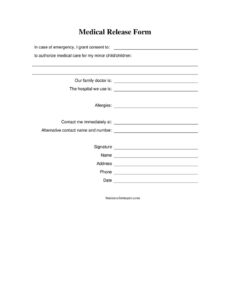
Medical Release Form For Minor
Download a free Medical Release Form for Minor to authorize emergency medical care when you're away — free PDF and DOCX template, no signup required.
PDF
DOCX
0
likes
Download Files
- DOCX
A Medical Release Form for Minor is a written authorization that lets a trusted adult consent to medical care for your child when you cannot be reached. Parents most often use it to cover babysitters, relatives, or camp staff during emergencies. This form is free to download in PDF and DOCX, with no signup required.
What Is a Medical Release Form for Minor?
A Medical Release Form for Minor is a short document signed by a parent or legal guardian that grants another named adult the authority to authorize medical treatment for a child in the parent’s absence. It documents who may make care decisions, identifies the family doctor, lists known allergies, and provides the fastest way to reach the parent and a backup contact. Healthcare providers, schools, and caregivers rely on it to act quickly when a parent is unavailable to give consent in person. While it is not a substitute for a guardianship order, it gives caregivers a clear, signed statement of the parent’s wishes regarding emergency medical care for the minor.
When Do You Need a Medical Release Form for Minor?
Any time your child will be in another adult’s care and you might be hard to reach, this form helps that adult act without delay. Common situations include:
- Leaving children with a babysitter or nanny while you travel for work or take an evening out.
- Sending a child to stay with grandparents or other relatives for a weekend, holiday, or extended visit.
- Summer camp, sports clinics, or field trips where staff may need to authorize treatment for an injury.
- Travel without a parent, such as a school trip or a vacation chaperoned by another family.
- Daycare or after-school programs that require emergency authorization on file.
- Co-parenting or shared custody arrangements where one parent travels and wants the other caregiver covered.
In each case, the goal is the same: if your child is hurt or falls ill and you cannot be reached fast enough, the named adult can speak to medical staff and approve necessary care.
What a Medical Release Form for Minor Should Have
A complete release leaves no doubt about who is authorized and how to reach you. The essential elements are:
- A clear statement granting consent to a specifically named adult to authorize medical care in an emergency.
- Identification of the minor child or children the consent covers.
- The family doctor’s name so providers can coordinate care.
- Known allergies and important medical notes that affect treatment.
- A direct number where the parent can be reached immediately.
- An alternative contact name and number as a backup.
- The parent or guardian’s printed name, address, phone, signature, and date.
How to Fill Out a Medical Release Form for Minor
- Name the authorized adult. In the consent line, write the full name of the person you trust to authorize medical care — for example the babysitter, grandparent, or camp director.
- Identify your child or children. List the minor’s full name (and the names of any siblings the form covers) so there is no ambiguity about who is included.
- Enter your family doctor. Write the pediatrician or family physician’s name on the “Our family doctor is” line; add a phone number if you have room.
- List allergies. Note any drug, food, or environmental allergies, plus reactions, so providers avoid harmful treatments. Write “none known” if applicable.
- Provide your immediate contact. On the “Contact me immediately at” line, give the best phone number to reach you in an emergency.
- Add an alternative contact. Enter a second trusted person’s name and number as a backup.
- Complete your details. Print your name, address, and phone, then sign and date the form to make it official.
Tips for Making the Form Effective
A release only helps if the right people can find it and read it. Print at least one copy for the caregiver to keep on hand and save a photo on your phone. Include your child’s date of birth and insurance information in the margin if there is space — many providers ask for both. If your child takes regular medication, list the name, dose, and schedule alongside allergies. Update the form whenever your contact numbers, doctor, or caregiver changes, and refresh it before each new trip or camp season so the information is never stale.
How This Differs From Other Medical Documents
A Medical Release Form for Minor is narrow and practical: it authorizes emergency care decisions by a caregiver. It is different from a HIPAA release, which permits a provider to share medical records; from a medical power of attorney, which grants broad ongoing authority; and from a guardianship order, which is granted by a court. For most short-term caregiving situations, a signed parental consent form like this one is what schools, camps, and babysitters expect. For long stays or complex medical needs, ask the facility whether it requires additional or notarized paperwork.
Common Mistakes to Avoid
- Leaving the authorized adult’s name blank — without a named person, the consent has no clear recipient.
- Forgetting to list allergies, which is exactly the information a provider needs first in an emergency.
- Using an outdated phone number so the caregiver cannot actually reach you when it matters.
- Omitting the backup contact, leaving no one to reach if the parent is unavailable.
- Not signing or dating the form, which weakens its credibility with medical staff.
- Failing to give the caregiver a copy — a form filed at home does no good on a trip.
Frequently Asked Questions
What is a medical release form for a minor used for? It authorizes a named adult to consent to medical care for your child when you cannot be reached. Caregivers such as babysitters, relatives, and camp staff use it so doctors can begin treatment without delay during an emergency.
How do I fill it out? Name the trusted adult, identify your child, list your family doctor and any allergies, then provide your immediate and backup contact numbers. Finish by printing your name, address, and phone and signing and dating the form.
Does a medical release form need to be notarized? Notarization is usually not required for a basic caregiving release, and many schools and camps accept a signed parent’s copy. Requirements vary by state and by facility, so check whether the organization receiving the form wants it notarized or witnessed.
Is this form legally binding? A signed parental consent form gives caregivers and providers clear evidence of your authorization, but it does not transfer custody or guardianship. For long-term arrangements or major decisions, a medical power of attorney or court order may be needed.
How long is the form valid? It generally applies for the period you intend, such as a single trip, a camp season, or a school year. There is no universal expiration, but you should update and re-sign it whenever your contacts, doctor, or caregiver changes.
How much does this form cost? Nothing — you can download this Medical Release Form for Minor for free in PDF and DOCX with no signup. Print it, fill it in, and give a copy to your child’s caregiver.
This template is a general example provided for informational purposes only and is not legal, medical, or other professional advice. Requirements for authorizing care for a minor vary by jurisdiction and by facility — consult a qualified professional or the receiving organization to confirm what is needed for your situation.
Related Forms
- Health Insurance Comparison Chart
- Medical Records Release Letter
- Injury Report Record
- Medical Bills Tracker
- Accident Claim letter
- Request Medical Payment Plan
Browse more in Medical.