
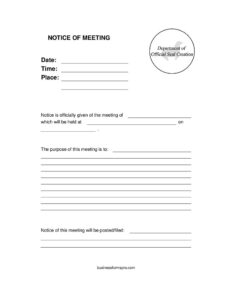
Notice of Meeting
Download a free Notice of Meeting template in PDF and DOCX to announce the date, time, location, and purpose of any official meeting—free download.
PDF
DOCX
2 downloads
0
likes
Download Files
- DOCX
A Notice of Meeting is a written announcement that formally informs members, directors, shareholders, or staff that a meeting will be held at a specific time and place. People most often use it to satisfy bylaw or policy requirements that members be given proper, documented advance notice before a meeting can be considered valid. This template is free to download in both PDF and DOCX formats with no signup required.
What Is a Notice of Meeting?
A Notice of Meeting is an official document issued by an organization—typically by its secretary, board chair, manager, or convening officer—to alert the relevant group that a meeting has been scheduled. It documents the essential details: who is meeting, where, when, and why. The notice serves both a practical purpose (telling people when and where to show up) and a procedural one (creating a record that proper notice was given). Many organizations, from nonprofit boards and homeowners associations to corporations and committees, are bound by bylaws or statutes that require a Notice of Meeting to be circulated a set number of days in advance for the meeting’s decisions to be binding.
When Do You Need a Notice of Meeting?
This form is useful any time a group must be formally summoned together. Common scenarios include:
- Board of directors meetings — notifying directors of a regular or special session and the matters to be discussed.
- Annual general meetings (AGMs) — alerting shareholders or members of the yearly meeting where elections, reports, and votes occur.
- Homeowners or condo association meetings — giving residents required advance notice of community gatherings and assessments.
- Committee or subcommittee meetings — convening a working group to review a specific issue or project.
- Special or emergency meetings — calling members together on short notice for an urgent decision.
- Club, union, or membership meetings — posting notice for general members of a voluntary association.
Types of Meeting Notices
Although they share a format, notices vary by purpose. A regular notice announces a routinely scheduled meeting at a known interval. A special meeting notice is issued for a meeting outside the normal schedule and often must state the specific business to be transacted—since special meetings are usually limited to that stated purpose. An annual meeting notice covers required yearly business such as elections and financial reports. Choosing the right framing matters because some bylaws restrict what can be voted on at a special meeting to only the items named in the notice.
What a Notice of Meeting Should Have
A complete and effective Notice of Meeting includes the name of the group or organization being called together, the exact location (physical address or virtual link), the date and time, and a clear statement of the meeting’s purpose or agenda. It should also indicate the date the notice itself is issued and how and where it will be posted or filed, so there is a verifiable record that notice was properly given. Including the issuer’s name or signature adds authority and traceability.
How to Fill Out a Notice of Meeting
- Notice of Meeting Date: Enter the date you are issuing the notice. This establishes when notice was given and helps confirm that any required advance-notice period is satisfied.
- Group: In the blank for {group}, write the full name of the body being convened—for example, “the Board of Directors of Maple Street HOA” or “the General Membership of the Riverside Cycling Club.”
- Location: Fill in {location} with the precise meeting place. Include the building name, room number, full street address, or a video conference link and access code for virtual meetings.
- Date: Enter the {date} the meeting will be held, and add the start time so attendees know exactly when to arrive or log in.
- Purpose of this meeting: State clearly why the meeting is being called. List the agenda items or the specific business to be transacted, especially for special meetings where the scope may be limited to what is named here.
- Posted/filed: Indicate how and where the notice will be distributed or recorded—such as posted on a bulletin board, emailed to members, mailed, or filed with the organization’s records.
Tips for Giving Proper Notice
Check your organization’s bylaws or governing documents before sending the notice. Many require a minimum notice period—often counted in days—and specify acceptable delivery methods such as mail, email, or physical posting. Keep a dated copy of the notice and a record of how it was distributed; this proof can become important if a decision made at the meeting is later challenged. For special meetings, be especially careful to describe the purpose accurately, because conducting unrelated business may invalidate those actions. When meetings are held virtually or in a hybrid format, make sure the access details are complete and tested in advance.
Common Mistakes to Avoid
- Insufficient advance notice — sending the notice too close to the meeting date and failing to meet a required minimum notice period.
- Vague purpose statements — writing “general business” when bylaws require specific agenda items, particularly for special meetings.
- Incomplete location details — omitting a room number, address, or video link, leaving attendees confused about where to go.
- Forgetting the issue date — without it, you cannot prove the notice period was honored.
- Not documenting distribution — failing to record how and when the notice was posted, mailed, or emailed.
- Using an unauthorized delivery method — sending notice by a means not permitted under the organization’s rules.
Frequently Asked Questions
What is a Notice of Meeting used for? It is used to formally inform members, directors, or shareholders that a meeting will take place, giving them the date, time, location, and purpose. It also creates a documented record that proper notice was provided, which many bylaws and laws require for a meeting’s decisions to be valid.
How much advance notice is required? The required notice period varies by organization and jurisdiction—it is usually set in the bylaws, charter, or applicable statute. Common periods range from a few days to several weeks, so always check your governing documents before scheduling.
Does a Notice of Meeting need to be signed or notarized? Notarization is generally not required. A signature or the name of the issuing officer—such as the secretary or chair—is often included to confirm who authorized the notice, but the specific requirement depends on your organization’s rules.
What should the purpose section include? It should clearly state the reason for the meeting and, ideally, the agenda items to be discussed. For special meetings this is especially important, since many organizations limit business to only the items named in the notice.
Can a Notice of Meeting be sent by email? In many organizations email is an acceptable delivery method, but some bylaws require mail or physical posting. Confirm the permitted methods in your governing documents and keep proof of how the notice was distributed.
Is this Notice of Meeting template free to use? Yes. You can download this Notice of Meeting template free in both PDF and DOCX formats, with no signup required, and customize the group name, location, date, and purpose to fit your needs.
This template is provided as a general example for informational purposes only and does not constitute legal advice. Notice requirements vary by jurisdiction and by an organization’s bylaws or governing documents. Consult a qualified professional or your governing rules to ensure your notice meets all applicable requirements.
Official resource: for the rules that apply to your situation, see the U.S. Small Business Administration.
Related Forms
- 2025 Postal Holidays
- Meeting Agenda
- Lobby Hours
- Driver Delivery Schedule
- Meeting Agenda Simple
- Appointment Reminder Card
Browse more in Office.