
Landlord Checklist
Download a free Landlord Checklist template to document rental move-in and move-out condition room by room, available as a free PDF and DOCX download.
PDF
DOCX
1 downloads
0
likes
Download Files
- DOCX
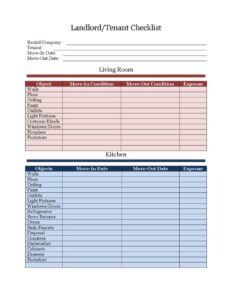
A Landlord Checklist is a room-by-room inspection form landlords and tenants use to record the condition of a rental property at move-in and move-out. The most common reason people use it is to create a clear, dated record that protects the security deposit and prevents disputes over damage. It’s free to download here in both PDF and DOCX formats, with no signup required.
What Is a Landlord Checklist?
A Landlord Checklist — often called a move-in/move-out condition checklist — is a document that walks through every area of a rental unit and notes the state of each fixture, surface, and appliance. It is typically completed jointly by the landlord (or rental company) and the tenant at the start and end of a tenancy. The form documents whether items like walls, floors, appliances, and plumbing are clean, damaged, or in need of repair. By capturing the property’s condition in writing, it establishes a baseline so both parties can fairly determine what normal wear is versus tenant-caused damage when the lease ends.
When Do You Need a Landlord Checklist?
This checklist comes into play at several key points in the rental relationship. Common scenarios include:
- Move-in inspection: Recording the condition of every room before the tenant takes possession, so existing wear isn’t blamed on them later.
- Move-out inspection: Comparing the unit’s condition to the move-in baseline to decide whether deductions from the security deposit are warranted.
- New lease signing: Attaching a completed checklist to the lease as an agreed reference document.
- Tenant turnover: Helping the rental company quickly assess what cleaning, painting, or repairs are needed between residents.
- Dispute resolution: Providing dated evidence if a deposit disagreement escalates to small claims court.
- Periodic inspections: Documenting the property’s state during a routine mid-lease walkthrough.
What a Landlord Checklist Should Have
A complete checklist captures both identifying information and a detailed condition record. It should include the tenant and rental company names, the move-in date and move-out date, and a structured list of every room and item to be inspected. For each item, there should be space to note the move-in condition and the move-out condition, plus a column for any expense or repair cost. The strongest checklists organize items by area — living room, kitchen, bathroom, bedrooms — and include both fixed features (walls, floors, ceilings) and appliances (refrigerator, dishwasher, washer/dryer). Signature lines and dates from both parties turn it into a mutually agreed record.
How to Fill Out a Landlord Checklist
- Enter the Rental Company and Tenant names at the top to identify who the record belongs to.
- Record the Move-In Date (and later the Move-Out Date) so the inspection is clearly dated.
- Work through each area in order: Foyer, Living Room, Dining Room, Halls, Stairs, Bedroom #1, and Bedroom #2.
- For every space, inspect the structural items — Walls, Floor, Ceiling, Paint, Windows/Doors, Light Fixtures, and Outlets — and note their condition.
- In the Kitchen, check the Counters, Cabinets/Drawers, Sink/Faucets, Refrigerator, Stove Burners, Ovens, Dishwasher, and Disposal.
- In the Bathroom, document the Toilet, Shower/Tub, Mirror, Sink/Faucets, and Drains.
- Cover additional features as applicable: Air Conditioning, Heating, Fireplace, Curtains/Blinds, Screens, Furniture, Washer/Dryer, and outdoor areas like Patio/Deck, Balcony, Carport/Driveway, Lawn/Garden, Attic, and Basement.
- For each line, fill in the Move-In Condition, and at lease end the Move-Out Condition, plus any Expense for repairs.
- Use the Other rows for unlisted items, then have both parties sign and date.
Tips for an Accurate Inspection
The value of a Landlord Checklist depends entirely on how carefully it is completed. Be specific in your notes — write “two-inch scuff on east wall near outlet” rather than just “damage.” Take dated, time-stamped photographs of each item as you go and reference them on the form so the written record and visual evidence line up. Whenever possible, complete the checklist together so the tenant can agree to each entry in real time, reducing the chance of a later disagreement. Pay close attention to high-cost appliances like the refrigerator, oven, and washer/dryer, since these often drive the largest deposit deductions.
Normal Wear vs. Tenant Damage
One of the trickiest parts of using this checklist at move-out is distinguishing ordinary wear and tear from actual damage. Faded paint, minor carpet wear, and small nail holes are generally considered normal use that landlords absorb, while large stains, broken fixtures, holes in walls, and missing items typically count as tenant responsibility. The move-in and move-out condition columns make this comparison straightforward: if an item was “good” at move-in and “cracked” at move-out, the change is documented. Local laws vary on what landlords may deduct and how deposits must be handled, so always check your jurisdiction’s rules before assessing charges.
Common Mistakes to Avoid
- Skipping the move-in inspection: Without a baseline, you cannot fairly assess damage at move-out.
- Vague condition notes: Writing “okay” or “fine” leaves too much room for interpretation later.
- Forgetting to date the form: Undated records carry far less weight in a dispute.
- Not getting both signatures: A one-sided checklist is easy for either party to contest.
- Ignoring outdoor and storage areas: Patios, lawns, attics, and basements are easy to overlook but often show damage.
- Failing to keep a copy: Both the landlord and tenant should retain a signed version for the full lease term and beyond.
Frequently Asked Questions
What is a Landlord Checklist used for? It is used to document the condition of a rental property room by room, typically at move-in and move-out. This creates a shared record that helps determine whether the security deposit should be returned in full or partially withheld for damage. It protects both the landlord and the tenant from unfair claims.
How do I fill out a Landlord Checklist? Start by entering the rental company, tenant, and dates, then inspect each room and note the condition of every item from walls and floors to appliances. Record the move-in condition first, and at the end of the tenancy add the move-out condition and any repair expense. Completing it jointly and adding photos makes it most reliable.
Does a Landlord Checklist need to be notarized? No, a checklist generally does not require notarization to be useful. What matters most is that both the landlord and tenant sign and date it to confirm they agree with the recorded conditions. Signatures and supporting photos are usually sufficient evidence.
Is a Landlord Checklist legally binding? While the checklist itself is primarily a documentation tool rather than a contract, a signed copy can serve as strong evidence in a deposit dispute or court proceeding. Many jurisdictions encourage or require move-in inspections as part of deposit law. Always check your local landlord-tenant regulations.
How much does this Landlord Checklist cost? The template on this page is completely free to download. You can get it in both PDF and DOCX formats with no signup or payment required. You’re free to customize it to match your specific property and lease.
When should the checklist be completed? Ideally it should be filled out twice: once at move-in before the tenant brings in belongings, and again at move-out after the unit is emptied. Completing both with the same form lets you compare conditions side by side. Some landlords also use it for periodic mid-lease inspections.
This Landlord Checklist template is a general example provided for informational purposes only and is not legal, financial, or tax advice. Landlord-tenant laws, security deposit rules, and inspection requirements vary by jurisdiction. Consult a qualified attorney or local housing authority to ensure your forms and procedures comply with applicable law.
Official resource: for the rules that apply to your situation, see HUD.
Related Forms
- Notice Of Intent To Enter Dwelling
- 5-Day Notice to Pay or Quit
- Landlord Proof of Residency
- Rental Unit Smoke Detector CO2 Log
- Eviction Notice Letter
- Notice Of Denial To Rent Apartment
Browse more in Landlord Documents.