
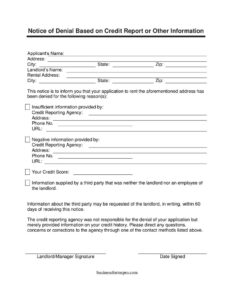
Notice Of Denial To Rent Apartment
Download a free Notice of Denial to Rent Apartment template to formally inform applicants their rental was denied based on credit—free PDF and DOCX download.
PDF
DOCX
1 downloads
0
likes
Download Files
- DOCX
A Notice of Denial to Rent Apartment is the written notice a landlord gives a rental applicant explaining that their application has been turned down, particularly when the decision was based in whole or in part on a credit report or third-party information. The single most common reason landlords use it is to satisfy the legal requirement to provide an applicant with an “adverse action” explanation after a credit-based denial. This template is free to download in both PDF and DOCX formats, with no signup required.
What Is a Notice of Denial to Rent Apartment?
A Notice of Denial to Rent Apartment is a formal document issued by a landlord, property manager, or leasing agent to a prospective tenant whose rental application has been rejected. It documents that the application was denied and identifies the source of the information that contributed to the decision—most often a credit reporting agency or another third party. The notice tells the applicant how to contact the agency to review or dispute the information on file. Because rental screening frequently relies on consumer credit data, this notice plays an important role in transparency and in helping applicants understand and correct errors. It protects both parties by creating a clear written record of the denial and its stated reason.
When Do You Need a Notice of Denial to Rent Apartment?
Landlords and property managers commonly send this notice in situations such as:
- An applicant’s credit report shows insufficient or incomplete information to evaluate the application.
- Negative information—such as late payments, collections, or a low credit score—influenced the denial.
- A third party other than the landlord supplied information that led to the rejection.
- A screening service flagged the applicant and the landlord must explain the adverse action.
- An applicant requests a written reason after being told verbally that they were not approved.
- A property manager wants a consistent, documented process for every denied applicant to demonstrate fair, even-handed treatment.
What a Notice of Denial Should Have
A complete notice clearly identifies everyone involved and the basis for the decision. It should include the applicant’s full name and address, the landlord’s name, and the rental property address. The heart of the document is the stated reason for denial—whether insufficient information, negative information, or data from a third party. When credit data is involved, the notice should name the credit reporting agency and list its address, phone number, and website so the applicant can follow up. It should also note the applicant’s credit score if a score factored into the decision, clarify that the agency only supplied data and did not make the decision, and explain the applicant’s right to request information about a third party in writing within 60 days. Finally, it requires the landlord or manager’s signature and the date.
How to Fill Out a Notice of Denial to Rent Apartment
- Enter the Applicant’s Name and full mailing address—Address, City, State, and Zip—at the top so the notice clearly identifies who is being notified.
- Fill in the Landlord’s Name and the Rental Address, City, State, and Zip for the unit the applicant applied for.
- Indicate the reason for denial. If the application lacked enough data, complete the Insufficient information provided by section, naming the Credit Reporting Agency with its Address, Phone No., and URL.
- If negative data drove the decision, complete the Negative information provided by section with the agency’s contact details, and enter the applicant’s Credit Score.
- If a third party other than the landlord supplied information, leave the prewritten notice intact so the applicant knows they may request details in writing within 60 days.
- Sign and date the form in the Landlord/Manager Signature and Date Signed fields before delivering it to the applicant.
Why the Credit Agency Information Matters
One of the most important features of this notice is that it directs the applicant to the source of the information rather than to the landlord. The form explicitly states that the credit reporting agency was not responsible for the denial—it merely provided the applicant’s credit history. This distinction protects the landlord and gives the applicant a clear path to correct errors. If an applicant believes the data is inaccurate, they can contact the agency using the address, phone number, or URL listed and request a copy of their file or dispute incorrect entries. Including complete, accurate agency contact details is essential, because an incomplete notice can leave the applicant unable to act on their rights.
Delivering the Notice Properly
How and when you deliver the notice matters as much as what it says. Many landlords send the notice promptly after the decision is made, keeping a dated copy for their records. Delivery by mail or email creates a timestamp showing the applicant was notified, which is useful if a dispute later arises. Avoid editorializing or adding subjective comments; stick to the factual reason for denial as captured on the form. Apply your screening criteria consistently across all applicants, and use the same notice format every time so your process is uniform and defensible. Keeping copies organized by property and date also helps if you ever need to demonstrate how and why a particular decision was made.
Common Mistakes to Avoid
- Leaving the credit reporting agency’s address, phone number, or URL blank, so the applicant cannot follow up.
- Failing to sign or date the notice, which weakens its value as a record.
- Giving a vague or inconsistent reason that differs from your actual screening criteria.
- Forgetting to mention the applicant’s right to request third-party information in writing within 60 days.
- Delaying delivery so long that the applicant cannot reasonably act on the information.
- Applying different reasons or standards to different applicants, which undermines a fair, uniform process.
Frequently Asked Questions
What is a Notice of Denial to Rent Apartment? It is a written notice a landlord gives an applicant whose rental application was rejected, especially when a credit report or third-party information influenced the decision. It documents the reason and tells the applicant how to contact the reporting agency. This creates transparency and a clear record for both sides.
How do I fill out this notice? Enter the applicant’s name and address, the landlord’s name, and the rental property address. Then check the reason for denial, list the credit reporting agency’s contact details and the applicant’s credit score where relevant, and sign and date the form before delivering it.
Does the credit agency decide whether to deny the application? No. The agency only supplies the applicant’s credit history; the landlord makes the actual decision. This notice states that distinction clearly and directs questions, corrections, or disputes to the agency.
Does this notice need to be notarized or witnessed? Generally no. A landlord or manager signature and date are usually sufficient. Notarization is not typically required, but you should keep a dated copy for your records.
How much does this template cost? Nothing—it is completely free to download here in both PDF and DOCX formats, with no signup or account required. You can edit the DOCX version to match your property and process.
How long does an applicant have to request third-party information? The notice states that information about a third party may be requested from the landlord, in writing, within 60 days of receiving the notice. Be prepared to respond to such requests promptly to stay consistent with the notice’s terms.
This template is provided as a general example for informational purposes only and is not legal, financial, or tax advice. Rental screening and adverse-action notice requirements vary by jurisdiction and may be subject to federal, state, and local law. Consult a qualified attorney or compliance professional to ensure your notice meets the requirements that apply to you.
Official resource: for the rules that apply to your situation, see HUD.
Related Forms
- Receipt And Holding Deposit Agreement
- Landlord Lead Disclosure Form
- Landlord Notice To Enter Premises
- Noise Complaint Letter
- Landlord Warning
- Property Safety Upgrades Tenant Notification
Browse more in Landlord Documents.