
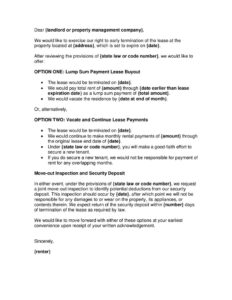
Tenant Lease Breaking Request Letter
Download a free Tenant Lease Breaking Request Letter template in PDF and DOCX to formally ask your landlord to end your lease early — free download.
PDF
DOCX
0
likes
Download Files
- DOCX
A Tenant Lease Breaking Request Letter is a written notice a renter sends to a landlord to formally ask permission to end a lease agreement before its scheduled expiration date. People most often use it when a job relocation, financial hardship, or family change forces an early move, and a clear written request opens the conversation about terms. You can download this template free in both PDF and DOCX formats — no signup required.
What Is a Tenant Lease Breaking Request Letter?
A Tenant Lease Breaking Request Letter is a formal document written by a tenant and addressed to a landlord or property manager requesting an early termination of an active lease. It documents who is requesting the change, which lease and property it concerns, the reason for the request, and the proposed move-out date. While the letter itself does not automatically release a tenant from their obligations, it creates a paper trail showing the tenant acted in good faith and gave proper notice. Landlords often respond with terms — such as a buy-out fee, forfeited deposit, or a date to vacate — and the letter becomes the starting point for that negotiation. It is courteous, professional, and far stronger than a verbal request.
When Do You Need a Tenant Lease Breaking Request Letter?
Renters reach for this letter whenever circumstances change and staying for the full lease term is no longer practical. Common situations include:
- Job relocation — a new position in another city or state requires you to move before the lease ends.
- Financial hardship — a job loss, reduced income, or unexpected expenses make the rent unaffordable.
- Family or health changes — marriage, divorce, a new baby, or caring for a relative changes your housing needs.
- Buying a home — you have closed on a property and need to coordinate moving out of the rental.
- Safety or habitability concerns — ongoing maintenance issues, harassment, or an unsafe environment prompt an early exit.
- Military deployment or transfer — service members often have specific legal protections for breaking a lease.
In each case, sending a written request early gives the landlord time to plan and improves your chances of negotiating reasonable terms.
What a Lease Breaking Request Letter Should Have
A complete and effective letter is concise but covers every essential detail so the landlord can respond without follow-up questions. A strong Tenant Lease Breaking Request Letter should include:
- The current date and your full name as the tenant on the lease.
- The landlord’s or property manager’s name and address.
- The complete rental property address, including unit number.
- A reference to the lease, including its start date or original term and the current end date.
- A clear, honest statement of the reason for the request.
- Your proposed move-out date and how much notice that provides.
- An offer to cooperate — for example, allowing showings or finding a replacement tenant.
- Your contact information and a signature line.
How to Fill Out a Tenant Lease Breaking Request Letter
Because this is a letter rather than a fixed form, work through it in a logical order:
- Enter the date at the top of the letter so there is a clear record of when you sent it.
- Add the landlord or property manager’s name and mailing address as the recipient.
- Write a short greeting addressing the landlord directly by name.
- State your full name and the complete rental address, including the unit number, in the opening sentence.
- Reference the lease by its start date and scheduled end date so there is no confusion about which agreement you mean.
- Clearly request to break the lease early and give your proposed move-out date.
- Briefly explain your reason — keep it factual and professional.
- Offer to cooperate, such as keeping the unit show-ready or helping find a new tenant, and ask about any fees.
- Close politely, add your signature, printed name, phone number, and email.
Negotiating Terms and Reducing Your Costs
Sending the letter is the first step; the response is where most of the real work happens. Many leases contain an early-termination clause that spells out a set fee — often one or two months’ rent — so review your agreement before you write. If your lease has no such clause, your landlord may still hold you responsible for rent until a new tenant moves in. You can reduce that exposure by offering to help re-rent the unit quickly: keep it clean, allow showings, and even suggest qualified replacement tenants if you know any. In many areas landlords have a duty to make reasonable efforts to re-rent rather than simply charge you for the remaining term, which can limit what you ultimately owe.
Delivering the Letter and Keeping Records
How you send the letter matters as much as what it says. Send it in a way that creates proof of delivery — certified mail with return receipt, email with a read receipt, or hand delivery with a witness or signed acknowledgment. Keep a copy of the signed letter and any reply for your records. If your landlord agrees to terms, ask for the agreement in writing, ideally signed by both parties, so there is no dispute later about the move-out date, fees, or the return of your security deposit.
Common Mistakes to Avoid
- Giving too little notice — request the move as far in advance as possible to give the landlord time to re-rent.
- Skipping the lease review — failing to check for an early-termination clause can lead to surprise fees.
- Being vague about dates — always state a specific proposed move-out date rather than “as soon as possible.”
- Relying on a verbal request — without a written, dated letter you have no proof you asked.
- Assuming the letter ends your obligation — you remain bound until the landlord agrees or the law releases you.
- Not getting the final agreement in writing — verbal promises about deposits or fees are hard to enforce.
Frequently Asked Questions
What is a Tenant Lease Breaking Request Letter? It is a formal written request from a tenant asking a landlord to end a lease before its scheduled expiration date. The letter documents the property, the lease, the reason, and a proposed move-out date, and serves as the starting point for negotiating terms.
How do I fill out the letter? Add the date, the landlord’s name and address, your name, and the full rental address. Reference your lease dates, clearly request early termination, state your proposed move-out date and reason, offer to cooperate, and sign it.
Does this letter automatically break my lease? No. The letter is a request, not a release. You remain responsible for your lease obligations until the landlord agrees to terms in writing or a legal provision allows you to terminate early.
Will I have to pay a fee to break my lease? It depends on your lease and local law. Many leases include an early-termination fee, while others hold you liable for rent until the unit is re-rented. Review your agreement and negotiate with your landlord.
Does the letter need to be notarized? Notarization is generally not required for a lease-breaking request. What matters most is that the letter is dated, signed, and delivered in a way that gives you proof the landlord received it.
How much does this template cost? Nothing. You can download the Tenant Lease Breaking Request Letter for free in PDF and DOCX formats, with no signup required, and customize it to fit your situation.
This template is provided as a general example for informational purposes only and is not legal advice. Landlord-tenant laws and lease-termination rules vary by state and locality, and individual lease agreements differ. Consult a qualified attorney or your local housing authority for guidance specific to your situation.
Official resource: for the rules that apply to your situation, see HUD.
Related Forms
- Eviction Notice Letter
- Covid Utilities Relief Landlord
- Property Safety Upgrades Tenant Notification
- Move-Out Inspection
- Notice Of Denial To Rent Apartment
- Tenant Late Rent Log
Browse more in Landlord Documents.