
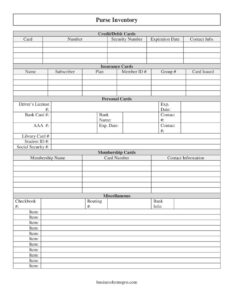
Purse Inventory
A free Purse Inventory template to record every card, ID, and item you carry so you can act fast if your purse is lost or stolen — free download.
PDF
DOC
0
likes
Download Files
- DOC
A Purse Inventory is a simple log that records every card, ID, and important item you keep in your purse so you can quickly cancel and replace them if it’s ever lost or stolen. The most common reason people create one is peace of mind — having card numbers, contact lines, and member IDs in one safe place turns a stressful emergency into a short to-do list. This template is free to download in PDF and DOCX, with no signup required.
What Is a Purse Inventory?
A Purse Inventory is a personal reference document that catalogs the contents of your handbag — particularly the credit and debit cards, insurance cards, personal identification, and membership cards that would be difficult or time-consuming to replace. It is created and kept by the purse owner, not issued by any agency. The form documents card numbers, expiration dates, issuer contact phone lines, and member or account identifiers in a structured layout. Its purpose is preparedness: if your purse goes missing, you have the exact details needed to call each issuer, freeze accounts, and request replacements without trying to recall them from memory under pressure.
When Do You Need a Purse Inventory?
This log is most valuable before anything goes wrong, but it serves people in several situations:
- Lost or stolen purse: You can immediately call each bank and card issuer with the card number and customer-service line on hand.
- Travel preparation: Before a trip, you record what you’re carrying so a hotel theft or pickpocketing abroad doesn’t leave you stranded.
- Annual financial review: Listing every card helps you spot expired, unused, or duplicate cards you can cancel.
- Identity-theft response: A complete record speeds reporting to banks, insurers, and the relevant authorities.
- Helping a parent or relative: Caregivers keep an inventory for an elderly family member so accounts can be managed if a wallet is misplaced.
- Insurance claims: Documentation of what was carried supports a homeowners or renters claim for stolen contents.
What a Purse Inventory Should Have
A useful inventory groups items by type and captures the details you’d actually need to replace each one. Strong inventories include the issuing organization’s name, the account or card number, an expiration date where applicable, and a direct contact phone number for reporting loss. They also separate sensitive identifiers — such as a Social Security number or full card numbers — so the owner can decide how securely to store them. The goal is completeness without clutter: enough to act fast, organized so nothing slips through.
How to Fill Out a Purse Inventory
- Credit/Debit Cards: For each card, write the Card name (issuer or network), the Number, the Security Number (CVV), the Expiration Date, and the issuer’s Contact Info. for reporting loss.
- Insurance Cards: Record the plan Name, the Subscriber, the Plan type, your Member ID #, the Group #, and when the Card Issued.
- Personal Cards: Enter your Driver’s License # and its Exp. Date; your Bank Card #, Bank Name, and Contact #; your AAA # with its Exp. Date and Contact #; plus Library Card #, Student ID #, and Social Security #.
- Membership Cards: List each Membership Name, its Card Number, and the Contact Information for the organization.
- Miscellaneous: Note your Checkbook #, Routing #, and Bank Info, and use the Item line for anything else of value.
How to Store Your Inventory Safely
Because this log lists card numbers, security codes, and a Social Security number, it is itself a sensitive document — treat it like one. Keep the completed copy somewhere separate from your purse, so a single theft doesn’t expose both. Good options include a locked drawer, a home safe, or an encrypted, password-protected file rather than an unprotected note on your phone. If you store it digitally, avoid emailing it to yourself in plain text. Some people keep two versions: a full master copy locked away, and a stripped-down version with only the last four digits of each card plus the issuer contact lines for everyday reference.
What to Do If Your Purse Is Lost
With a current inventory, your response becomes a checklist. Call each credit and debit card issuer using the contact line you recorded and request a freeze or replacement. Notify your bank about the checkbook and routing details so they can watch for fraudulent activity. Contact your insurance provider with your member ID and group number to obtain a new card. Report a missing driver’s license and replace other government or student IDs through the issuing office. Finally, monitor your accounts and credit for unexpected charges in the following weeks.
Common Mistakes to Avoid
- Leaving the inventory inside the purse: If both are taken together, the record is useless — and dangerous in the wrong hands.
- Writing full card and security numbers in an unsecured place: Store the document somewhere locked or encrypted.
- Forgetting to update it: An inventory listing expired cards or an old number won’t help when you call.
- Skipping the contact numbers: Card numbers alone aren’t enough; you need the issuer’s loss-reporting line to act fast.
- Recording only some cards: Capture insurance, membership, and personal IDs too, not just bank cards.
- Including the Social Security card in your purse at all: List the number for reference, but most experts advise against carrying the physical card daily.
Frequently Asked Questions
What is a Purse Inventory used for? It is a personal record of every card, ID, and valuable item in your purse, kept so you can quickly cancel and replace them if your purse is lost or stolen. It also helps with travel preparation, insurance claims, and annual financial reviews.
How do I fill out a Purse Inventory? Work through it by section: list your credit and debit cards with numbers, security codes, expiration dates, and contact lines; then add insurance cards, personal IDs, membership cards, and miscellaneous banking details. Use the fields provided and fill in each one as it applies to what you actually carry.
Is it safe to write down my card and Social Security numbers? It can be, as long as you store the completed inventory securely — in a locked drawer, a home safe, or an encrypted file kept separate from your purse. Never leave it inside the bag itself, and consider a reference copy that shows only the last four digits.
How often should I update my Purse Inventory? Review it whenever you add, replace, or cancel a card, and do a full check at least once a year. Cards expire and account numbers change, so an out-of-date inventory can leave gaps exactly when you need accurate details.
Is a Purse Inventory a legal document? No — it is a personal organizational record with no legal status. However, a thorough inventory can support an insurance claim or a police report by documenting what was carried at the time of a loss.
How much does this template cost? Nothing — this Purse Inventory template is completely free to download in both PDF and DOCX formats, with no signup or account required. You can print it to fill in by hand or complete the DOCX version on your computer.
This Purse Inventory template is provided as a general example for informational purposes only and is not legal, financial, or insurance advice. Because privacy practices and insurance requirements vary by jurisdiction and provider, consult a qualified professional for guidance specific to your situation.
Related Forms
- Maintenance Log Form
- Computers Storage Inventory Card
- Aquarium Maintenance: Schedule & Free Log
- Elapsed Time Log
- Household Inventory Card
- Supplier Schedule
Browse more in Log and Inventory.