
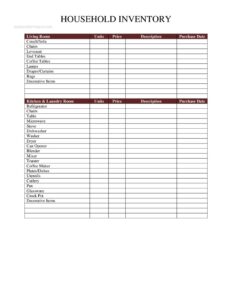
Household Inventory Card
Document and value your belongings room by room with this free Household Inventory Card template — organize your home contents and download free in PDF or DOCX.
PDF
DOCX
1 downloads
0
likes
Download Files
- DOCX
A Household Inventory Card is a room-by-room record of the belongings in your home, including each item’s description, quantity, price, and purchase date. People most often use it to document possessions for insurance, estate planning, or a move — and you can download it free here in PDF and DOCX with no signup required.
What Is a Household Inventory Card?
A Household Inventory Card is a structured worksheet that lets you catalog the contents of your home, organized by location — living room, kitchen, bedrooms, bathrooms, garage, and more — alongside high-value categories such as electronics, jewelry, and artwork. For each entry you note the number of units, the price or value, a short description, and the date of purchase. Homeowners, renters, and families use it to create a single, comprehensive snapshot of what they own and what it’s worth. That record becomes invaluable when you need to prove ownership, support an insurance claim, divide assets, or simply understand the total value of your household.
When Do You Need a Household Inventory Card?
- Filing a homeowners or renters insurance claim after a fire, theft, flood, or storm, when the insurer asks you to list and value everything that was lost.
- Buying or updating insurance coverage to make sure your policy limits actually match the value of your possessions.
- Moving to a new home, so you can track what’s loaded, transported, and unpacked, and verify nothing was damaged or lost.
- Estate planning or settling an estate, where a clear list of household contents helps with distribution among heirs.
- Renting out a furnished property, to document the condition and items provided to tenants.
- General financial organization, giving you a running tally of asset value for budgeting, downsizing, or a divorce settlement.
What a Household Inventory Card Should Include
A useful inventory card captures enough detail to identify and value each item without becoming overwhelming. The core columns are Units (how many you own), Price (purchase or replacement value), Description (brand, model, size, or distinguishing features), and Purchase Date. Items are grouped by room or category — Living Room, Kitchen & Laundry Room, Family Room/Den, Dining Room, Bathrooms, Bedrooms, Electronics, Jewelry, Artwork, and Garage/Attic/Storage. The card pre-lists common items in each space — couch, refrigerator, bed, computer, wedding rings, lawn mower — so you simply fill in the numbers and add anything unique to your home. Photos and receipts attached separately make the record far stronger.
How to Fill Out a Household Inventory Card
- Start with one room at a time. For the Living Room, work down the list — Couch/Sofa, Chairs, Loveseat, End Tables, Coffee Tables, Lamps, Drapes/Curtains, Rugs, Decorative Items — and enter the number of Units for each.
- Add the Price for each item, using either what you paid or, better for insurance, the cost to replace it today.
- Write a clear Description — brand, model, color, material, or any identifying detail (for example, “Samsung 65-inch LED TV”).
- Record the Purchase Date where you know it; an approximate month and year is fine.
- Move through the Kitchen & Laundry Room (refrigerator, stove, microwave, washer, dryer, small appliances), then the Family Room/Den, Dining Room, and each Bathroom.
- Complete every Bedroom (bed, mattress, dressers, nightstands, linens) and the high-value sections: Electronics, Jewelry, Artwork, and Garage/Attic/Storage.
- Add rows for anything not pre-printed, then total the values and store the card with your receipts and photos.
Tips for an Accurate, Claim-Ready Inventory
The strength of a Household Inventory Card lies in the detail behind it. For expensive items — electronics, jewelry, artwork, and appliances — record serial numbers, model numbers, and appraised values in the Description column. Photograph or video each room with the card in hand, capturing the items, brand labels, and overall condition. Keep digital copies of receipts and appraisals alongside the inventory, and store a backup off-site or in cloud storage so a single disaster can’t destroy both your belongings and the proof of what you owned. Update the card whenever you make a significant purchase or dispose of an item, and review the whole document at least once a year.
Inventory Card vs. a Full Home Inventory App
A printable Household Inventory Card and a dedicated inventory app serve the same goal but suit different people. The card is simple, free, works offline, and requires no account — ideal if you want a one-page record you can print, attach to a binder, or hand to an insurer or family member. Apps may add barcode scanning and cloud sync, but they depend on a subscription and internet access. Many people use both: the card as the master printed copy and photos stored digitally as backup evidence.
Common Mistakes to Avoid
- Listing only big-ticket items and skipping the dozens of smaller things — utensils, towels, books, decorative items — that quietly add up in a total-loss claim.
- Recording quantities but no values, which leaves an insurer guessing and can shrink your settlement.
- Forgetting the garage, attic, and storage areas, where tools, power equipment, and patio furniture are easy to overlook.
- Not attaching photos or receipts, so you have a list but no proof of ownership or condition.
- Letting the inventory go stale after new purchases, upgrades, or items you’ve sold or donated.
- Storing the only copy at home, where the same fire or flood could destroy both your possessions and your record.
Frequently Asked Questions
What is a Household Inventory Card used for? It is used to document everything you own in your home, room by room, along with quantities, values, and purchase dates. The most common reason people create one is to support a homeowners or renters insurance claim, but it’s also valuable for moving, estate planning, and tracking your assets.
How do I fill out a Household Inventory Card? Go through your home one room at a time and fill in the Units, Price, Description, and Purchase Date for each item listed. Add rows for anything unique to your home, and include serial or model numbers for high-value electronics, jewelry, and appliances to make the record more reliable.
Does a Household Inventory Card need to be notarized? No. It is a personal record rather than a legal contract, so notarization and witnesses are not required. To make it more credible for an insurance claim, keep dated photos, videos, and receipts together with the completed card.
What value should I write for each item? For insurance purposes, replacement cost — what it would cost to buy the item new today — is usually the most useful figure. If you prefer, you can record the original purchase price; just be consistent and note which method you used.
How often should I update my inventory? Review and update it at least once a year, and any time you make a significant purchase or get rid of a major item. Keeping it current ensures your insurance coverage and your records always match what you actually own.
Is this Household Inventory Card free to download? Yes. You can download this Household Inventory Card template free in PDF and DOCX formats with no signup required. Use the editable DOCX on your computer or print the PDF to fill it out by hand.
This Household Inventory Card template is provided as a general example for informational purposes only and is not legal, financial, insurance, or tax advice. Coverage rules, claim documentation requirements, and valuation methods vary by insurer and jurisdiction — consult your insurance provider or a qualified professional for guidance specific to your situation.
Related Forms
- Beauty Salon Supplies Inventory Card
- List of Vehicles
- Flood Emergency Checklist
- Monthly Editorial Calendar
- Library Loan List
- Trip Vehicle Inspection Checklist
Browse more in Log and Inventory.