
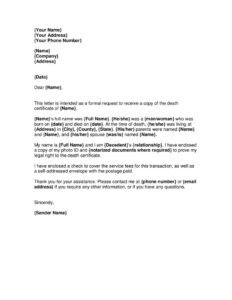
Request For Death Certificate
Download a free Request for Death Certificate template in PDF and DOCX to formally request a certified copy from a vital records office — free download.
PDF
DOCX
15 downloads
0
likes
Download Files
- DOCX
A Request for Death Certificate is a formal letter you send to a vital records office, funeral home, or county clerk to obtain a certified or informational copy of a deceased person’s death certificate. People most often use it to settle estates, claim life insurance, or close financial accounts after a loved one passes away. You can download this Request for Death Certificate template free in PDF and DOCX — no signup required.
What Is a Request for Death Certificate?
A Request for Death Certificate is a written letter that asks an official record holder to release a copy of a person’s death record. It is typically issued by a family member, estate executor, or authorized representative and directed to a state or county vital records department. The letter documents who the deceased was, who is requesting the certificate, the requester’s relationship to the deceased, and proof of their legal right to obtain the record. Because a death certificate contains sensitive personal information, most jurisdictions restrict who may request a certified copy — which is why this letter also serves as a record that you provided identification and any required supporting documents.
When Do You Need a Request for Death Certificate?
You may need to send a Request for Death Certificate in many situations, including:
- Settling an estate or probate matter where the executor must prove a death to the court.
- Filing a life insurance claim, which almost always requires a certified copy of the death certificate.
- Closing bank accounts, credit cards, or investment accounts held by the deceased.
- Transferring property titles, vehicle registrations, or pension and Social Security benefits.
- Replacing a lost or damaged certificate, or obtaining additional certified copies for multiple agencies.
- Conducting genealogical or family-history research on a deceased relative (often an informational copy).
Certified vs. Informational Copies
Many record offices issue two types of death certificates. A certified copy carries an official seal and is required for legal and financial transactions such as insurance claims and estate settlement. An informational copy is usually stamped “not for legal use” and may be available to a broader group of requesters for genealogy or personal records. When you write your request, state clearly which type you need and how many copies, since fees are usually charged per copy and processing rules differ.
What a Request for Death Certificate Should Have
A complete request lets the record office verify the deceased, confirm your eligibility, and process payment without delays. It should include your contact information, the full legal name of the deceased and their key dates and locations, your relationship to the decedent, proof of identity, any notarized documents required by the jurisdiction, the applicable fee, and a self-addressed stamped envelope for the return. The more accurate the identifying details, the faster the office can locate the correct record.
How to Fill Out a Request for Death Certificate
- Enter Your Name, Your Address, and Your Phone Number at the top so the office can reach you.
- Add the recipient block: the contact Name, Company or office, Address, and the Date.
- Open with the salutation “Dear {Name},” then state that the letter is a formal request for the death certificate of the deceased.
- Provide the decedent’s Full Name, whether they were a man or woman, the date of birth, and the date of death.
- List the decedent’s last residence — Address, City, County, and State — to help locate the record.
- Name the decedent’s parents and spouse, which are common identifying fields on the certificate.
- Identify yourself with your Full Name and your relationship to the decedent.
- Confirm you have enclosed a copy of your photo ID and any notarized documents required, plus a check for the service fees and a self-addressed prepaid envelope.
- Close with your phone number and email address, then sign as the Sender.
Verifying Your Legal Right to the Record
Because death records are protected, most offices will only release a certified copy to people with a direct and tangible interest — typically the spouse, parent, child, sibling, or legal representative such as an executor or attorney. This template prompts you to enclose a photo ID and, where required, notarized documents proving that relationship. If you are acting as an estate representative, you may need to include letters testamentary or a court appointment order. Check the specific eligibility and documentation rules for the state or county where the death occurred before mailing your request, since requirements and accepted ID vary widely.
Tips for a Smooth Request
Double-check the spelling of every name and the exact dates before sending. Call or visit the vital records office’s website to confirm the current fee, the number of copies you can order, and acceptable forms of payment. Use a trackable mailing method when sending sensitive identification, and keep a copy of the completed letter for your records. If you need several certified copies for different institutions, request them all at once to save on repeat processing time.
Common Mistakes to Avoid
- Omitting the decedent’s date and place of death, which slows the search for the correct record.
- Forgetting to enclose a photo ID or the notarized documents some jurisdictions require.
- Sending the wrong fee amount or an unaccepted payment method, causing the request to be returned.
- Not specifying whether you need a certified or informational copy, or how many copies.
- Failing to include a self-addressed prepaid envelope for the return mailing.
- Misstating your relationship to the decedent, which can lead to a denied request.
Frequently Asked Questions
Who can request a death certificate? Eligibility varies by jurisdiction, but certified copies are usually limited to immediate family members, the surviving spouse, the estate’s legal representative, or someone with a documented legal interest. Informational copies are often available to a wider group. Always confirm the rules in the state or county where the death was recorded.
How do I fill out a Request for Death Certificate? Enter your contact details and the recipient’s office information, then provide the decedent’s full name, dates of birth and death, last residence, and the names of parents and spouse. State your relationship, enclose your ID and any required documents, include the fee and a return envelope, and sign the letter.
Does this request need to be notarized? Some jurisdictions require a notarized signature or notarized supporting documents to release a certified copy, while others do not. The template includes a placeholder for notarized documents where required. Check your local vital records office to confirm whether notarization applies to your situation.
How long does it take to receive a death certificate? Processing times range from a few days to several weeks depending on the office, the request method, and current backlogs. Mailed requests generally take longer than in-person or online orders. Including complete information and the correct fee helps avoid delays.
How much does it cost to use this template? The template itself is completely free to download in PDF and DOCX with no signup. You will, however, owe a service fee to the record office for each copy of the death certificate, which you enclose with your letter as noted in the form.
Is a written letter legally binding? The request letter is not a contract; it is a formal application for a public record. Its purpose is to provide the information and proof the office needs to act on your request. The death certificate it produces is the official legal document.
This template is a general example provided for informational purposes only and is not legal, financial, or tax advice. Requirements for requesting and releasing death certificates vary by state and county. Consult the relevant vital records office or a qualified professional for guidance specific to your situation.
Related Forms
- Personal Request Rejection
- Request For Bank Statement
- Supplies Requisition Form
- Specialty Item Form
- Additional Work Authorization Form
- Drug and Alcohol Testing Individual
Browse more in Request and Authorization.