
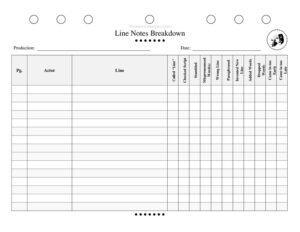
Line Notes Breakdown
Track actor line errors during rehearsals with this free Line Notes Breakdown template, a clear stage manager tool available as a free download.
PDF
DOCX
6 downloads
0
likes
Download Files
- DOCX
A Line Notes Breakdown is a stage management worksheet used to record exactly where and how an actor’s spoken lines differed from the scripted text during a rehearsal or performance. The most common reason people use it is to give performers precise, page-by-page feedback so they can tighten up their lines before opening night. It’s free to download here in both PDF and DOCX, with no signup required.
What Is a Line Notes Breakdown?
A Line Notes Breakdown is a tracking form, typically maintained by the stage manager or an assistant stage manager, that documents line accuracy on a script. While an actor delivers their lines on stage, the note-taker follows along in the prompt book and logs any deviation from the written text. Each entry ties a specific actor and page number to a category of error “called for line,” stumbled, paraphrased, dropped words, and so on. The completed form becomes a concise reference that the production team can hand to actors or review in notes sessions, turning vague impressions into actionable, specific corrections that improve the show’s polish and pacing.
When Do You Need a Line Notes Breakdown?
This form earns its place at nearly every stage of putting up a production once actors are expected to be off-book. Common situations include:
- Off-book runs: The first rehearsals without scripts in hand, when memorization gaps are most visible and most useful to catch.
- Technical and dress rehearsals: When line accuracy matters most because timing, cues, and effects all hinge on the right words landing at the right moment.
- Long-running shows: Tracking when seasoned cast members start drifting from the script or improvising over time.
- Understudy and replacement rehearsals: Verifying that a new performer has the lines exactly right before going on.
- Student and academic productions: Helping directors and teachers give measurable, fair feedback on memorization progress.
- Playwright-sensitive works: Productions of contemporary or rights-protected plays where contracts require the text be delivered verbatim.
What a Line Notes Breakdown Should Have
An effective Line Notes Breakdown captures both context and the precise nature of each error. At minimum it should identify the Production and the Date so notes can be filed and compared across rehearsals. It needs a page number column to locate each issue in the script, the Actor name, and the actual Line in question. Crucially, it should offer a consistent set of error categories so feedback is objective rather than subjective: called for a line, checked script, stumbled, mispronounced words, wrong line, paraphrased, invented a new line, added words, dropped words, came in too early, and came in too late. Standardizing these categories keeps notes neutral and easy for actors to act on.
How to Fill Out a Line Notes Breakdown
- Enter the Production title at the top so the sheet is correctly identified in the prompt book.
- Record the Date of the rehearsal or performance being tracked.
- As you follow the script, note the Pg. (page) where each error occurs.
- Write the Actor name responsible for the line.
- Jot the Line itself, or enough of it to identify the moment clearly.
- If the actor stopped and asked for the next line, mark Called “Line”.
- If they glanced at or referred to their Checked Script, note it.
- Use the behavior columns to categorize the error: Stumbled, Mispronounced Word(s), Wrong Line, Paraphrased, Invented New Line, Added Words, or Dropped Words.
- For timing problems, mark Came in too Early or Came in too Late.
- Continue down the page chronologically, then distribute the finished notes to each actor by name.
How to Use the Categories Effectively
The strength of this form is the way it distinguishes between very different kinds of mistakes. A paraphrase means the actor kept the meaning but changed the words; added words and dropped words are smaller deviations that can still throw off rhythm or a setup-and-payoff joke. An invented new line is a complete fabrication that may confuse scene partners, while a wrong line means the actor jumped to text from elsewhere in the script. Timing notes like came in too early or too late often signal a cue or listening issue rather than a memorization problem. Sorting errors this way lets directors decide what truly matters for the production and avoids overwhelming actors with undifferentiated criticism.
Tips for Delivering Line Notes
Line notes work best when they are precise, prompt, and impersonal. Deliver them in writing soon after the run while memory is fresh, and keep them factual rather than evaluative the form’s columns already do the judging for you. Many stage managers give actors only their own notes to avoid singling anyone out in front of the cast. Encourage performers to look up the exact scripted line and rehearse the correct version rather than simply being told they were “wrong.” Over several rehearsals, comparing dated sheets reveals whether an actor is improving or whether a particular passage is a recurring trouble spot worth extra attention.
Common Mistakes to Avoid
- Skipping the date or production: Without these, notes lose meaning when filed alongside other sheets.
- Vague line references: Writing only a page number without a snippet of the line makes it hard for the actor to find the moment.
- Editorializing: Adding opinions instead of marking the objective category undermines the neutral tone that makes line notes useful.
- Confusing error types: Logging a paraphrase as a wrong line, or a timing issue as a memorization gap, sends the wrong correction.
- Holding notes too long: Delaying delivery until details are forgotten reduces their value.
- Tracking inconsistently: Catching errors for some scenes but not others gives actors an incomplete picture of their accuracy.
Frequently Asked Questions
What is a Line Notes Breakdown used for? It is a stage management tool for recording exactly how an actor’s spoken lines differed from the script during a rehearsal or performance. The completed sheet gives performers specific, page-by-page feedback so they can correct memorization and timing issues before opening.
Who fills out a Line Notes Breakdown? Usually the stage manager or an assistant stage manager following along in the prompt book. In smaller or educational productions, a director, dramaturg, or designated line-tracker may handle it instead.
What does “Called Line” mean on the form? It indicates the actor stopped and asked for a prompt because they could not remember what came next. It is one of the clearest signals that a passage needs more memorization work.
How is this different from general rehearsal notes? General rehearsal notes cover blocking, props, design, and broad direction, while a Line Notes Breakdown focuses strictly on the accuracy and timing of spoken text. Keeping line notes separate makes them easy to distribute to individual actors.
Should I share everyone’s notes with the whole cast? Many stage managers give each actor only their own notes to keep feedback private and avoid putting anyone on the spot. The form’s by-actor structure makes it simple to separate notes for individual distribution.
How much does this template cost? Nothing. You can download the Line Notes Breakdown for free in PDF and DOCX formats here, with no signup required, and adapt the columns to fit your production’s needs.
This template is a general example provided for informational purposes only and is not legal, contractual, or professional advice. Performance rights agreements and production requirements vary, so consult your licensing agreement and a qualified professional before relying on any particular practice.
Related Forms
- Stage Choreography Numbers Black
- Script Assignment Tracker
- Intermission Checklist
- Character Breakdown
- Comp Ticket Request Form
- Weekly Rehearsal Schedule
Browse more in Theater.