
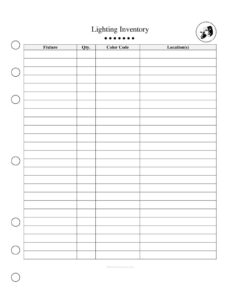
Lighting Inventory Sheet
Track every fixture, dimmer, and accessory with this free Lighting Inventory Sheet template, available as a free download in PDF and DOCX.
PDF
DOC
3 downloads
0
likes
Download Files
- DOC
A Lighting Inventory Sheet is a working document that lists every lighting fixture, dimmer, cable, and accessory a theater, venue, or production company owns or has on hand. The most common reason people reach for one is to know exactly what gear exists, where it lives, and what condition it’s in before a show is hung. It’s free to download here in both PDF and DOCX formats, with no signup required.
What Is a Lighting Inventory Sheet?
A Lighting Inventory Sheet is a structured record maintained by a master electrician, lighting designer, technical director, or venue manager to catalog all the lighting equipment in a space or rental stock. It documents fixture types and quantities, lamp wattages, dimmer and circuit counts, control gear, gel and gobo stock, cabling, and accessories such as clamps, safety cables, and color frames. The sheet captures the practical details a team needs to plan a hang and budget a rental: model numbers, condition, location, and notes on repairs. Unlike a one-off pull list for a single production, a Lighting Inventory Sheet is an ongoing source of truth that gets updated as gear is purchased, retired, loaned out, or damaged.
When Do You Need a Lighting Inventory Sheet?
Lighting inventory tracking matters anytime equipment moves, multiplies, or needs accountability. Common situations include:
- Pre-production planning — confirming you own enough Source Fours, PARs, or LED washes to realize a designer’s plot before renting the difference.
- Annual or seasonal audits — reconciling physical stock against records at the start or end of a producing season.
- Rental and loan tracking — recording what left the building, who took it, and when it’s due back.
- Insurance and asset valuation — providing a documented list of fixtures and their replacement value after theft, fire, or water damage.
- Maintenance scheduling — flagging fixtures with burned lamps, frayed cable, or failing electronics for repair.
- Facility handover — giving an incoming technical director a clear picture of what the venue actually holds.
What a Lighting Inventory Sheet Should Have
A complete Lighting Inventory Sheet balances enough detail to be useful with enough simplicity to stay current. Strong sheets include a header identifying the venue or company and the date of the count, plus columns for each piece of gear. Typical elements are:
- An item or fixture name and type (conventional, LED, moving head, accessory).
- Manufacturer and model number.
- Quantity on hand and quantity in working condition.
- Lamp type and wattage, where applicable.
- Storage location, dimmer or circuit assignment, and condition rating.
- A notes field for repairs, missing parts, or loan status.
How to Fill Out a Lighting Inventory Sheet
Because this template is intentionally flexible, fill it out in a logical order so nothing is missed:
- Header: Enter the venue or production company name, the person conducting the count, and the inventory date.
- Category: Group entries by type — conventional fixtures, LED units, moving lights, dimmers, control, cable, and accessories — so the sheet stays scannable.
- Item description: Write the fixture name, then add the manufacturer and model number for clarity (for example, ETC Source Four 26°).
- Quantity: Record the total count and, separately, how many are currently functional.
- Lamp and wattage: Note lamp type and wattage to support load and power calculations.
- Location: List where each item is stored or rigged — a specific shelf, road case, or electric.
- Condition: Mark good, needs repair, or out of service.
- Notes: Capture loan status, missing accessories, or repair details, then date and sign at the bottom.
Organizing Your Inventory for Faster Counts
The usefulness of a Lighting Inventory Sheet depends heavily on how you organize it. Sorting by fixture family — all your ellipsoidals together, then PARs, then LED washes, then movers — lets you count in physical sweeps through storage rather than jumping between cases. For accessories, group consumables like gel, gobos, and color frames separately from durable hardware like C-clamps, safety cables, and barn doors, since consumables are counted differently and reordered more often. If your venue uses a numbered cable or fixture tagging system, include those identifiers; they make it far easier to trace a specific unit when it fails mid-run. Many electricians keep a master sheet for the permanent house rig and a separate sheet for rental or touring stock that comes and goes.
Keeping the Sheet Accurate Over Time
An inventory is only valuable if it stays current. Update the sheet whenever fixtures are purchased, retired, sent for repair, or loaned out, and run a full physical reconciliation at least once per season. Date every revision so you can tell which version reflects reality. Pairing the sheet with a simple sign-out log for borrowed gear prevents the most common source of error: equipment that walks out the door and is quietly forgotten. When a fixture is damaged beyond repair, mark it out of service rather than deleting the line, so the historical record remains intact for insurance and budgeting.
Common Mistakes to Avoid
- Counting total quantity only — without a working count, you’ll discover dead units the night you need them.
- Vague descriptions — “spotlight” tells the next person nothing; include manufacturer and model.
- Skipping the location column — gear you can’t find is functionally gear you don’t have.
- Forgetting accessories — missing clamps, safety cables, or gel frames stall a hang as surely as missing fixtures.
- Never updating — an inventory from two seasons ago is a guess, not a record.
- No date or signature — without these, you can’t tell which count is authoritative.
Frequently Asked Questions
What is a Lighting Inventory Sheet used for? It is used to catalog all the lighting equipment a venue or production company owns, including fixtures, dimmers, cable, and accessories. Teams rely on it to plan hangs, budget rentals, schedule maintenance, and document assets for insurance. It serves as the single source of truth for what gear exists and where it is.
Who fills out a Lighting Inventory Sheet? Typically the master electrician, technical director, lighting designer, or venue manager completes it. In smaller organizations, a single technician may own the document, while larger venues may assign it to a lighting department head. Whoever maintains it should update it consistently after every change to the stock.
How detailed should my inventory be? Detailed enough to be actionable but not so dense it never gets updated. At minimum, capture item type, quantity, working count, location, and condition; add model numbers and lamp wattage where load planning or rentals matter. Match the level of detail to how often you rent, tour, or insure your gear.
How often should I update the sheet? Update it whenever equipment is purchased, retired, repaired, or loaned, and perform a full physical count at least once each producing season. Frequent small updates are far more reliable than occasional large audits. Always record the date of each revision.
Is a Lighting Inventory Sheet a legal document? It is primarily an operational and asset-tracking record rather than a contract, though it is often used to support insurance claims and equipment valuations. Keeping it accurate and dated strengthens its credibility if you ever need to document a loss. Pair it with receipts and photos for the most reliable record.
Is this template really free? Yes. You can download this Lighting Inventory Sheet template for free in PDF and DOCX formats with no signup required. Customize the categories and columns to match your venue’s gear and workflow.
This template is provided as a general example for informational purposes only and does not constitute legal, financial, insurance, or professional advice. Equipment records, valuation methods, and insurance requirements vary by organization and jurisdiction. Consult a qualified professional for guidance specific to your situation.
Related Forms
- Intermission Checklist
- Line Notes Breakdown
- Blocking Key
- Production Calendar
- Instrument Schedule
- Pre-Show Checklist
Browse more in Theater.