
Company Policy Explanation
Download a free Company Policy Explanation letter template to clarify workplace rules and reissue your handbook—free PDF and DOCX download, no signup.
PDF
DOCX
0
likes
Download Files
- DOCX
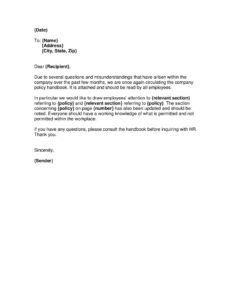
A Company Policy Explanation is a short internal letter that reissues or clarifies your employee handbook and points staff to the specific policies they need to re-read. Most companies send one when questions or misunderstandings keep coming up about what is and isn’t allowed at work. You can download this template free in PDF and DOCX, with no signup required.
What Is a Company Policy Explanation?
A Company Policy Explanation is a formal communication—usually from HR, a manager, or company leadership—that accompanies the distribution or redistribution of an employee handbook. Rather than rewriting every rule, it draws attention to particular sections that have caused confusion or that have recently changed. The letter documents that employees were notified of the policies and were asked to read them. It serves both a practical purpose (reducing repeat questions to HR) and a record-keeping purpose (showing the company communicated its expectations). It is informational and directive in tone, not disciplinary, and it works best when it is clear, concise, and points to exact handbook pages and section numbers.
When Do You Need a Company Policy Explanation?
This letter is useful any time written rules need to be reinforced across a team or the whole organization. Common situations include:
- Recurring confusion: The same questions keep reaching HR about dress code, remote work, or time-off requests, signaling the handbook needs a refresh.
- A policy update: A specific section—say, on data security or attendance—has been revised and everyone must be made aware of the new wording.
- Onboarding waves: Several new hires joined at once and need a consolidated reminder of where to find the rules.
- After an incident: A misunderstanding led to a problem, and management wants to clarify expectations before it recurs.
- Annual review cycles: Many employers recirculate the handbook yearly to keep policies top of mind.
- Mergers or restructuring: Teams are being combined and need a single, current set of standards to follow.
What a Company Policy Explanation Should Have
An effective explanation letter is short but complete. It should include the date, the recipient’s name and address, and a clear greeting. The body should state why the handbook is being recirculated, identify the attached handbook, and call out the precise sections and page numbers that need attention. It should name the relevant policies so employees know exactly what to focus on. A polite instruction to consult the handbook before contacting HR helps reduce unnecessary inquiries. Finally, it should close with a thank-you and the sender’s name and title so employees know who to follow up with if a question genuinely isn’t answered in the handbook.
How to Fill Out a Company Policy Explanation
- Date: Enter the date the letter is issued so the notice is timestamped for your records.
- To / Name: Add the recipient’s name. For a company-wide send, use a group label like “All Employees” or the team name.
- Address and City, State, Zip: Include the recipient’s or office address; for internal distribution you may use the company location.
- Dear {Recipient}: Open with a courteous greeting using the employee’s name or “Team.”
- First {relevant section} and {policy}: Name the first handbook section and the policy it covers that you want read again.
- Second {relevant section} and {policy}: Repeat for a second area needing attention.
- Updated {policy} on page {number}: Specify the policy that changed and its exact page number so staff can find it quickly.
- Sender: Sign off with the sender’s name and title, such as the HR manager or department head.
Tips for Getting the Message Read and Acted On
A policy letter only works if people actually open it and follow up. Keep the message focused on the two or three sections that matter most right now; listing too many policies dilutes the point. Reference real page numbers and section headings rather than vague descriptions—”Section 4.2 on remote work, page 11″ is far more actionable than “the work-from-home rules.” Pair the letter with the attached handbook in the same email or envelope so nothing is missing. If a policy has changed materially, consider summarizing the change in one sentence so employees understand what’s different without hunting for it. For sensitive updates, you may also ask employees to acknowledge receipt, which strengthens your internal record.
How It Differs From a Policy Itself
It helps to keep two documents distinct. The handbook contains the actual rules—the detailed policies, procedures, and standards. The Company Policy Explanation is the cover communication that delivers and directs attention to those rules. Think of the handbook as the rulebook and this letter as the memo that says “please reread these pages.” Because this letter doesn’t create new rights or obligations on its own, it should never contradict the handbook; if there’s a discrepancy, the handbook controls. When you change a rule, update the handbook first, then issue the explanation letter to announce it.
Common Mistakes to Avoid
- Forgetting to attach the handbook: The letter references an attachment—make sure it’s actually included.
- Vague section references: Pointing to “the rules” instead of naming the section and page number leaves employees guessing.
- Overloading the letter: Highlighting ten policies at once means none get real attention; focus on what’s changed or most misunderstood.
- A scolding tone: The letter should inform, not reprimand; keep it professional and neutral.
- No sender details: Omitting the sender’s name and title leaves employees unsure who to ask for clarification.
- Skipping a record: Failing to keep a copy or acknowledgment means you can’t show the policy was communicated later.
Frequently Asked Questions
What is a Company Policy Explanation letter used for? It is used to recirculate an employee handbook and direct staff to specific policies that have caused confusion or have recently been updated. Employers send it to reinforce expectations and to create a record that employees were notified of the rules. It reduces repeat questions to HR by pointing people to the right pages.
How do I fill out the template? Add the date, recipient name and address, and a greeting, then name the specific sections, policies, and page numbers you want employees to review. Finish by signing with the sender’s name and title. Replace each placeholder in braces with your own details and attach the current handbook.
Is this letter legally binding? The letter itself is a communication rather than a contract, so it generally does not create new legal obligations on its own. The binding rules live in your handbook and employment agreements. The letter mainly serves to notify and document that policies were shared.
Should I send it to one employee or the whole company? Either works depending on the situation. Use it company-wide when policies have changed or confusion is widespread, and address it to an individual when clarification is specific to one role or person. Adjust the greeting and recipient fields accordingly.
Do employees need to sign or acknowledge it? The template does not require a signature, but many employers add an acknowledgment line or request a reply confirming receipt. This strengthens your internal record that the policy was communicated. Whether to require acknowledgment is up to your company’s practice.
Is this template really free to download? Yes. You can download the Company Policy Explanation template free in both PDF and DOCX formats with no signup required. Edit the fields to match your handbook and company before distributing it.
This template is a general example provided for informational purposes only and is not legal, HR, or employment advice. Employment policies and notice requirements vary by jurisdiction and by company. Consult a qualified professional or your legal counsel before relying on this document.
Official resource: for the rules that apply to your situation, see the U.S. Department of Labor.
Related Forms
- Tarjeta De Tiempo Contratista Miniatura
- Salary Verification Letter
- Direct Deposit Authorization
- Employee Reference Request
- Employee Work Schedule
- Employee Official Warning Letter
Browse more in Employment.