
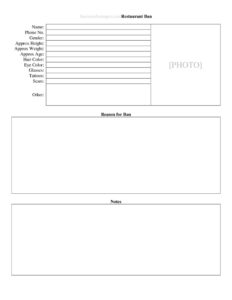
Restaurant Ban Form
Use this free Restaurant Ban Form template to formally document and enforce a customer ban, recording the incident, person, and duration — free download.
PDF
DOCX
1 downloads
0
likes
Download Files
- DOCX
A Restaurant Ban Form is a written record that documents a restaurant’s decision to prohibit a specific customer from entering or being served at the establishment. The most common reason people use one is to formally enforce a ban after an incident such as harassment, theft, violence, or repeated disruptive behavior, creating a clear paper trail for staff and management. It is free to download here in both PDF and DOCX formats with no signup required.
What Is a Restaurant Ban Form?
A Restaurant Ban Form is an internal document used by restaurant owners, managers, and security staff to record that an individual has been barred from the premises. It captures who the banned person is, what incident triggered the ban, when the ban begins, and how long it lasts. Once completed, it serves as an official notice and reference so that all team members — including new hires and different shifts — know the person is not welcome. The form also protects the business by demonstrating that the decision was made for a documented reason and communicated consistently. It is part log entry, part formal notice, and part incident record, all in one place.
When Do You Need a Restaurant Ban Form?
Restaurants and food-service businesses turn to a ban form whenever they need to remove a problem customer in a documented, defensible way. Common situations include:
- A customer becomes verbally abusive, threatening, or violent toward staff or other patrons.
- An individual is caught stealing, dining and dashing, or repeatedly disputing legitimate charges.
- A guest repeatedly violates house rules — refusing to pay, harassing servers, or causing disturbances.
- Someone is intoxicated and disruptive, and management decides they should not be served again.
- A person damages property, vandalizes the restroom, or causes a health and safety hazard.
- A former employee or known troublemaker needs to be formally barred from returning.
In each case, the form converts a verbal decision into a written, dated record that any manager can pull up later if the person returns or if the situation escalates.
What a Restaurant Ban Form Should Have
Because this form doubles as both a log entry and a formal notice, it should clearly capture the key facts of the ban. A complete form generally includes the restaurant or business name and location, the date the ban is issued, and the full name and a physical description of the banned individual. It should record the reason for the ban with a factual description of the incident, the date and time the incident occurred, and any witnesses. It should also state the duration of the ban — permanent or for a fixed period — along with the name and signature of the manager or owner authorizing it. A space for delivering or posting notice to the individual rounds out a thorough form.
How to Fill Out a Restaurant Ban Form
Work through the form in order, keeping the language factual and free of opinion or emotion:
- Restaurant details: Enter the business name, address, and location where the ban applies — note if it covers multiple branches.
- Date issued: Record the date the ban is being created and goes into effect.
- Banned individual: Write the person’s full name if known, plus a physical description (height, build, hair, clothing) to help staff identify them.
- Incident description: Describe what happened plainly — what the person did, where, and any property or people affected.
- Date and time of incident: Note when the triggering event occurred.
- Witnesses: List employees or patrons who saw the incident and can confirm the account.
- Ban duration: Specify whether the ban is permanent or ends on a set date.
- Authorization: Have the manager or owner print their name, title, and sign and date the form.
- Notice delivery: Record how the individual was informed — in person, by mail, or posted notice.
Keeping the Ban Enforceable and Consistent
A ban form is only effective if every shift knows about it. After completing the form, keep a copy in a designated binder or shared file near the host stand or manager’s office so any team member can check it. Many restaurants also keep a running ban log alongside the individual forms, listing names and photos for quick reference. Consistency matters: enforce the ban uniformly for everyone, and avoid singling people out based on protected characteristics such as race, religion, disability, or national origin. A ban should always trace back to documented conduct, not assumptions. If a banned person returns and refuses to leave, the form gives staff a clear basis to contact local authorities for trespassing.
Ban Form vs. Incident Report
These two documents often work together but serve different purposes. An incident report records the details of what happened — useful for insurance, internal review, or police. A Restaurant Ban Form goes a step further by stating the consequence: that the individual is no longer permitted on the premises. For a serious event, many businesses complete both, attaching the incident report to the ban form so the record is complete. The ban form is the operative document staff reference going forward, while the incident report is the underlying evidence.
Common Mistakes to Avoid
- Vague descriptions: Writing “a rude guy” instead of a usable physical description makes the ban hard to enforce.
- Emotional language: Stick to facts; subjective insults weaken the document if it’s ever reviewed.
- No duration stated: Failing to specify whether the ban is permanent or temporary creates confusion later.
- Skipping authorization: A ban issued without a manager’s or owner’s signature lacks authority.
- Not sharing the form: Filing it away where staff never see it defeats the purpose.
- Inconsistent enforcement: Banning some people for behavior you tolerate from others invites disputes and possible discrimination claims.
Frequently Asked Questions
What is a Restaurant Ban Form used for? It is used to formally document and enforce a decision to prohibit a specific customer from a restaurant. It records the person’s identity, the incident, and the duration of the ban so all staff can apply it consistently and the business has a written record.
Is a Restaurant Ban Form legally binding? The form itself is an internal record rather than a court order, but as a private business a restaurant generally has the right to refuse service for legitimate, non-discriminatory reasons. The completed form supports a trespassing claim if the banned individual returns and refuses to leave.
Do I have to notify the banned customer? It is best practice to inform the person, in writing or in person, that they are no longer welcome, since enforcement is clearer once they have been notified. The form includes a space to record how and when notice was given.
Can a restaurant ban anyone for any reason? A restaurant can refuse service for behavior-based reasons, but it cannot ban people based on protected characteristics such as race, religion, disability, or national origin. Always tie a ban to documented conduct and enforce it consistently.
How long should a ban last? That depends on the severity of the incident and is set on the form as either a fixed period or a permanent ban. Minor disruptions might warrant a temporary ban, while violence or theft often justifies a permanent one.
Is this Restaurant Ban Form free to download? Yes. You can download this template free in PDF and DOCX formats with no signup required, then customize it with your restaurant’s name and policies.
This template is a general example provided for informational purposes only and is not legal advice. Laws regarding refusal of service and trespassing vary by jurisdiction. Consult a qualified attorney or local authority to ensure your policies and enforcement comply with applicable laws.
Related Forms
- Household Inventory Card
- Nanny Daily Log
- Home Inventory List of Possessions
- Trip Vehicle Inspection Checklist
- Pest Sighting Log
- List of Home Services
Browse more in Log and Inventory.